

Part 107 Load part 2

Presentation
•
Other
•
9th - 12th Grade
•
Practice Problem
•
Hard

Scott Freeman
Used 1+ times
FREE Resource
18 Slides • 0 Questions
1
Weight
The center of Gravity is the point at which, if a string was attached, the object would be in equilibrium.
Always pointed towards the center of the Earth, opposite to Lift.
If the weight of the aircraft exceed the Maximum Allowable Weight, the airfoil won’t be able to generate enough lift to counteract the weight.
2
Drag
Opposes Thrust.
During an un-accelerated flight, Thrust equals Drag.
Two types of drag.
✓ Parasite Drag,
✓ (Lift) Induced Drag.
3
Drag
Parasite Drag
Created as a byproduct of flying through the air.
Increases as speed increases.
Three different types:
✓ Form Drag: shape of an object (think Ferrari vs PT Cruiser),
✓ Interference Drag: 1 + 1 = 3,
✓ Skin Friction: imperfection on the surface of the lift-generating surface.
4
Drag
Induced Drag
With fixed-wing, generated as soon as lift is created.
With rotorcraft, created as soon as lateral motion starts.
Decreases as speed increases.
Greater angle of attack = greater induced drag
5
Drag

6
Stalls
Stalls
Occurs when the airfoil reaches the Critical Angle of Attack.
Most aircraft have a published stall speed at which the aircraft will stall.
However, a stall can happen at ANY airspeed but is usually associated with flying too slow.
The most efficient way to determine approach to a stall is by installing an angle of attack indicator.
7
Stalls
Stalls
The airflow is no longer laminar over the top of the wing, therefore lift is no longer produced.
In fixed-wing aircraft, this results in a nose drop.
Only way to recover from a stall is to lower the nose (reduce the angle of attack).
8
9
10
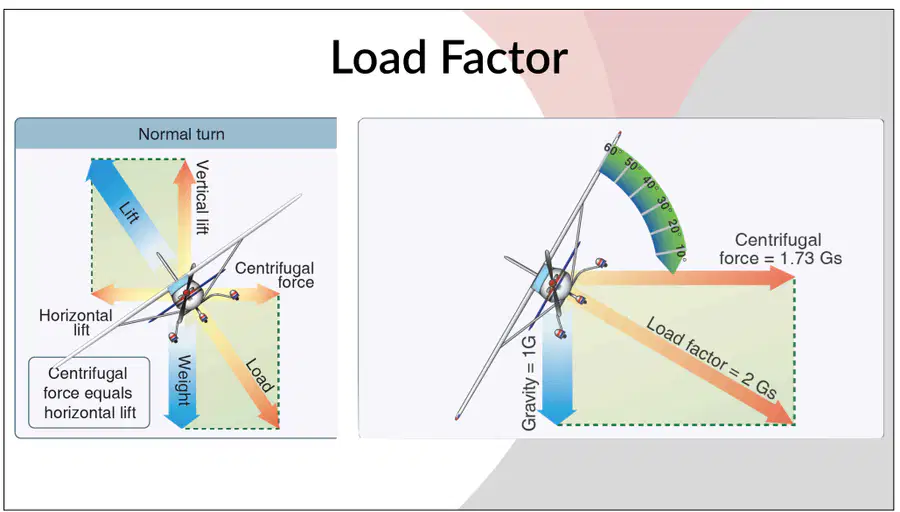
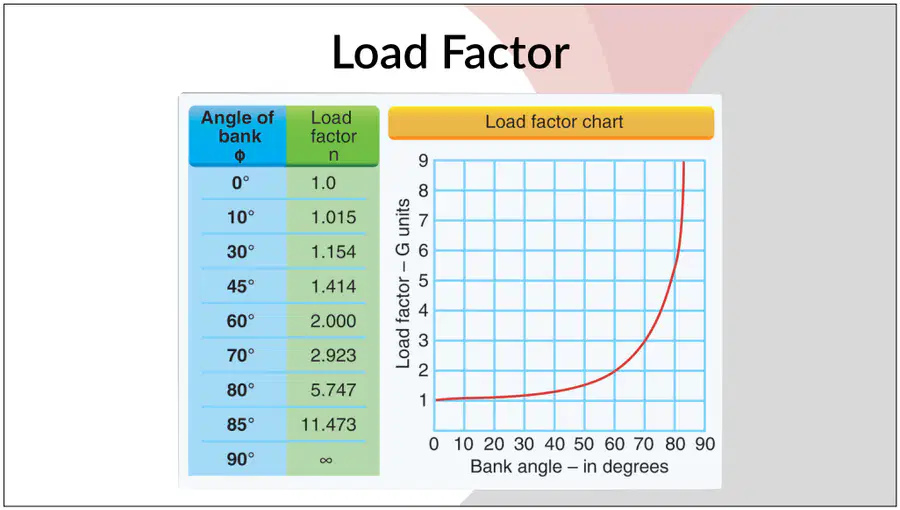
The weight of the plane is multiplied by the weight and the load factor.
40 pound plane at 30 degrees
Load factor at 30 degrees 1.154
40* 1.154
46 pounds the plane must beable to control
11
Load Factor and Stalling Speeds
Load factor increases with bank angle.
Stall speed also increases with load factor.
This is important when flying at slower airspeed since abrupt maneuvers can lead to stalling.
Remember that stall occurs when the critical angle of attack is reached, which can be at ANY airspeed.
12
Center of Gravity Location
Let’s define a few terms first
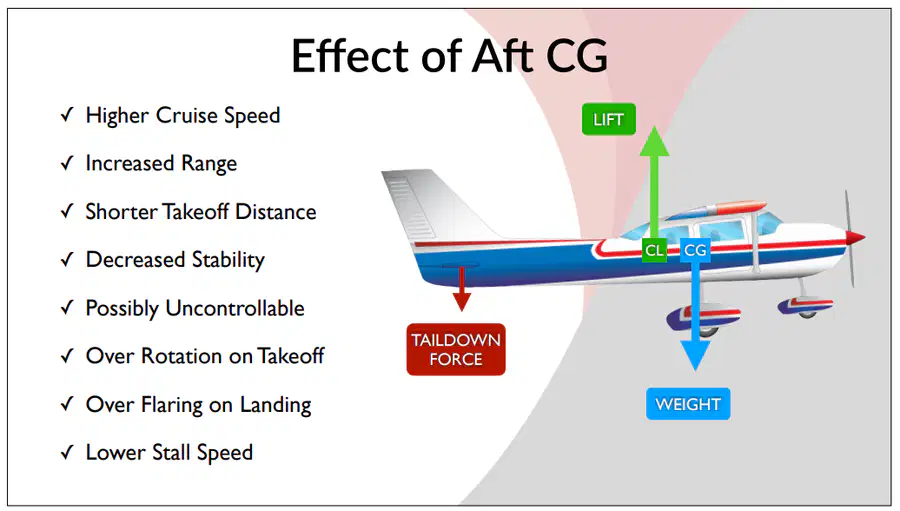
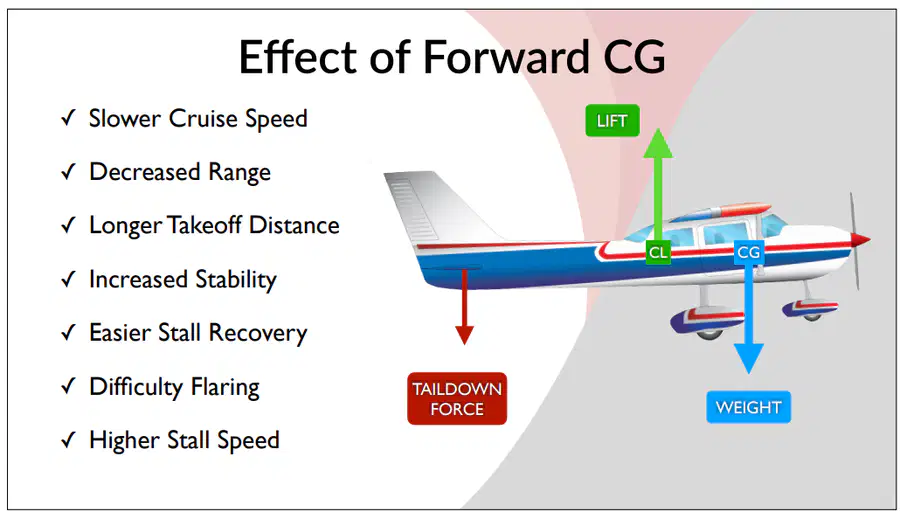
Center of Gravity (CG): the point at which, if a string was attached, the object would be in equilibrium. The point at which WEIGHT is applied.
Center of Pressure (CP): the point at which LIFT is applied.
Arm (A): the distance between the CG and where a force is applied.
Moment (M): the efficiency of a force. Calculated as:
13
14
15
Altitude
As altitude increases, outside pressure decreases.
As a result, engine performance decreases.
Lift is also reduced.
Think about flying at sea level versus flying in Denver.
16
Temperature and Humidity
As temperature increases, performance decreases.
As humidity increases, performance decreases.
A hot humid summer day = worst case scenario.
17
Weight
A heavier aircraft requires more lift to get off the ground.
More lift is achieved with a faster speed and/or higher angle of attack.
This leads to more drag which reduces overall performance:
✓ Longer take off/landing distance,
✓ Reduced climb performance.
18
Other Factors
Other factors to consider are:
✓ Runway/launch area length
✓ Surface
✓ Slope
✓ Surface Wind
✓ Obstacles
Weight
The center of Gravity is the point at which, if a string was attached, the object would be in equilibrium.
Always pointed towards the center of the Earth, opposite to Lift.
If the weight of the aircraft exceed the Maximum Allowable Weight, the airfoil won’t be able to generate enough lift to counteract the weight.
Show answer
Auto Play
Slide 1 / 18
SLIDE
Similar Resources on Wayground

9 questions
Nutrition part 2
Presentation
•
9th - 12th Grade
16 questions
Matter Cycles
Presentation
•
9th - 12th Grade
13 questions
PBS DNA Structure Part 2
Presentation
•
9th - 12th Grade
16 questions
Chapter 2 Construction Materials Concrete
Presentation
•
9th - 12th Grade
17 questions
Factors affecting bloodflow
Presentation
•
9th - 12th Grade
17 questions
Water Pollution
Presentation
•
9th - 12th Grade
13 questions
Rhetorical Analysis Practice
Presentation
•
9th - 12th Grade
20 questions
Chapter 7 Infant Growth and Development
Presentation
•
9th - 12th Grade
Popular Resources on Wayground
6 questions
Secondary Safety Quiz
Presentation
•
9th - 12th Grade
10 questions
MyPath Diagnostic Overview
Presentation
•
6th - 8th Grade
20 questions
Lab Safety Quiz

Quiz
•
6th Grade
21 questions
Continents and Oceans
Quiz
•
6th Grade
20 questions
Adding and Subtracting Decimals
Quiz
•
5th Grade
20 questions
Parts of Speech
Quiz
•
5th Grade
16 questions
Subject & Predicate
Quiz
•
5th Grade
21 questions
Lab Safety
Quiz
•
10th Grade
Discover more resources for Other
6 questions
Secondary Safety Quiz
Presentation
•
9th - 12th Grade
21 questions
Lab Safety
Quiz
•
10th Grade
10 questions
Fact Check Ice Breaker: Two truths and a lie
Quiz
•
5th - 12th Grade
12 questions
Lab Safety Quizizz
Quiz
•
9th Grade
20 questions
Bloom Day School Community Quiz
Quiz
•
10th Grade
20 questions
Characteristics of Life
Quiz
•
9th - 10th Grade
10 questions
Scientific Method (The scientific method)

Interactive video
•
9th Grade
20 questions
REGULAR Present tense verbs
Quiz
•
8th - 9th Grade