

2.1 INCOMPLETE

Presentation
•
Construction
•
Vocational training
•
Practice Problem
•
Hard

Paul Ward
FREE Resource
5 Slides • 3 Questions
1
LO2 Understand direct current principles
2
2.1 Electron Theory
The attached picture shows the structure of an atom, which includes:
✚ the nucleus made up of Protons, which are Positively charged, and
✚Neutrons, which have a Neutral charge (no charge).
✚ Electrons, which are Negatively charged and orbit the nucleus.

3
Labelling
Label correctly the structure of an atom
Positron
Neutron
Nucleus
Proton
Electron
4
2.1 Electron Theory
Electricity is the flow of electrons from one atom to another.
Materials that are good conductors have electrons which move out of orbit from atom to atom. When the material is connected to an electro-motive force (EMF) such as a battery, the flow can be controlled in one direction. This is because the electrons are attracted to the positive plate of the battery. This flow of electrons is called charge and happens in materials that are good conductors, such as copper. Atoms which keep their electrons in orbit make good insulators, such as atoms in rubber or PVC. What makes materials or elements different are the atoms. The number of electrons orbiting the nucleus is different for different types of materials. For example, copper has 29 electrons but iron has 26. The number of electrons in an atom equals the number of protons.
When 6.24 × 10¹⁸ electrons flow in one direction, this is one coulomb of charge.
5
2.1 Electron Theory
Electricity is the flow of electrons from one atom to another.
Materials that are good conductors have electrons which move out of orbit from atom to atom. When the material is connected to an electro-motive force (EMF) such as a battery, the flow can be controlled in one direction. This is because the electrons are attracted to the positive plate of the battery. This flow of electrons is called charge and happens in materials that are good conductors, such as copper. Atoms which keep their electrons in orbit make good insulators, such as atoms in rubber or PVC. What makes materials or elements different are the atoms. The number of electrons orbiting the nucleus is different for different types of materials. For example, copper has 29 electrons but iron has 26. The number of electrons in an atom equals the number of protons.
When 6.24 × 10¹⁸ electrons flow in one direction, this is one coulomb of charge.
6
2.1 Electron Theory
Conductors Materials, such as gold, silver and copper, which have atoms less densely packed together and so allow electron flow.
Charge (symbol Q) The measure of electron flow in a material; it is measured in coulombs (C)
Insulators Materials, such as plastics or glass, that have atoms which are densely packed together, and so electrons are less likely to flow from one atom to another.
7
Dropdown
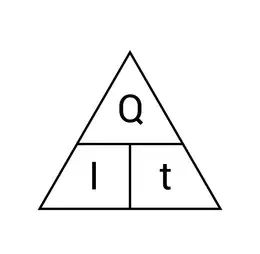
Where Q =
I =
t =
8
Fill in the Blanks
Type answer...
LO2 Understand direct current principles
Show answer
Auto Play
Slide 1 / 8
SLIDE
Similar Resources on Wayground

6 questions
Life Cycle of the Stars
Presentation
•
9th - 12th Grade
6 questions
Fraction area models
Presentation
•
KG
6 questions
Name the Shapes
Presentation
•
KG
6 questions
Reading Comprehension activity
Presentation
•
University
6 questions
math addition
Presentation
•
KG
6 questions
TV history
Presentation
•
KG
6 questions
Metodologi pembelajaran
Presentation
•
KG
6 questions
Tc. Syada Farm: Quizz
Presentation
•
KG
Popular Resources on Wayground
10 questions
HCS SCI 03 Summer School Review 4

Quiz
•
3rd Grade
11 questions
HSMS - Standard Response Protocol
Quiz
•
6th - 8th Grade
16 questions
1.1-1.2 Quiz Review
Quiz
•
9th - 12th Grade
12 questions
Exponent Expressions
Quiz
•
6th Grade
20 questions
Adding and Subtracting Integers
Quiz
•
6th - 7th Grade
11 questions
Northeast States
Quiz
•
3rd - 4th Grade
10 questions
Characterization
Quiz
•
3rd - 7th Grade
10 questions
Common Denominators
Quiz
•
5th Grade