
Search Header Logo
46 Muscles Lesson IG/AP/A Level and Muscle Contractions

46 Muscles Lesson IG/AP/A Level and Muscle Contractions

Assessment

Presentation

Biology

9th - 12th Grade

Hard

NGSS
HS-ESS3-1, HS-ESS2-4, HS-LS2-5

+6

Standards-aligned

Created by

Jeffrey Reed

Used 15+ times

FREE Resource

24 Slides • 0 Questions

1

media
media

More than 600 muscles make up the
system known as the muscular system .
Muscles are bundles of muscle fibers
held together by connective tissue.

The 5 main functions of the muscular system are :

movement

Support

Protection

heat generation

blood circulation.

2

media
media

Muscles move body parts by
contracting and then relaxing.
Muscles can pull bones, but they
can't push them back to the
original position. So they work in
pairs of flexors and extensors.
The flexor contracts to bend a
limb at a joint.

3

media
media

Generate Heat

Heat is a byproduct of
muscle activity. As ATP is
used to power muscles
about ¾ of its energy
escapes as heat. Skeletal
muscle is most responsible
for generating heat.

4

media
media

Skeletal muscles also play a
key role in the movement of
blood around the body. Veins
embedded within a muscle
are compressed during
contraction of that muscle,
causing an increase in blood
pressure due to the presence
of one-way valves within the
veins. This increase in
pressure drives the blood
towards the heart.

Blood Circulation

5

media
media

There are 3 types of muscles:

Skeletal muscles:the muscles that connect
to your bones and allow you to perform a wide
range of movements and functions. Skeletal
muscles are voluntary, meaning you control
how and when they work.

6

media
media

Smooth Muscles:

These muscles are involuntary,
meaning they work without
thinking about it.

7

media

Cardiac Muscles

Cardiac muscles are also
involuntary and are found in the
heart. Cardiac muscles contract
the heart to keep blood flowing
throughout the body during its
lifetime.

Blood vessels contain only smooth muscle cells.
These muscle cells reside within the tunica media
along with elastic fibers and connective tissue.

8

media
media

9

Skeletal Muscle Structure

  • Muscle fibers are grouped in bundles called fascicles. A sheath of tougher connective tissue called the perimysium encases the fascicles. Another layer of connective tissue, called the epimysium, surrounds the muscle as a whole and binds all the muscle fibers together.

media

10

Structure of Muscle Fibers

  • Myofibrils consist of even finer fibers, called myofilaments. There are two types of myofilaments: thin and thick.

    •Thick myofilaments are made of a protein called myosin.

    •Thin myofilaments consist of a protein called actin.

  • The arrangement of actin and myosin gives skeletal muscle its striated appearance.

media

11

media

12

media

13

Antagonistic Muscles

Skeletal muscles work across a joint and are attached to the bones by strong cords known as tendons.

They work in pairs, each contracting or relaxing in turn to create movement.

Ex. The biceps brachii and the triceps brachii are known as antagonistic muscles; as one muscle shortens, the other lengthens.

Subject | Subject

Some text here about the topic of discussion

media

14

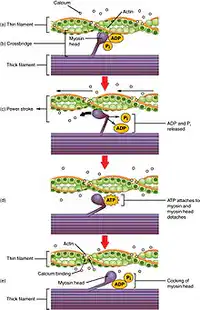
There are three stages of muscle contraction:

  1. Muscle excitation at the neuromuscular junction

  2. Excitation-contraction coupling

  3. Cross-bridge cycling

15

16

media

Label the parts

17

media

Thick Myosin Filament

Thin Actin Filament

Elastic Thin Filament

I Band

A Band

Z Disc

H Zone

M Line​

Sarcomere:

a structural unit of a myofibril in striated muscle​

18

media

19

media

20

media

21

media

22

media

23

media

24

media
media

More than 600 muscles make up the
system known as the muscular system .
Muscles are bundles of muscle fibers
held together by connective tissue.

The 5 main functions of the muscular system are :

movement

Support

Protection

heat generation

blood circulation.

Show answer

Auto Play

Slide 1 / 24

SLIDE
