
Fall of Rome/Byzantine Empire Review
Presentation
•
History
•
7th Grade
•
Practice Problem
•
Medium
Brian Johnson
Used 38+ times
FREE Resource
25 Slides • 27 Questions
1
2
3
Multiple Choice
What does this statement mean: “Rome’s fall did not mean the end of Roman civilization.”
The Visigoths were not successful in taking over the last Roman emperor in the west.
The influence of Rome lived on all the way to our time,
Rome built aqueducts to carry water throughout the empire.
There is no evidence in today’s world of Roman civilization.
4
5
6
7
Multiple Choice
Map Skills: Which geographic formation did not act as the northern borders of the Roman Empire at its height.
Rhine River
Danube River
Black Sea
Rubicon River
8
Multiple Choice
Map Skills: What form of transportation was most likely used to carry trade goods between the cities of Rome and Carthage?
donkeys
horses
ships
wagons
9
10
Multiple Choice
Map Skills: Find Byzantium on the map. Identify how its geography made it a good location for a city.
its location near a mountain range enabled it to be isolated from other communities
its location near a mountain range provided a natural defense barrier
its location near bodies of water fostered trade, transportation, and cultural diffusion
its location near bodies of water provided a natural defense barrier from pirates
11
12
13
Multiple Choice
Which is NOT an additional cause that created inflation in the Roman Empire
The Roman government used less silver and more inexpensive metals so they could create more coins
More currency was created
The amount of goods and services remained the same
The Roman economy was thriving
14
Multiple Choice
One of the internal political factors that weakend the Roman Empire was that power shifted from the west to east. Which is NOT an internal factor.
weakening military
government corruption within the Senate
Civil wars and unstable government
Invasions by barbarian tribes/King Alaric of the Visigoths
15
16
Multiple Choice
Rome and the _______ fell when waves of barbarian tribes invaded.
17
Multiple Choice
The _______became known as the Byzantine Empire.
18
Multiple Choice
The Eastern Roman Empire known as the B__________.
Byzantine Empire
19
Multiple Choice
Why did the power of the Roman Empire shift from West to East?
The empire was split in half, and the capital was moved to London
The empire was split in half when the military developed rival factions
The empire was split in half, and the capital was moved to Constantinople.
The empire was split in half when a civil war was fought between the two sides
20
Reasons the capital of the Roman Empire was moved to Constantinople:
1. it had excellent harbors for trade
2. had good natural defenses.
21
Multiple Choice
What is one reason the capital of the Roman Empire was moved to Constantiople?
It had a good inland location that prevented invasions by sea.
It had a large city center and access to the water on two sides.
It had a less central location and a good harbor for launching ships.
It had an excellent harbor for trade that also had good natural defenses.
22
Multiple Choice
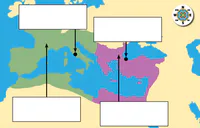
Locate The Western Roman Empire on the Map.
1
2
3
4
23
Multiple Choice
Locate the Capital of the Western Roman Empire.
1
2
3
4
24
Multiple Choice
Locate the Capital of the Eastern Roman Empire.
1
2
3
4
25
Multiple Choice
Locate the Eastern Roman Empire
1
2
3
4
26
27
28
Multiple Choice
Emperor Constantine named his capital city for himself. By 500 C.E. it was the capital of the:
The Western Roman Empire
The Kingdom of Visigoths
The Byzantine Empire
The Sassanid Empire
29
Multiple Choice
The word vandalism comes from the Vandals, a Germanic tribe whose raids involved destruction of property. By 500
C.E., they ruled islands in the _____________ and territory on the continent of ____________.
Black Sea, Asia
Atlantic Ocean, Europe
Mediterranaen Sea,
North Africa
Caspian Sea, Asia
30
31
32
33
34
Multiple Select
Why were the cities of the Byzantine Empire able to prosper? (choose 2)
hey had Roman culture and language.
They were thought to be protected by Roman gods.
They were hospitable to new people and ideas.
They were less likely to be invaded.
35
Multiple Choice
Which area of the map represents the Byzantine Empire?
A
B
A&B
36
37
38
39
40
Multiple Choice
The Byzantine Empire was founded as a
Christian
polytheistic
non-religious
41
Multiple Choice
_______traveled to the Byzantine Empire over the Roman roads.
Roman Gods
Christianity
The plague
42
43
Multiple Choice
How did Constantinople become a commercial and cultural center?
It was located on trading routes connecting Europe and Asia.
It was located on the western edge of the empire near Western Europe.
It was surrounded by water on three sides which allowed it to avoid invasions.
It was surrounded by water on three sides which provided it with many natural resources.
44
Multiple Choice
The Silk Road was a series of trade routes that connected
Asia and Arabia
Europe, Africa, Asia
Western and Eastern Europe
45
Multiple Choice
These routes made the Byzantine Empire________because its location PROMOTED the movement of people, places, and ideas.
a cultural crossroads
less wealthy and important
isolated
46
Multiple Choice
_______ in the Empire helped to foster the spread of Christianity.
Conquests
Hardships
Trade Routes
47
48
49
Multiple Select
Which statements explain the importance of the Code of Justinian? (choose 2)
It upheld past Roman laws without any new additions.
It influenced many modern law codes including those in Europe.
It eliminated many women’s rights allowed under previous Byzantine codes.
It provided commentary from judges that helped educate future legal minds in the Byzantine Empire.
50
51
The Hagia Sophia is a basilica that is used as a church.
52
Multiple Choice
The Hagia Sophia is an example of a ________used as a________ , rather than a public building.
Roman Column, mosque
basilica, church
dome, synagouge
Show answer
Auto Play
Slide 1 / 52
SLIDE

Similar Resources on Wayground
43 questions
Bill of Rights
Presentation
•
8th Grade
45 questions
Danger! This Mission to Mars Could Bore You to Death!
Presentation
•
7th Grade
47 questions
Genetic Mutations
Presentation
•
7th Grade
51 questions
Unit 1 Weather Review
Presentation
•
7th Grade
45 questions
Gregor Mendel
Presentation
•
7th Grade
47 questions
Probability Lesson 1
Presentation
•
7th Grade
50 questions
Biomes and Ecosystems
Presentation
•
7th Grade
47 questions
The Rise of Democracy
Presentation
•
6th - 7th Grade
Popular Resources on Wayground
20 questions
"What is the question asking??" Grades 3-5
Quiz
•
1st - 5th Grade
20 questions
“What is the question asking??” Grades 6-8
Quiz
•
6th - 8th Grade
10 questions
Fire Safety Quiz
Quiz
•
12th Grade
20 questions
Equivalent Fractions
Quiz
•
3rd Grade
34 questions
STAAR Review 6th - 8th grade Reading Part 1
Quiz
•
6th - 8th Grade
20 questions
“What is the question asking??” English I-II
Quiz
•
9th - 12th Grade
20 questions
Main Idea and Details
Quiz
•
5th Grade
47 questions
8th Grade Reading STAAR Ultimate Review!
Quiz
•
8th Grade
Discover more resources for History
36 questions
8th Grade US History STAAR Review
Quiz
•
KG - University
15 questions
Students of Civics Unit 8: The Judicial Branch
Quiz
•
7th - 11th Grade
10 questions
Exploring Westward Expansion and Manifest Destiny
Interactive video
•
6th - 10th Grade
48 questions
8th Grade U.S. History STAAR Review Part I
Quiz
•
5th - 8th Grade
12 questions
The Fast and the Curious (MD)
Quiz
•
6th - 8th Grade
12 questions
Andrew Jackson
Quiz
•
7th Grade
26 questions
Chapter 14 Test Review
Quiz
•
7th Grade
18 questions
Chapter 6- The Byzantine Empire Vocabulary
Quiz
•
7th Grade