

Fingerprinting Basics

Presentation
•
Science
•
6th - 8th Grade
•
Practice Problem
•
Easy
Standards-aligned

Raegan Coles
Used 15+ times
FREE Resource
13 Slides • 7 Questions
1
2

How are finger Prints Unique?
Made up of ridges (raised lines) and valleys (spaces between)
No two people have exactly the same fingerprints
Stay the same throughout life unless scarred
3
Koalas have fingerprints similar to humans
Even with powerful microscopes, they're hard to tell apart
They're one of the few non-primates with fingerprints
Scientists think this developed to help them grip tree branches
4

This is the science of fingerprints...
Police collect "dactylograms" (fingerprints)
Used to identify people
Based on three main pattern types
Used in crime-solving and identification
Dactyloscopy
5
Multiple Select
What are the 3 types of patterns a finger print can have?
Arch
Whorl
Loop
Divot
6
Simplest pattern type
Ridges enter one side and exit the other
Two types:
Plain arch (smooth curve)
Tented arch (has a spike in middle)
About 5% of people have arches
Type 1- Arches

7
Most common pattern
Has one delta (triangle shape)
Ridges enter and exit on same side
Two types:
Ulnar loop (toward pinky)
Radial loop (toward thumb)
About 60% of people have loops
Type 2- Loops

8
Circular or spiral pattern
Has two deltas
Four types:
Plain whorl
Central pocket whorl
Double loop whorl
Accidental whorl
About 35% of people have whorls
Type 3- Whorl

9
Poll
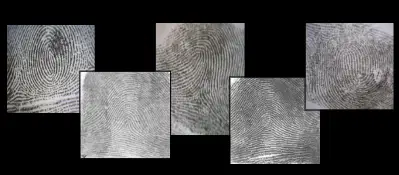
Look at your left pointer finer... does it have an arch, loop or whorl print?
Arch
Loop
Whorl
10

Small details in fingerprints
Help identify specific prints
Common features:
Ridge ending
Fork (bifurcation)
Island (dot)
Crossover
Core
Ridge Features
11
Word Cloud
What makes finger prints special?
12
Never change (except for scars)
Unique to each person
Can't be removed permanently
Easy to collect
Hard to fake
13


Roll from side to side
Use light pressure
Cover the whole fingertip
Avoid smudgingKeep fingers clean and dry
When taking your own fingerprints....
Check the science resource sheet for a link to do your own fingerprints> https://drive.google.com/drive/folders/1rsI4PDxoRZm8PJoz2fueEJzmZxHgQI3a
14
Materials Needed:
Pencil (regular graphite pencil)
Paper (any color)
Clear tape
White paper (for contrast)
Steps:
Rub the pencil: Scribble a thick patch of pencil on a piece of paper.
Press your finger: Rub your fingertip on the pencil patch to transfer the graphite.
Lift with tape: Press a piece of clear tape onto the fingerprint-covered finger and peel it off.
Stick to paper: Place the tape onto white paper, and you should see the fingerprint details!
15

Powder and Tape Method
This method mimics real fingerprint lifting techniques used in forensic science.
Materials Needed:
Clear tape (packing tape or Scotch tape)
Fine powder (cocoa powder, cornstarch, or fingerprint powder if available)
Soft brush (makeup brush, paintbrush, or a clean, dry sponge)
Dark or light surface (a glass, a countertop, or a piece of paper in a contrasting color)
Steps:
To make a fingerprint, Have the student press their finger on a smooth surface (like glass or a countertop). Oily or slightly sweaty fingers work best.
Apply powder: Lightly dust the area with cocoa powder (for light surfaces) or cornstarch (for dark surfaces) using the soft brush. Tap off excess powder.
Reveal the print: The powder will stick to the fingerprint’s ridges, making it visible.
Lift the print: Carefully press a piece of clear tape over the print, then peel it off.
Transfer the print: Stick the tape onto a piece of white or black paper to preserve the fingerprint.
16
Word Cloud
Where do we use fingerprinting verification in our every day life?
17
Identical twins have different fingerprints
Fingerprints form before birth
They help us grip things better
Some people are born without them
They're mostly water and oil
Alright... let's see who paid attention...
18
Multiple Select
What are the 3 main types of fingerprints?
Divot
Loop
Arches
Wholr
19
Fill in the Blanks
Which finger print pattern is the most common?
20
Open Ended
Why are fingerprints important?
Show answer
Auto Play
Slide 1 / 20
SLIDE
Similar Resources on Wayground

16 questions
Phonics a_e Part 3
Presentation
•
KG
17 questions
Cancer
Presentation
•
6th - 8th Grade
19 questions
Physical and Chemical Properties
Presentation
•
6th - 8th Grade
18 questions
Physical and Chemical Weathering
Presentation
•
6th - 8th Grade
18 questions
Piano Basics
Presentation
•
6th - 8th Grade
13 questions
Circle Circumference and Area
Presentation
•
7th - 8th Grade
14 questions
Fitness Week 1
Presentation
•
6th - 8th Grade
15 questions
STEM 9.30.20
Presentation
•
6th - 8th Grade
Popular Resources on Wayground
10 questions
Safety Day 2026 – Student Review

Quiz
•
9th Grade
21 questions
Continents and Oceans
Quiz
•
6th Grade
20 questions
Parts of Speech
Quiz
•
5th Grade
16 questions
Subject & Predicate
Quiz
•
5th Grade
25 questions
Multiplication Facts
Quiz
•
5th Grade
12 questions
Map Skills
Quiz
•
3rd Grade
22 questions
Continents and Oceans
Quiz
•
5th Grade
15 questions
Rounding Decimals
Quiz
•
5th Grade
Discover more resources for Science
20 questions
Newton's Laws of Motion
Quiz
•
8th Grade
20 questions
Elements, compounds, and mixtures
Quiz
•
6th Grade
10 questions
6.6D - Relative Density Review
Quiz
•
6th Grade
15 questions
potential and kinetic energy
Quiz
•
8th Grade
21 questions
Newton's Laws of Motion
Quiz
•
8th Grade
20 questions
Elements, Compounds and Mixtures
Quiz
•
8th Grade
10 questions
Exploring Chemical and Physical Changes

Interactive video
•
6th - 10th Grade
20 questions
CONDUCTION,CONVECTION AND RADIATION
Quiz
•
6th Grade