
Evidence of Earth Changes Over Time
Presentation
•
Science
•
8th Grade
•
Medium
+2
Standards-aligned

Jamie Lock
Used 2+ times
FREE Resource
13 Slides • 30 Questions
1
2
Multiple Choice
the hypothesis that the Earth’s continents were once one large landmass and have moved over geologic time relative to each other
Law of Superposition
Plate Tectonics
Continental Drift Theory
Fossil
3
Multiple Choice
What type of boundary is illustrated in the diagram?
Convergent
Divergent
Transform
4
Multiple Choice
What type of crust is involved in the illustration?
Oceanic-Oceanic
Continental-Continental
Oceanic-Continental
5
Multiple Choice
What type of crust is involved in the illustration?
Oceanic-Oceanic
Continental-Continental
Oceanic-Continental
6
Multiple Choice
What type of boundary is illustrated in the diagram?
Convergent
Divergent
Transform
7
Multiple Choice
What type of boundary is illustrated in the diagram?
Convergent
Divergent
Transform
8
Multiple Choice
Who proposed the Theory of Continental Drift?
Charles Darwin
Alfred Wegener
Harry Hess
Albert Einstein
9
Multiple Choice
True or False: Scientists celebrated Wegener's theory when he first proposed it.
TRUE
FALSE
10
Multiple Choice
Fossil records indicate that the continents were once connected. How do fossil records support this claim?
We have been able to transport the same types of fossils from one continent to another.
Fossils of the same organism have been found on continents that are now separated by oceans.
Some continents contain fossils of many different types of organisms.
11
12
Multiple Choice
One piece of evidence for Plate Tectonics is that--
some continents appear to fit together like a puzzle.
we have video footage of the plates actually moving.
all continents have formed from volcanic eruptions.
the continents are no longer moving.
13
Multiple Choice
plate boundaries where the plates are moving toward each other
Convergent boundary
Divergent Boundary
Transform Boundary
Subduction Zone
14
Multiple Choice
15
16
Multiple Choice
Which of the following is NOT evidence to support the theory of plate tectonics?
Fossils
Continental fit
Glaciers
Sand Erosion
17
Multiple Choice
plate boundaries where the plates are moving away from each other
Convergent boundary
Divergent Boundary
Transform Boundary
Subduction Zone
18
Multiple Choice
Which of the following occurs because of convection currents?
Pressure in the crust decreases.
The mantle increases in size.
Pressure in the crust increases.
Pieces of the crust, known as tectonic plates, move.
19
20
Multiple Choice
At first, a lack of evidence for continental drift prevented many scientists from believing a single supercontinent called _________ existed.
Glossopteris
Pangaea
Gondwanaland
Mesosaurus
21
Multiple Choice
the impression of prehistoric organism preserved in rock
plate tectonic
Law of Superposition
Fossil
Convergent Boundary
22
Multiple Choice
The theory of _______ states that Earth’s crust and upper mantle are broken into sections that are in constant, slow motion.
Plate Tectonics
continental drift
seafloor spreading
divergent boundaries
23
24
Multiple Choice
25
Multiple Choice
Earth’s surface is broken into large pieces called plates that are constantly moving and changing at a very slow rate
plate tectonics
divergent boundary
transform boundary
subduction zone
26
Multiple Choice
27
28
Multiple Choice
29
Multiple Choice
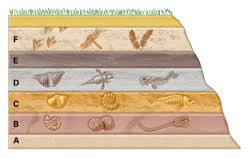
each rock layer is older than the one above it
continental drift theory
subduction zone
fossil
law of superposition
30
Multiple Choice
The deeper the layer the fossil is found, the older the fossil will likely be.
True
False
31
32
Multiple Choice
Who first suggested the continental drift theory?
Charles Darwin
Alfred Wegener
Isaac Newton
Dmitri Mendeleev
33
Multiple Choice
plate boundaries where the plates are moving past each other in different directions
convergent boundary
divergent boundary
transform boundary
subduction zone
34
Multiple Choice
A scientist drew some diagrams of ancestors of elephants based on fossil evidence. Which is the BEST conclusion that can be made from comparing the diagrams?
(Model Description: The first elephant ancestor is 50 million years old and very small, the second elephant ancestor is 30 million years old and much larger. The trunk is also short. The last ancestor is 20 million years old and taller, but shorter width wise. The trunk is also longer.)
Ancient elephants were better adapted than modern elephants.
Elephant habitats have remained the same over time.
Elephant fossil evidence is widespread and complete.
Elephant species have changed over time.
35
36
Multiple Choice
Fossils are the preserved ____ of once living organisms.
plants
adaptations
remains
variations
37
Multiple Choice
a feature where two tectonic plates collide and one plate is forced beneath the other
convergent boundary
divergent boundary
transform boundary
subduction zone
38
Multiple Choice
An organism is ______________ if it no longer exits and will never live again on Earth.
rare
plentiful
missing
extinct
39
40
41
42
43
Show answer
Auto Play
Slide 1 / 43
SLIDE

Similar Resources on Wayground
36 questions
The Genetic Code: Ch 4 L 1
Presentation
•
7th - 8th Grade
37 questions
Scientific Method Notes
Presentation
•
8th Grade
35 questions
Chapter 10 Forces and Motion Lesson 1 & 2
Presentation
•
8th Grade
37 questions
Continental Drift
Presentation
•
8th Grade
39 questions
4/26- Elements, Compounds and Mixtures!
Presentation
•
8th Grade
42 questions
Metamorphic Rocks Lesson
Presentation
•
8th Grade
38 questions
Excretory System
Presentation
•
8th Grade
39 questions
PURE SUBSTANCES AND MIXTURES
Presentation
•
7th Grade
Popular Resources on Wayground
6 questions
Secondary Safety Quiz
Presentation
•
9th - 12th Grade
10 questions
MyPath Diagnostic Overview
Presentation
•
6th - 8th Grade
20 questions
Lab Safety Quiz
Quiz
•
6th Grade
21 questions
Continents and Oceans
Quiz
•
6th Grade
20 questions
Adding and Subtracting Decimals
Quiz
•
5th Grade
20 questions
Parts of Speech
Quiz
•
5th Grade
16 questions
Subject & Predicate
Quiz
•
5th Grade
21 questions
Lab Safety
Quiz
•
10th Grade
Discover more resources for Science
10 questions
Lab Safety
Quiz
•
8th Grade
20 questions
Lab Safety
Quiz
•
5th - 8th Grade
10 questions
Lab Safety Essentials
Interactive video
•
6th - 10th Grade
20 questions
Scientific Method and Variables
Quiz
•
8th Grade
20 questions
Scientific method and variables
Quiz
•
8th Grade
27 questions
Counting Atoms - Subscripts
Quiz
•
8th Grade
22 questions
Scientific Method and Variables
Quiz
•
8th Grade
10 questions
Essential Guidelines for Science Lab Safety
Interactive video
•
6th - 10th Grade