
Seismic Waves Lesson

Presentation
•
Science
•
8th Grade
•
Hard

James Gonzalez
FREE Resource
8 Slides • 10 Questions
1

Earth's Layers and Seismic Waves
2
Vocabulary
Earthquake - a sudden and violent shaking of the ground, sometimes causing great destruction, as a result of movements within the earth's crust
Fault Line - an extended break in a body of rock, marked by the relative displacement and a discontinuity of strata on either side of a particular surface (where rock layers don’t match up because of an earthquake)
Epicenter - the point on earth's surface above where an earthquake occurred
Seismic Wave - a wave in the earth produced by an earthquake
Primary (P) Wave - a type of seismic wave that causes rock to vibrate in the direction of the wave; faster of the two seismic waves and can travel through solid and liquid portions of the earth (pressure wave)
Secondary (S) Wave - a type of seismic wave that causes rock to move at right angles (perpendicular) of the wave; second fastest of the seismic waves and can only travel through solid portions of the earth (shear wave)
Seismograph - an instrument that measures and records details of earthquakes, such as force and duration
Seismogram - a record of seismic activity produced by a seismograph
Triangulation - using three seismometers (seismographs) in order to locate the epicenter of an earthquake (by measuring the distance between each seismograph and the earthquake)
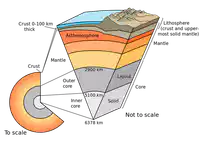
Crust - outermost hard solid layer of the earth
Mantle - hot dense region of earth’s interior between the crust and the core
Core - innermost layer of earth, mostly made of iron and nickel
Lithosphere - Outer layer of earth made of hard/rigid, solid rock (crust and tiny part of upper mantle; made up of tectonic plates)
Asthenosphere - Soft/Plastic, solid layer of the earth that makes up the upper mantle (where mantle convection occurs)
Mesosphere - Hard/Rigid, solid layer of earth that makes up the lower mantle
Outer Core - the outer liquid part of the core
Inner Core - the inner solid part of the core
3

4

5
Earthquakes originate underground and many of them are so weak that they can't be noticed by humans without a machine. Occasionally, even though they can't be detected by people, they can still cause damage to infrastructure. This means it's important to observe earthquake data to determine if cities need to look for places that need repairs. Geologists can determine an earthquakes position using triangulation, which requires three seismographs to pinpoint the origin/epicenter.

6

7

8

9
Multiple Choice
Which layer of the earth is liquid?
Lithosphere
Asthenosphere
Outer Core
Inner Core
10
Multiple Choice
How do scientists record seismic waves?
Seismograph
Relative Dating
Sound Recorder
Surveys
11
Multiple Choice
How many seismographs are needed to locate the epicenter of an earthquake?
1
2
3
4
12
Multiple Choice
Which of these statements correctly describes P-Waves and S-Waves?
P-Waves are released first, then S-Waves. P-Waves can go through solids and liquids, while S-Waves can only go through solids.
P-Waves and S-Waves are released at the same time. P-Waves are faster and can travel through liquids and solids, while S-Waves are slower and can only travel through solids.
S-Waves are released first, then P-Waves. S-Waves can go through solids and liquids, while P-Waves can only go through solids.
S-Waves and P-Waves are released at the same time. S-Waves are faster and can travel through liquids and solids, while P-Waves are slower and can only travel through solids.
13
Reorder
List the layers of the earth in order from the one closest to the surface to the one that's the deepest.
Lithosphere
Asthenosphere
Mesosphere
Outer Core
Inner Core
14
Multiple Choice

The picture shows a cross section of half of the earth. If an earthquake were to happen at the location marked 0° , which of these locations would not register P-Waves or S-Waves?
30°
60°
90°
120°
15
Multiple Choice
The picture shows a cross section of half of the earth. If an earthquake were to happen at the location marked 0° , which of these locations would register P-Waves but not S-Waves?
45°
90°
120°
150°
16
Multiple Choice
What is the core of the earth mostly made of?
Igneous Rock
Metamorphic Rock
Sedimentary Rock
Iron and Nickel
17
Multiple Choice
What quality of earth's layers cause seismic waves to move faster as they get deeper into the earth?
Layers become more dense
Layers become less dense
Layers become hotter
Layers become colder
18
Multiple Choice
As seismic waves go through the earth they are ________, which is caused by their change in speed.
reflected
transmitted
refracted
diffracted
Earth's Layers and Seismic Waves
Show answer
Auto Play
Slide 1 / 18
SLIDE
Similar Resources on Wayground

13 questions
Metric Conversion Review
Presentation
•
8th Grade
13 questions
Speed, Velocity, Acceleration
Presentation
•
8th Grade
13 questions
Phase Change Diagrams
Presentation
•
8th Grade
13 questions
Wave Properties
Presentation
•
8th Grade
13 questions
Symbiosis and Food Webs
Presentation
•
8th Grade
13 questions
Newton's Third Law
Presentation
•
8th Grade
14 questions
Combustion & Flame
Presentation
•
8th Grade
15 questions
Cell and cell organelle
Presentation
•
8th Grade
Popular Resources on Wayground
10 questions
Safety Day 2026 – Student Review

Quiz
•
9th Grade
21 questions
Continents and Oceans
Quiz
•
6th Grade
20 questions
Parts of Speech
Quiz
•
5th Grade
16 questions
Subject & Predicate
Quiz
•
5th Grade
25 questions
Multiplication Facts
Quiz
•
5th Grade
12 questions
Map Skills
Quiz
•
3rd Grade
22 questions
Continents and Oceans
Quiz
•
5th Grade
15 questions
Rounding Decimals
Quiz
•
5th Grade
Discover more resources for Science
20 questions
Newton's Laws of Motion
Quiz
•
8th Grade
15 questions
potential and kinetic energy
Quiz
•
8th Grade
21 questions
Newton's Laws of Motion
Quiz
•
8th Grade
20 questions
Elements, Compounds and Mixtures
Quiz
•
8th Grade
10 questions
Exploring Chemical and Physical Changes

Interactive video
•
6th - 10th Grade
20 questions
Physical vs Chemical Changes
Quiz
•
8th Grade
20 questions
Conduction, convection, and Radiation Practice
Quiz
•
8th Grade
21 questions
Waves and Wave Properties
Quiz
•
6th - 8th Grade