

Universal Gravitation

Presentation
•
Physics
•
9th - 12th Grade
•
Hard

James Gonzalez
FREE Resource
7 Slides • 10 Questions
1

2
Open Ended
What is the difference between weight and mass?
3
Mass vs Weight
Mass is an inherent quality of objects.
It is the amount of matter present in an object.
Whether on Earth, in space, or on the moon, this amount remains the same.
Weight, on the other hand, is the force acting on an object that has mass.
This force is the pull of gravity.
Weight is not a property of the object; rather, it is the pull exerted by the surface on which the object exists.
Therefore, objects will have different weights on different planets.
4
Open Ended
Are mass and weight vector or scalar quantities? Give reasons for your answers.
5
Calculating Weight
Recall that Newton's Second Law states the sum of the forces acting on an object is equal to the mass of the object times its acceleration.
Since weight is a force, we can say that: Fg = mg
Here Fg is the wieght, m is the mass, and g is the acceleration due to gravity.
On a planet then, the weight vector is pointed towards the center of the planet.
While there are many units used to measure weight in society, since it is a force, we use the units of newtons (N) in physics.
So for example, a 2.0 kg bar would be said to weigh 19.6 N on Earth, since g = -9.8 m/s2
6
Multiple Choice
The value of acceleration due to gravity on the planet Saturn (gSaturn) is about 11.2 m/s2. How much will an object weighing 680 newtons on Earth weigh on Saturn?
777 N
7616 N
61 N
595 N
560 N
7
Universal Law of Gravitation
We know that gravity is a field force, meaning that it doesn't need contact to transmit the force.
We also know that the acceleration from gravity is different on different planets.
What we haven't mentioned yet is that the acceleration of gravity is different depending on how far we are from the planet's center of mass.
The table shows the values for different distances from the Earth's surface.

8
Inverse Square Law
Based on the motion of the planets, Newton proposed that the force of gravity (Fg) follows an inverse square law with respect to the distance between two bodies.
In other words: Fg ∝ 1/r2
This means that if we double the distance between two objects, then the gravitational force decreases by a factor of four.
Newton also realized that gravity's pull on an object is not just influenced by its distance from Earth's center, its mass also plays a role.
The greater the mass of the object, the greater the pull of gravity.
Gravity is directly proportional to the mass of the object.
9
Universal Law of Gravitation
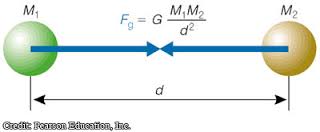
Putting all of this together, we can express gravity as: Fg = G(mE⋅mobj)/r2.
Where mE is the mass of the Earth, mobj is the mass of the object, and G is the universal gravitational constant.
The value of G was found by Lord Henry Cavendish almost a century after Newton's death.
He found that the value of the gravitational force between two objects of 1 kilogram each, kept 1 meter apart, would equal just 0.0000000000667 newtons.
Thus, the value of G is 6.673 × 10⁻¹¹ newtons⋅meters2/kilograms2.
From the value of this constant you can see that the gravitational force is insignificant for most day–to–day objects you encounter.
10
Multiple Choice
An astronaut is on a spacewalk 300 kilometers above Earth's surface. If the astronaut's mass plus suit is 170 kilograms, what is the force of interaction between Earth and the astronaut? (Earth's radius is 6.38 × 10⁶ meters, Earth's mass = 5.98 × 1024 kg, and G = 6.673 × 10⁻¹¹ Nm2/ kg2)
6.9 x 10² N
1.7 x 10³ N
8.6 x 10² N
4.9 x 101 N
11
12
Multiple Choice

13
Multiple Choice
14
Multiple Choice
Find the distance between two objects whose masses are m1 = 4,500 kg, and m2 = 8,700 kg; if the gravitational force between them is F = 2.0 x 10⁻⁸ N.
130565.25 m
361.34 m
0.19575 m
0.783 m
15
Multiple Choice
Doubling the mass of an object...
...will double the force of gravity.
...will half the force of gravity.
...will quadruple the force of gravity.
...will quarter the force of gravity.
16
Multiple Choice

Calculate the gravitational force between two objects when they are 0.750m apart. Each object has a mass of 5.00kg.
2.96x10⁻⁹N
3.00x10⁻⁶N
2.22x10⁻⁹N
2.23x10⁻⁸N
17
Multiple Choice
If the sun's mass is 2.0x1030 kg, and its radius is 7.0 x 10⁸ m, what is the strength of its gravitational field, "g"?
9.8 m/s2
272.2 m/s2
27.2 m/s2
200 m/s2
Show answer
Auto Play
Slide 1 / 17
SLIDE
Similar Resources on Wayground

12 questions
Ecological Succession
Presentation
•
9th - 12th Grade
12 questions
Solving Logarithmic Equations
Presentation
•
9th - 12th Grade
12 questions
Asymptotes
Presentation
•
9th - 12th Grade
12 questions
Tragedy of the Commons
Presentation
•
9th - 12th Grade
12 questions
Trigonometric Ratios
Presentation
•
9th - 12th Grade
14 questions
Radioactive decay
Presentation
•
9th - 12th Grade
13 questions
Hacking
Presentation
•
9th - 12th Grade
13 questions
Color
Presentation
•
10th - 12th Grade
Popular Resources on Wayground
10 questions
How much do you know about our Portrait of an Eagle?

Quiz
•
10th Grade
10 questions
Fast Food Slogans
Quiz
•
6th - 8th Grade
21 questions
Continents and Oceans
Quiz
•
6th Grade
20 questions
Parts of Speech
Quiz
•
5th Grade
16 questions
Subject & Predicate
Quiz
•
5th Grade
25 questions
Multiplication Facts
Quiz
•
5th Grade
12 questions
Map Skills
Quiz
•
3rd Grade
22 questions
Continents and Oceans
Quiz
•
5th Grade
Discover more resources for Physics
20 questions
Position vs. Time Graphs
Quiz
•
9th Grade
20 questions
Calculating Net Force
Quiz
•
6th - 9th Grade
18 questions
Interpreting Motion Graphs
Presentation
•
9th - 12th Grade
10 questions
Exit Check 4.1 - Destructive Processes
Quiz
•
9th Grade
21 questions
Distance/Time Graphs
Quiz
•
9th Grade
20 questions
Unit 2 - Waves Test - 2026
Quiz
•
9th - 12th Grade
10 questions
Exit Check 4.2 - Constructive Forces
Quiz
•
9th Grade
10 questions
Exit Check 4.3 - Conservation of Momentum
Quiz
•
9th Grade