
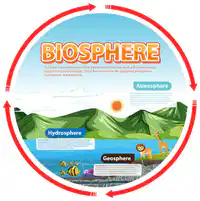
Biosphere

Presentation
•
Science
•
9th - 12th Grade
•
Hard

James Gonzalez
FREE Resource
8 Slides • 4 Questions
1

2

3
-
1 What is Ecology?
Studying Our Living Planet
• Ecology is the scientific study of
interactions among organisms and
between organisms and their
environment, or surroundings.
• Ecology is the study of nature’s
“houses” and the organisms that live
in those houses.
3

The Biosphere
• The biosphere consists of all life on Earth
and all the parts of the Earth in which life
exists including land, water, and air or
atmosphere.
It extends
8 km
above
earth and
11 km
below
ocean.
4
5
Open Ended
What is BIOSPHERE, in your own words?
6

Interactions and Interdependence
Organisms and their environment are interdependent. These
giraffes could not survive without plants to eat, and the
plants could not grow unless bacteria and other organisms
help recycle nutrients in the water and soil.
7
Categorize
Living things
Match the following terms.
8

Levels of Organization
The study of ecology ranges from
individual organisms to populations,
communities, ecosystems, biomes, and
the entire biosphere.
9

Levels of Organi
zation
• A
biome
is a group of ecosystems that have the
same climate and similar dominant communities.
• An
ecosystem
is a collection of all the organisms
that live in a particular place, together with their
nonliving, or physical, environment.
• A
community
is composed of different populations
that live together in a define area.
• A
population
is a group of individuals that belong
to the same species and live in the same area.
• A
species
is a group of individual organisms similar
to one another.
Biology.com – Activities: Art in Motion
10
Reorder

Change the following from a single organism to a collection of organisms in chronological order.
Individual
Population
Community
Ecology
Biosphere
11

Biotic and Abiotic Factors
•
Biotic Factor
– any living part of the environment
with which an organism might interact. (animals,
plants, bacteria)
•
Abiotic Factor
– any nonliving part of the
environment. ( sunlight, heat, precipitation, wind)
12
Categorize
spider plant
dry eraser
Sort the following terms into biotic and abiotic categories.
Show answer
Auto Play
Slide 1 / 12
SLIDE
Similar Resources on Wayground

12 questions
Experience 3: Atomic Emission Spectra
Presentation
•
9th - 12th Grade
10 questions
Genetic Engineering
Presentation
•
10th - 11th Grade
10 questions
Influences on Darwin
Presentation
•
9th - 12th Grade
8 questions
Chemical and Physical Changes
Presentation
•
9th - 12th Grade
10 questions
Grammar 4A - ir + a + infinitive
Presentation
•
9th - 12th Grade
10 questions
Synthetic Division
Presentation
•
9th - 12th Grade
10 questions
Genetics Dihybrid Crosses
Presentation
•
9th - 12th Grade
11 questions
Adaptations
Presentation
•
9th - 12th Grade
Popular Resources on Wayground
10 questions
How much do you know about our Portrait of an Eagle?

Quiz
•
10th Grade
10 questions
Fast Food Slogans
Quiz
•
6th - 8th Grade
21 questions
Continents and Oceans
Quiz
•
6th Grade
20 questions
Parts of Speech
Quiz
•
5th Grade
16 questions
Subject & Predicate
Quiz
•
5th Grade
25 questions
Multiplication Facts
Quiz
•
5th Grade
12 questions
Map Skills
Quiz
•
3rd Grade
22 questions
Continents and Oceans
Quiz
•
5th Grade
Discover more resources for Science
10 questions
Exploring Chemical and Physical Changes

Interactive video
•
6th - 10th Grade
20 questions
Atomic Structure
Quiz
•
9th Grade
10 questions
Decoding the Periodic Table of Elements
Interactive video
•
6th - 10th Grade
10 questions
Exploring the Periodic Table
Interactive video
•
6th - 10th Grade
14 questions
Physical and Chemical Changes
Quiz
•
10th Grade
22 questions
Periodic Table Review
Quiz
•
9th - 12th Grade
20 questions
Observation vs. Inference
Quiz
•
7th - 9th Grade
14 questions
Periodic Trends
Interactive video
•
11th Grade