

Thermal Energy Review

Presentation
•
Physics
•
8th - 10th Grade
•
Hard

James Gonzalez
FREE Resource
33 Slides • 10 Questions
1
2

3
4

5
Multiple Choice
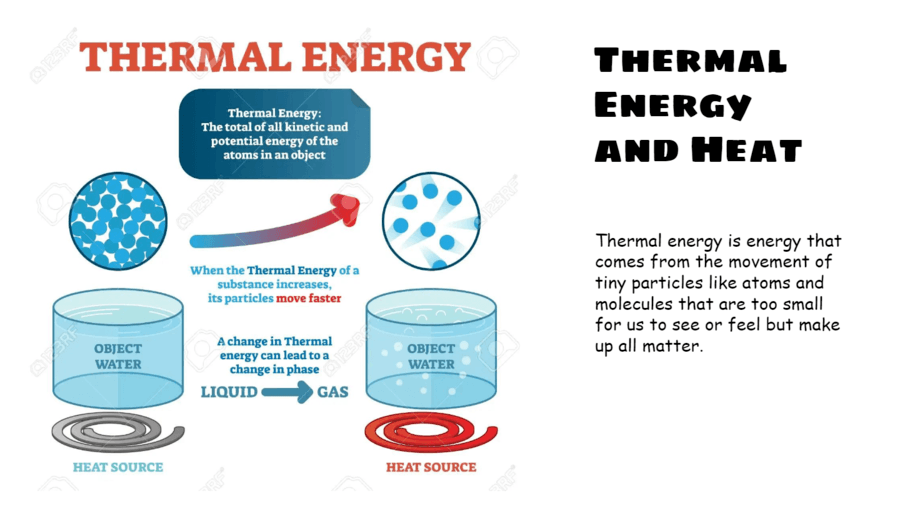
All matter is made of tiny particles that are constantly moving
True
False
6

7

8

9
10

11
Multiple Choice
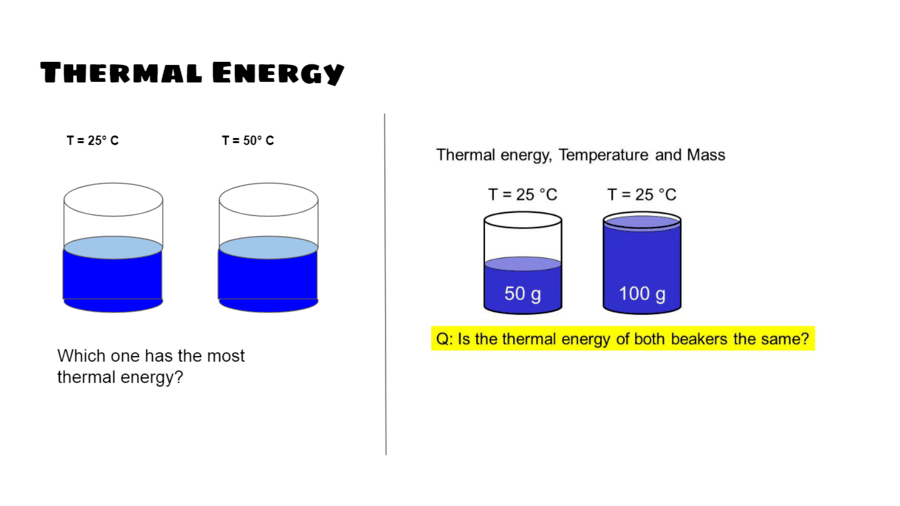
What is the thermal energy of a system?
the total kinetic energy of moving particle
the average kinetic energy of moving particles
the amount of heat in a substance
12
Multiple Select
Which of the following will increase the thermal energy of an object. (May be more than one answer)
increasing the temperature
increasing the mass
reducing the mass
reducing the temperature
13

14

15

16

17

18
Match
Specific Heat Capacity
Temperature
Thermal Energy
Convection
Conduction
the amount of energy it takes to raise the temperature of a substance
the average amount of kinetic energy in particles
the total amount of kinetic energy in particles
the movement of fluids (gases and liquids) due to temperature differences
the transfer of thermal energy through collisions of particles when objects touch
the amount of energy it takes to raise the temperature of a substance
the average amount of kinetic energy in particles
the total amount of kinetic energy in particles
the movement of fluids (gases and liquids) due to temperature differences
the transfer of thermal energy through collisions of particles when objects touch
19

20
Fill in the Blanks
A substance with a high specific heat requires (more/less) energy to raise the temperature.
21

22
Fill in the Blanks
If you want the temperature to go up quickly, you should choose a substance with a (high/low) specific heat.
23
Multiple Choice

24
Multiple Choice
25

26

27

28

29
The Crust is the Outermost layer, and there are two types: Oceanic and Continental.
Oceanic crust is denser than continental crust, and has twice as much iron, calcium, and magnesium.
The crust is one of two parts of the Lithosphere of the Earth. The other part of the Lithosphere is the outermost layer of the Mantle.
Notes: What are the Layers of the Earth?


30
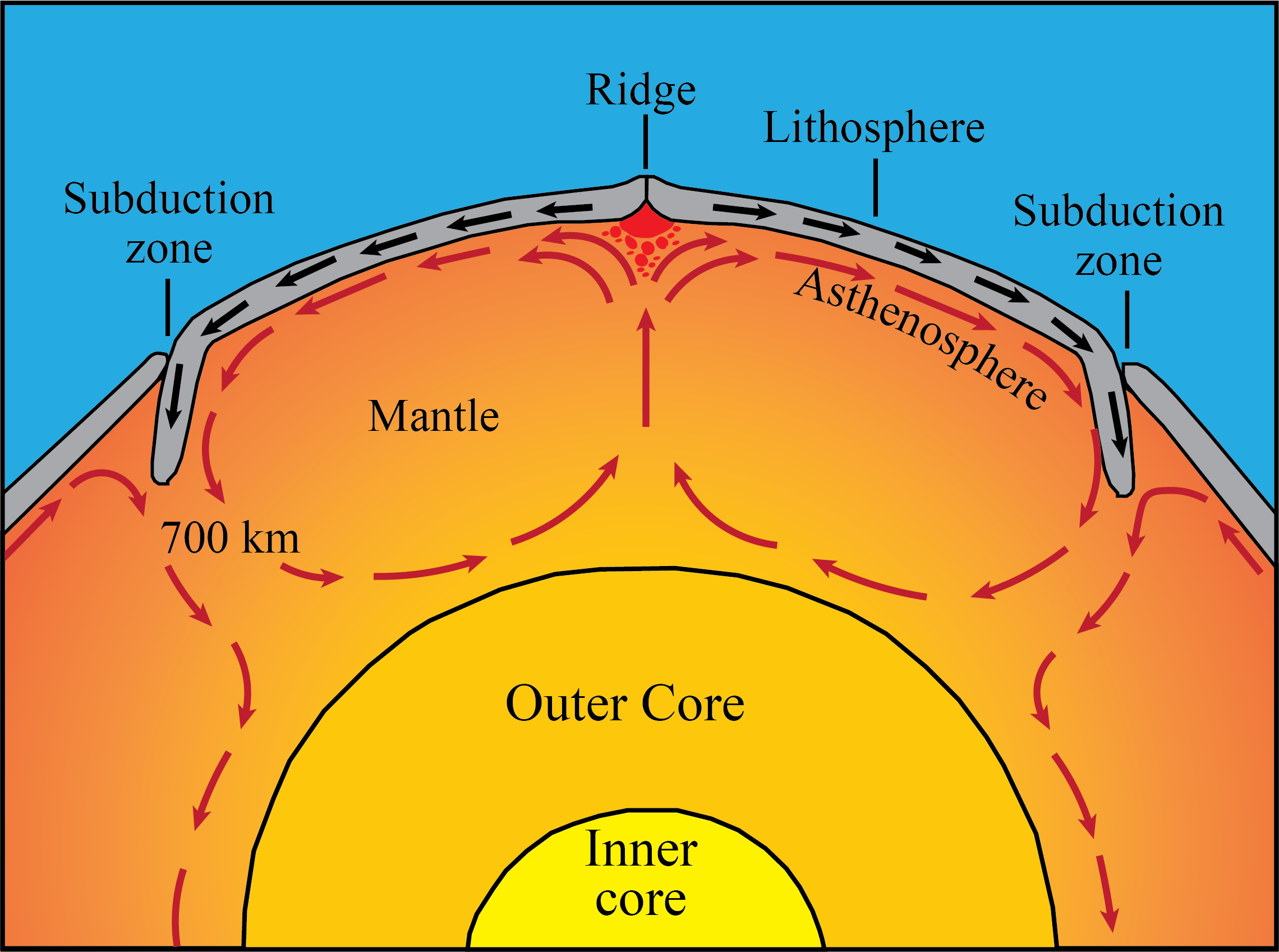
The Mantle is between the Core and the Crust. The Mantle is made of hot, slow-flowing, rock (magma). Convection occurs in this layer (hot magma goes up, "cool" magma goes down)
.
The Mantle is denser than the crust (allowing the crust to "float" on it), and geologists believe that the main factor for the motion of plate tectonics is convection currents that occurs in the mantle.
Notes: What are the Layers of the Earth?
31
The Lithosphere is made up of tectonic plates that move in different directions and speeds.
As mentioned previously, scientists believe that convection currents in the Earth's Mantle cause the plates to move.
Plate tectonics give us mountains, mid-ocean ridges, seafloor spread, and earthquakes.
Notes: How does the Earth Move?

32

33

34

35


Energy
Stores
Table
36


A N E X A M P L E O F
A T H E R M A L
E N E R G Y
T R A N S F E R B Y
H E A T I N G , I S A
H O T C O F F E E
H E A T I N G U P
C O L D H A N D S
Thermal energy is
transferred by heating from
the hot coffee to the mug
and to the cold hands
37


Sankey diagram is a way
of using picture to show
how energy is going in to
a system, how much useful
energy is coming out, and
how much energy is lost
by system.
SANKEY
DIAGRAM
38


Sankey
Diagram
for
Electrical
Bulb
39
energy that flows from a system to its surrounding
measured in J
q = positive = heat released from system into surroundings = exothermic
q = negative = heat absorbed into system from surroundings = endothermic
sig figs become very important here (as we often only have 2, due to temp - don't round early!)

40

41
42
Multiple Choice
The air in a living room has a mass of 60 kg and a specific heat of 1,020 J/kg*C. What is the change in thermal energy of the air when it warms from 20C to 25C?
306,000 J
0.15 kg
1,020 J
5 C
43
Multiple Choice
The thermal energy of water in a mug increases by 12,552 J when the water is heated from 20C to 40C. If the specific heat of eater is 4,184 J/kg*C. What is the mass of the water?
306,000 J
0.15 kg
1,020 J
5 C
Show answer
Auto Play
Slide 1 / 43
SLIDE
Similar Resources on Wayground

36 questions
Factoring Polynomials
Presentation
•
8th - 9th Grade
38 questions
Present tense of "er" and "ir" verbs
Presentation
•
9th Grade
36 questions
LOCATION SENSOR
Presentation
•
7th - 10th Grade
39 questions
Intro to Genetics
Presentation
•
9th Grade
38 questions
Exponential Growth & Decay
Presentation
•
9th Grade
38 questions
Work & Power
Presentation
•
8th - 11th Grade
35 questions
Motion: Speed & Velocity
Presentation
•
8th - 11th Grade
38 questions
Genetics Terms part 2
Presentation
•
9th - 10th Grade
Popular Resources on Wayground
10 questions
Safety Day 2026 – Student Review

Quiz
•
9th Grade
21 questions
Continents and Oceans
Quiz
•
6th Grade
20 questions
Parts of Speech
Quiz
•
5th Grade
16 questions
Subject & Predicate
Quiz
•
5th Grade
25 questions
Multiplication Facts
Quiz
•
5th Grade
12 questions
Map Skills
Quiz
•
3rd Grade
22 questions
Continents and Oceans
Quiz
•
5th Grade
15 questions
Rounding Decimals
Quiz
•
5th Grade
Discover more resources for Physics
20 questions
Position vs. Time Graphs
Quiz
•
9th Grade
22 questions
Physical Properties of Matter
Quiz
•
8th Grade
10 questions
Exit Check 5.1 - Forms of Energy
Quiz
•
9th Grade
11 questions
Electricity Explained

Interactive video
•
9th - 12th Grade
87 questions
25-26 Unit 1.2 Review - Radioactivity & Earth's Age
Quiz
•
8th - 10th Grade
15 questions
Position vs. Time and Velocity vs. Time Graphs
Quiz
•
10th - 12th Grade
21 questions
Calculating Speed Distance and Time
Quiz
•
6th - 8th Grade
18 questions
Quiz #8 Practice: Forces on an Incline
Quiz
•
9th Grade