Search Header Logo
Evidence of Evolution

Evidence of Evolution

Assessment

Presentation

•

Biology

•

10th Grade

•

Medium

•
NGSS
MS-LS4-2, MS-LS4-3, MS-ESS1-4

+7

Standards-aligned

Created by

Heyana Mims

Used 14+ times

FREE Resource

11 Slides • 20 Questions

1

media

2

media

3

media

4

Multiple Choice

A change in the inherited characteristics of an organism over time is ________
1
evolution.
2
development.
3
growth.
4
ancestry.

5

Multiple Choice

The most recent ancestral form or species from which two different species evolved is known as ________________________.
1
a common ancestor.
2
an embryonic stage.
3
development.
4
evolution.

6

media

7

media

8

Multiple Choice

What comparative anatomy structure is a result from left over traits that are no longer needed for survival and no longer serve a purpose?

1

Analogous Structures

2

Homologous Structures

3

Vestigial Structures

9

media

10

Multiple Choice

What comparative anatomy structure has similar form/structure but different function?

1

Analogous Structures

2

Homologous Structures

3

Vestigial Structures

11

media

12

Multiple Choice

What comparative anatomy structure has a different form/structure but the same function?

1

Analogous Structures

2

Homologous Structures

3

Vestigial Structures

13

Multiple Choice

Question image

Some organisms have features that have different functions, but similar structures. One example is the forelimb of humans, dogs, birds, and whales. What term best describes the relationship between these forelimbs?

1

They are homologous.

2

They are vestigial.

3

They are analogous.

4

They are embryological.

14

media

15

Multiple Choice

Question image
Study of embryos of various organisms to show a common ancestor because of similarities in development
1
natural selection
2
embryology
3
speciation
4
evolution

16

Multiple Choice

Question image

What type of evidence are shown in the picture above?

1

Fossils

2

Embryology

3

Homologous Structures

4

Vestigial Structures

17

Multiple Choice

Question image
The diagram illustrates an embryonic stage of two organisms.

Which of the following can be determined by observing the embryos shown in the diagram
1
The organisms share a common ancestry.
2
The organisms belong to the same genus.
3
The organisms are native to the same geographic areas.
4
The organisms will grow into anatomically similar adults.

18

media

19

Multiple Choice

How do fossils support evolution?

1

The fossil record provides evidence that organisms have changed over time.

2

Individual species disappear and reappear in the fossil record over time.

3

The fossil record provides evidence that all organisms developed at the same time.

4

Organisms in the fossil record are identical to living organisms.

20

media

21

Multiple Choice

Relative dating of rock layers tells us that the deeper we dig, 
1
the younger the rocks get.
2
the simpler the rocks get.
3
the harder the rocks get.
4
the older the rocks get.

22

Multiple Choice

Question image
Which layer is the youngest
1
1
2
2
3
3
4
4

23

Multiple Choice

Question image
Which layer is the oldest
1
B
2
A
3
E
4
C

24

Multiple Choice

Question image

The diagram shows a portion of the fossil record in sedimentary rock. Different rock layers and fossils are clearly visible. Which of these statements is true of the fossils and rock layers shown in the diagram?

1

Layer B contains the second-oldest fossils.

2

Layer A contains the most recently formed fossils

3

The fossils in layer B are older than those in layer D.

4

The fossils in layer D are the most recently formed

25

media

26

Multiple Choice

Which of these statements is true about DNA and evolution?

1

Two species that have the same DNA provide evidence that evolution has taken place.

2

Two species with very similar DNA likely evolved from a common ancestor.

3

Each living species has DNA made from different ingredients, showing that organisms have evolved.

4

DNA from related species is identical, providing evidence that all organisms have evolved in the same way.

27

Multiple Choice

Question image

What type of evidence is shown in the image above?

1

Fossils

2

Vestigial structures

3

Homologous Structures

4

DNA

28

Multiple Choice

Question image
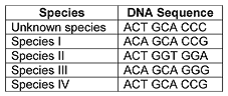
According to this data, the unknown bacterial species is most closely related to: 
1
Species I
2
Species II
3
Species III
4
Species IV

29

Multiple Choice

Question image

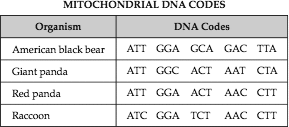
What conclusions can be made based on this table shown?

1

the American black bear and the giant panda are most closely related

2

the giant panda and the red panda are most closely related

3

the red panda and the racoon are the most closely related

4

the giant panda and the racoon are most closely related

30

Multiple Choice

A scientist is studying the DNA of three species. Species A and species B have DNA that is 97% similar. Species C and species A have DNA that is 95% similar. What can the scientist conclude?

1

Species B is equally related to both species A and species C

2

Species B has a closer evolutionary relationship with species C than it does with species A

3

Species A has a closer evolutionary relationship with species B than it does with species C.

4

Species A has a closer evolutionary relationship with species C than it does with species B.

31

Multiple Choice

Question image

The diagram shows a model of the proposed relationships among some groups of mammals. Which of these organisms is most closely related to whales?

1

bison

2

camel

3

hippopotamus

4

pig

media

Show answer

Auto Play

Slide 1 / 31

SLIDE