Unit 2.0 Review Atoms, Periodic Table, Bohr Diagram, Lewis dot
Presentation
•
Science
•
9th Grade
•
Medium
+3
Standards-aligned
Kimberly Dixon
Used 4+ times
FREE Resource
33 Slides • 48 Questions
1
Parts of the atom
2
3
4
Multiple Choice
What is the charge of a Krypton nucleus?
84
36
-84
+36
5
Multiple Choice
What is the charge of the nucleus of a Beryllium atom?
9.012
+4
-4
-9.012
6
7
8
Atoms, Elements, and Trends.
Understanding the periodic table
9
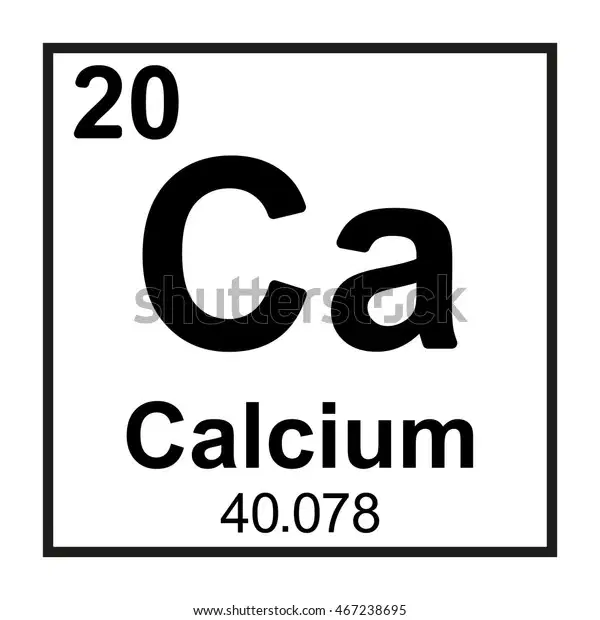
The whole number at the top, represents the number of protons, as well as the number of electrons in a balanced atom.
This number is called the atomic number.
10
Multiple Choice
How many protons does helium have?
2
4
0.003
2.003
11
Multiple Choice
How many electrons does helium have?
2
4
0.003
2.003
12
Multiple Choice
How many protons does calcium have?
40
60
20
none
13
Multiple Choice
How many electrons does calcium have?
40
60
20
none
14
The atomic mass is a decimal.
To find the neutrons of an atom, round the decimal to the nearest whole number and subtract the atomic number.
Rounded atomic mass-atomic number=neutrons
15
Multiple Choice
16
Multiple Choice
How many neutrons does Lithium have?
3
3.94
6.94
4
17
Multiple Choice
How many neutrons does Oxygen have?
8
7.599
15.599
.599
18
Multiple Choice
How many neutrons are in Magnesium?
36
12
24
6
19
20
21
22
23
Multiple Choice
Which element has the smaller atomic radius: potassium (K) or bromine (Br)?
potassium (K)
bromine (Br)
24
Multiple Choice
Which element has the greatest ionization energy: Aluminum (Al) or Chlorine (Cl)?
Aluminum (Al)
Chlorine (Cl)
25
Multiple Choice
Which element has the greatest electronegativity: Nitrogen (N) or Arsenic (As)?
Nitrogen (N)
Arsenic (As)
26
Multiple Choice
As you move down a group, atomic radius increases because -
you add more and more neutrons
you add more and more protons
you add more and more shells (energy levels)
you add more atomic mass
27
Multiple Choice
As you move across the periodic table from left to right, the atomic radius decreases. This is because -
the number of protons increases, so attraction to electrons increases
the number of energy levels increases
the number of electrons increases
the atomic mass increases
28
Multiple Choice
Francium (Fr) has the lowest ionization energy in Group 1 because -
it has the smallest number of valence electrons
it has the greatest atomic mass
it has the greatest number of protons, so it attracts its electrons the strongest
its 1 valence electron is very far from the nucleus, so little energy is needed to remove it
29
Bohr Models
30
Multiple Choice
What is a Bohr Model?
a simplified representation of an atom
vertical column in periodic table
horizontal row in periodic table
Only shows the element symbol and it's outer most electron shell
31
32
Multiple Choice
What is the atomic number of this element?
17
18
35
35.453
33
34
35
Multiple Choice
This is the location of electrons in an atom.
nucleus
protons
orbitals
neutrons
36
Multiple Choice
What is a valence electron?
37
Multiple Choice
How many valence electrons?
5
6
7
8
38
Multiple Choice
Which row (period) of the Periodic Table must this element come from?
1
2
3
4
39
40
41
Multiple Choice
How many electrons can go in the second shell (energy) level of a Bohr diagram?
1
2
8
9
42
Multiple Choice
How many electrons can fit on the 1st energy level (orbital) for any Bohr Model?
2
6
8
10
43
Multiple Choice
How many valence (outer) electrons does Chlorine have?
7
8
2
3
44
Multiple Choice
Which is the correct Bohr Diagram for Lithium?
45
Multiple Choice
Which Bohr model represents Be?
46
47
What are Lewis Dot Structures? What can they tell us?
How many BONDS an atom can make
How many VALENCE ELECTRONS an atom has
48
Multiple Choice
Recap: What are Valence Electrons?
Inner most electrons
Outer most electrons
Electrons that only form bonds
49
Valence Electrons
Are the outer most electrons of an atom
They are usually represented by what group an atom is in
50
Groups
Groups go UP AND DOWN. There are 18 groups total on the periodic table. Groups have names known as families
51
What do group numbers tell us?
Each group number tells us the number of valence electrons, which tell us the Lewis Dot Structure of an atom
52
Multiple Choice
You can use the _______ to tell you information about the atom's Lewis Dot Structure
Group number
Period number
Name
53
Multiple Choice
Which structure belongs to group 14?
54
Multiple Choice
This could be the dot diagram of
Mg
Cl
C
O
55
Multiple Choice
56
Multiple Choice
This is a correct dot diagram for oxygen (O)?
true
false
57
Nuclear Chemistry
When we name an isotope we use its element name and its atomic mass
Examples: Oxygen-16, Oxygen-17 and Oxygen 18
58
In isotopes, the number of neutrons changes. You need to subtract the atomic number, from the atomic mass. 17-8=9 neutrons
Neutrons
the number of protons and electrons are the same from the periodic table. 8 protons, and 8 electrons.
Protons and electrons
Oxygen-17
59
Multiple Choice
How many protons and electrons are in Oxygen-17 and Oxygen-18
8 electrons and 8 protons
17 electrons and 17 protons
8 protons and 17 electrons
impossible to tell.
60
Multiple Choice
How many neutrons are in Oxygen-18
8
10
18
9
61
Multiple Choice
In terms of neutrons, why does Carbon-14 have a larger mass than Carbon-13
Carbon 14 has 8 neutrons and Carbon-13 has 7
They don't have a difference in mass
Carbon 14 and Carbon 13 have the same number of neutrons
Carbon 14 has more protons.
62
Multiple Choice
The process of combining the nuclei of atoms to make different atoms is called _________?
Fission
Nuclear Reaction
Fusion
Particle Accelerator
63
Multiple Choice
Breaking up the nucleus of an atom is called _________?
Fusion
Nuclear Reaction
Fission
Particle Accelerator
64
Multiple Select
Which of the following correctly display nuclear fusion?
65
Multiple Choice
66
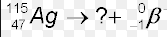
Find the Missing Product to Balance Nuclear Equations
67
68
Do not use the mass on the periodic table
Use the periodic table to find the missing product
Use the mass number given -
Am - 241
69
General Rule: Subtract the numbers on the right side of the equation from thenumbers on the left side of the equation
70
71
Multiple Choice
Complete the nuclear reaction
2760Co --> ___ + -10e
2556Mn
2860Ni
2358V
2759Co
72
Multiple Choice
20985At = ___ + 42He
73
Multiple Choice
94Be + 11H → _____ + 42He
74
Starts with 1 neutron and ends with 3. Breaks up a larger, heavier nucleus into 2 or more lighter ones.
Fission
Always takes two light elements and makes a heavier one.
Fusion
Fission vs. Fusion
75
Multiple Choice
76
Multiple Choice
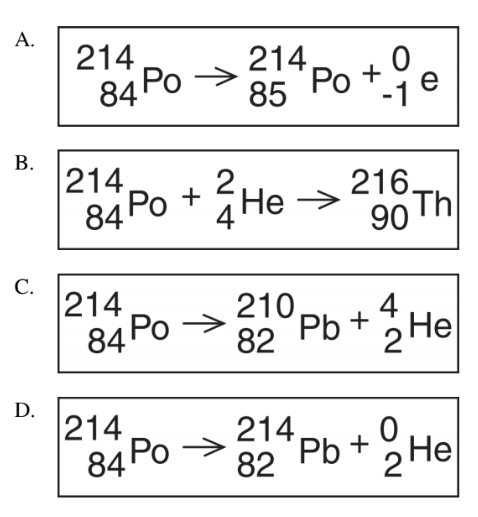
Which equation correctly represents the alpha decay of polonium-214?
A
B
C
D
77
Multiple Choice
614C = ___ + -10e
410Be
714N
714Si
613C
514B
78
Half Life and Half Life Calculations
• Half Life- time it takes for half
of the radioactive sample to
decay.
– Ranges from a fraction of a
second to billions of years
79
Multiple Choice
Using the graph, determine the half life of the isotope.
50
35
4
40
80
Calculate the number of 1/2 lives past.
Make a chart
Calculating remaining isotope
81
Multiple Choice
What is a half life?
A slightly boring life
The amount of time it takes for 1/2 of a radioactive isotope to decay
A period of time when one is not productive
A state of being in between two different stages
Parts of the atom
Show answer
Auto Play
Slide 1 / 81
SLIDE

Similar Resources on Wayground
75 questions
Exponent Properties
Presentation
•
8th - 9th Grade
74 questions
Y10 Lesson 1.5 Forces in Motion
Presentation
•
9th Grade
75 questions
Egalitarianism & Solidarity in the Paleolithic Age
Presentation
•
8th Grade
78 questions
F3 Module Unit 5 Can industrial development be more sustainable?
Presentation
•
9th Grade
79 questions
Living Things in the Biosphere
Presentation
•
9th Grade
78 questions
SS8H5a Causes of the Civil War
Presentation
•
8th Grade
79 questions
Ecology
Presentation
•
9th Grade
75 questions
Rock Identification
Presentation
•
8th Grade
Popular Resources on Wayground
28 questions
US History Regents Review
Quiz
•
11th Grade
36 questions
Biology Regents Review
Quiz
•
9th - 10th Grade
20 questions
Math Review
Quiz
•
3rd Grade
38 questions
Regents Life Science General Review
Quiz
•
9th Grade
20 questions
Math Review
Quiz
•
6th Grade
21 questions
EOY Grade 6 Benchmark Assessment - Content Skills
Quiz
•
6th Grade
20 questions
Inferences
Quiz
•
4th Grade
20 questions
Figurative Language Review
Quiz
•
6th Grade
Discover more resources for Science
38 questions
Regents Life Science General Review
Quiz
•
9th Grade
45 questions
Earth and Space Science Regents: Exam Cram
Presentation
•
7th - 12th Grade
20 questions
Explore Human Impact on Climate and Sustainability
Quiz
•
9th - 12th Grade
135 questions
Biology Final Review.
Quiz
•
9th Grade
23 questions
Explore Adaptations and Natural Selection
Quiz
•
9th - 12th Grade
23 questions
2024 2nd semester 1/3
Quiz
•
9th Grade
23 questions
2024 2nd semester 2/3
Quiz
•
9th Grade
50 questions
Earth Science Regents Review 819
Quiz
•
9th Grade