

NCCER Module 26112-23 PT12

Presentation
•
Engineering
•
11th Grade
•
Practice Problem
•
Hard

Kevon Kirton
Used 1+ times
FREE Resource
39 Slides • 0 Questions
1


Electrical
Module 26112-23
Electrical Test Equipment
Copyright © 2024 by NCCER, Alachua, FL 32615. Published by Pearson. All rights reserved.
2

1.0.0 Identifying Meters
3

Module 26112-23 – Electrical Test Equipment
Objective
1. Identify different kinds of electrical test equipment.
a. Identify the applications of a voltmeter.
b. Identify the applications of an ohmmeter.
c. Identify the applications of a clamp-on meter.
d. Identify the applications of other meters.
4

Module 26112-23 – Electrical Test Equipment
Performance Tasks
There are no Performance Tasks associated with this section.
5


Module 26112-23 – Electrical Test Equipment
1.0.0–1.1.1 Identifying Meters (1 of 2)
•
Analog meters use the D’Arsonval meter
movement to make measurements.
–
It’s good for measuring momentary
fluctuations.
•
Digital meters use solid-state digital
components.
–
They are easier to read than analog
meters.
6


Module 26112-23 – Electrical Test Equipment
1.0.0–1.1.1 Identifying Meters (2 of 2)
•
Voltmeters measure the exact voltage.
•
Many digital voltmeters are autoranging.
–
This means the meter will automatically
search for the correct scale.
•
If not autoranging, always start with the
highest voltage range.
•
Voltage testers determine if there is voltage
present and the general range.
–
They are also used for live-dead-live
testing.
7

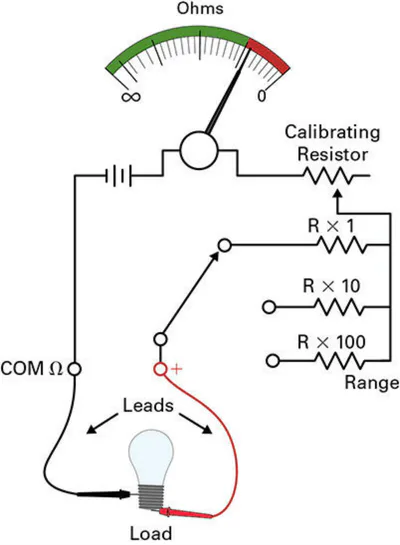
Module 26112-23 – Electrical Test Equipment
1.2.0 Ohmmeter
•
Ohmmeters are used to measure
resistance.
•
Be sure to adjust the meter to read
zero before each measurement.
WARNING!
Verify both sides of the circuit are de-
energized before using an ohmmeter
to take a reading.
8


Module 26112-23 – Electrical Test Equipment
1.3.0 Ammeter
A clamp-on ammeter measures
current without touching uninsulated
wires.
•
It detects the electromagnetic
field around the wires.
WARNING!
Never use a clamp-on ammeter
unless you are trained and using
the proper PPE.
9


Module 26112-23 – Electrical Test Equipment
1.4.0 Multimeter
The multimeter combines the
functions of a voltmeter, ohmmeter,
and an ammeter.
•
Also known as a volt-ohm-
multimeter (VOM).
WARNING!
Before using a multimeter, check it
with a proving unit or known source
of electricity.
10


Module 26112-23 – Electrical Test Equipment
1.5.0–1.5.1 Megohmmeter
•
Megohmmeters are used
to measure high levels of
resistance.
•
Always read and follow
instructions and all safety
precautions to ensure safe
use.
11


Module 26112-23 – Electrical Test Equipment
1.5.2 Motor and Phase Sequence Indicators
The legs of a motor must be matched
to the phases of the circuit to ensure
the motor rotates in the correct
direction.
•
A motor rotation meter is used
to identify the motor legs.
•
A phase sequence indicator is
used to identify the circuit
phases.
12


Module 26112-23 – Electrical Test Equipment
1.5.3 Circuit Tester
A circuit tester can be used to verify
the condition of a grounded circuit.
13


Module 26112-23 – Electrical Test Equipment
1.5.4 Irradiance Meter
Irradiance meters are used when
installing and testing solar
photovoltaic systems.
•
They measure solar radiation
energy over a period of time.
14


Module 26112-23 – Electrical Test Equipment
1.5.5–1.5.6 Remote Readout Meters
•
Recording instruments create a permanent record of measured quantities
over a period of time.
•
Remote readout meters allow readings to be taken at a safe distance.
15

Module 26112-23 – Electrical Test Equipment
Trade Terms
Coil: Numbers of turns in wire, especially in spiral form. It is used for
electromagnetic effects or for providing electrical resistance.
Continuity: A complete (unbroken) circuit that can conduct current. This is
also called a closed circuit.
D’Arsonval meter movement: A meter movement that uses a permanent
magnet and moving-coil arrangement to move a pointer across a scale.
Frequency: The number of cycles completed each second by a specific AC
voltage. Frequency is usually expressed in hertz. One hertz equals one cycle
per second (cps).
16

Module 26112-23 – Electrical Test Equipment
1.0.0 Section Review Question 1
1. A voltmeter is used to measure the value of a circuit’s _____.
a. electromagnetic field
b. resistance
c. electromotive force
d. current
17

Module 26112-23 – Electrical Test Equipment
1.0.0 Section Review Question 1 Answer
1. A voltmeter is used to measure the value of a circuit’s _____.
a. electromagnetic field
b. resistance
c. electromotive force
d. current
18

Module 26112-23 – Electrical Test Equipment
1.0.0 Section Review Question 2
2. A closed circuit is indicated by an ohmmeter reading of _____.
a. zero
b. infinity
c. ERR
d. ten
19

Module 26112-23 – Electrical Test Equipment
1.0.0 Section Review Question 2 Answer
2. A closed circuit is indicated by an ohmmeter reading of _____.
a. zero
b. infinity
c. ERR
d. ten
20

Module 26112-23 – Electrical Test Equipment
1.0.0 Section Review Question 3
3. A meter that can take measurements without touching uninsulated wire is
a(n) _____.
a. clamp-on ammeter
b. megohmmeter
c. motor rotation tester
d. ohmmeter
21

Module 26112-23 – Electrical Test Equipment
1.0.0 Section Review Question 3 Answer
3. A meter that can take measurements without touching uninsulated wire is
a(n) _____.
a. clamp-on ammeter
b. megohmmeter
c. motor rotation tester
d. ohmmeter
22

Module 26112-23 – Electrical Test Equipment
1.0.0 Section Review Question 4
4. Current measurements in milliamps are typically read using a(n) _____.
a. clamp-on ammeter
b. VOM
c. megohmmeter
d. insulation resistance tester
23

Module 26112-23 – Electrical Test Equipment
1.0.0 Section Review Question 4 Answer
4. Current measurements in milliamps are typically read using a(n) _____.
a. clamp-on ammeter
b. VOM
c. megohmmeter
d. insulation resistance tester
24

Module 26112-23 – Electrical Test Equipment
1.0.0 Section Review Question 5
5. An expected resistance of 1,000,000Ω would be measured using a _____.
a. recording instrument
b. clamp-on ammeter
c. multimeter
d. megohmmeter
25

Module 26112-23 – Electrical Test Equipment
1.0.0 Section Review Question 5 Answer
5. An expected resistance of 1,000,000Ω would be measured using a _____.
a. recording instrument
b. clamp-on ammeter
c. multimeter
d. megohmmeter
26

Next…
2.0.0
Category Ratings and Safety Requirements
Read Sections 2.0.0 through 2.2.0. Complete the 2.0.0 Section
Review.
27


Electrical
Module 26112-23
Electrical Test Equipment
Copyright © 2024 by NCCER, Alachua, FL 32615. Published by Pearson. All rights reserved.
28

2.0.0 Category Ratings and Safety Requirements
29

Module 26112-23 – Electrical Test Equipment
Objective
2. Identify meter category ratings and safety requirements.
a. Describe how to select a meter with the correct category rating for an
application.
b. Identify electrical test equipment safety hazards.
30

Module 26112-23 – Electrical Test Equipment
Performance Tasks
1. Measure the voltage in the classroom from line to neutral and line to
ground.
2. Use an ohmmeter to measure the value of various resistors.
31


Module 26112-23 – Electrical Test Equipment
2.0.0–2.1.1 Category Safety Rating for Meters
•
CAT I — Protected electronic
equipment and circuitry
•
CAT II — Single-phase
receptacle-connected loads
•
CAT III — Three-phase
distribution
•
CAT IV — Three-phase power at
the meter, outdoor conductors,
electricity meters, and service
entrances
32


Module 26112-23 – Electrical Test Equipment
2.1.2–2.1.3 Understanding Meter Calibration
Requirements
•
Choose a meter rated for the highest category
you will be working in.
–
Use meters that are independently tested and
certified by UL Solutions, CSA, or another
recognized testing organization.
•
Calibrate all meters by following the
manufacturer’s instructions.
–
ANSI requires that all field and lab instruments
be calibrated at least once per year.
33

Module 26112-23 – Electrical Test Equipment
2.2.0 Electrical Test Equipment Safety Hazards
Often, accidents could have been prevented if safety rules were followed.
Therefore, you should:
•
Always turn off power inputs and perform proper LOTO procedures.
•
Use a voltage tester to ensure equipment is safe.
•
Remember 120V is not a harmless voltage and has caused more
deaths than any other.
•
Thoroughly inspect all test equipment each time you use it.
•
Never shortcut safety!
34

Module 26112-23 – Electrical Test Equipment
Trade Terms
Backfeed: The reverse flow of electrical power in a distribution system.
Backfeed is caused by power induced into the system from outside sources,
such as when using a generator during outages or when using a solar
photovoltaic (PV) system. Backfeeds can also be caused by equipment
overloads.
Voltage transient: A temporary, unwanted voltage in an electrical circuit that
ranges from a few volts to several thousand volts and lasts microseconds up
to a few milliseconds.
35

Module 26112-23 – Electrical Test Equipment
2.0.0 Section Review Question 1
1. Which category rating poses a greater risk to the electrician’s safety?
a. CAT I
b. CAT II
c. CAT III
d. CAT IV
36

Module 26112-23 – Electrical Test Equipment
2.0.0 Section Review Question 1 Answer
1. Which category rating poses a greater risk to the electrician’s safety?
a. CAT I
b. CAT II
c. CAT III
d. CAT IV
37

Module 26112-23 – Electrical Test Equipment
2.0.0 Section Review Question 2
2. Which of the following is true about meter safety?
a. 120V power is relatively harmless.
b. All test leads have the same category rating.
c. When you test circuits, test at the lowest ranges first, then work your
way up.
d. Carefully inspect all test equipment before use.
38

Module 26112-23 – Electrical Test Equipment
2.0.0 Section Review Question 2 Answer
2. Which of the following is true about meter safety?
a. 120V power is relatively harmless.
b. All test leads have the same category rating.
c. When you test circuits, test at the lowest ranges first, then work your
way up.
d. Carefully inspect all test equipment before use.
39

Next…
Review for Module Testing
Complete the Review Questions at the end of the module and prepare
for the Module Test.
Electrical
Module 26112-23
Electrical Test Equipment
Copyright © 2024 by NCCER, Alachua, FL 32615. Published by Pearson. All rights reserved.
Show answer
Auto Play
Slide 1 / 39
SLIDE
Similar Resources on Wayground

35 questions
Properties of a Well-Written Text
Presentation
•
11th - 12th Grade
35 questions
History of the Atom
Presentation
•
10th - 12th Grade
34 questions
SAT Math Prep Calculator 16 Questions Part 1
Presentation
•
11th - 12th Grade
35 questions
Sustainable Development Goal - UNESCO (SDG1 to 5)
Presentation
•
11th Grade
33 questions
Caída Libre
Presentation
•
11th Grade
34 questions
6.1 Stoichiometry Pt.1 Practice
Presentation
•
10th Grade
36 questions
Remediation 3.2 CFA Exponential Graphs
Presentation
•
11th Grade
34 questions
SISTEM GERAK MANUSIA
Presentation
•
11th Grade
Popular Resources on Wayground
10 questions
Safety Day 2026 – Student Review

Quiz
•
9th Grade
21 questions
Continents and Oceans
Quiz
•
6th Grade
20 questions
Parts of Speech
Quiz
•
5th Grade
16 questions
Subject & Predicate
Quiz
•
5th Grade
25 questions
Multiplication Facts
Quiz
•
5th Grade
12 questions
Map Skills
Quiz
•
3rd Grade
22 questions
Continents and Oceans
Quiz
•
5th Grade
15 questions
Rounding Decimals
Quiz
•
5th Grade
Discover more resources for Engineering
26 questions
SLIME!!!!!
Quiz
•
KG - 12th Grade
20 questions
Cell Transport
Quiz
•
9th - 12th Grade
20 questions
Budgeting
Quiz
•
9th - 12th Grade
20 questions
Investing
Quiz
•
9th - 12th Grade
8 questions
DNA vs. RNA
Presentation
•
9th - 12th Grade
12 questions
Identify Rigid Transformations
Quiz
•
8th - 12th Grade
10 questions
Complementary, Supplementary, Vertical, and Linear Pairs
Quiz
•
9th - 12th Grade
20 questions
Managing Credit
Quiz
•
9th - 12th Grade