
The Theory of Plate Tectonics
Presentation
•
Science
•
6th - 8th Grade
•
Hard

Joseph Anderson
FREE Resource
7 Slides • 10 Questions
1
Theory of Plate Tectonics
2
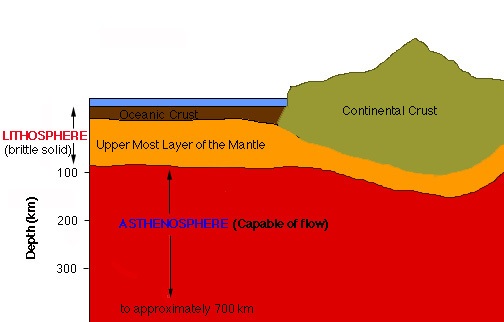
The lithosphere is broken into Tectonic Plates
The lithosphere is made from the crust and the uppermost part of the mantle
The lithosphere is rigid, brittle rock
These plates float on the asthenosphere
3
4
Pangea
The super continent that Alfred Wegener described in his theory of Continental Drift
5
How do the plates ACTUALLY MOVE?
Convection currents in the asthenosphere drive the movement of lithospheric plates
6
7
How does a convection cell occur?
Hot magma in the asthenosphere begins to rise, similar to the way hot air rises.
As it rises to the top of the asthenosphere, it cools and becomes more dense.
This cooler, dense magma then sinks again. As it sinks, it gets warmer, until the process begins again
This movement of magma is what drives the plates to move.
8
Multiple Choice
Tectonic plates consist of
continental crust
mesospheric crust
both continental and oceanic crust
oceanic crust
9
Multiple Choice
The idea that the continents were once part of a single landmass that broke apart and
moved is
Continental Drift
Tectonic Plates
Transform
10
Multiple Choice
The region where two lithospheric plates meet
Continental Drift
Plate tectonics
Plate Boundaries
11
Multiple Choice
The scientist who developed the big idea called "sea-floor spreading"
Alfred Wedgener
Harry Hess
Edward Dutton
Ortelius
12
Multiple Choice
Pangaea was an ancient supercontinent made up of...
America, Greenland, and Europe
Antarctica, India, and America
all of Earth’s continents
South Africa, India, Australia, and South America
13
Multiple Choice
Why did no one believe Wegener's thoery that the continents were once together?
He could not explain HOW the continents moved
He didn't have evidence
His data was wrong
He didn't use the right technology to gather data
14
Multiple Choice
The movement of the tectonic plates is caused by
the rotation of the Earth
convection currents in the Asthenosphere
the gravity of the iron-nickel core
the Moho discontinuity
15
Multiple Choice
Which layer of the Earth consists of tectonic plates?
asthenosphere
mantle
mesosphere
lithosphere
16
Multiple Choice
Tectonic plates “float” on
the lithosphere
the mantle
the ocean
the asthenosphere
17
Multiple Choice
The fact that similar fossils are found on both sides of the ocean is evidence of
magnetic reversal
global positioning
continental drift
oceanic drift
Theory of Plate Tectonics
Show answer
Auto Play
Slide 1 / 17
SLIDE

Similar Resources on Wayground
11 questions
PHYSICAL AND CHEMICAL PROPERTIES
Presentation
•
6th - 8th Grade
13 questions
Water Cycle
Presentation
•
6th - 8th Grade
14 questions
Kinetic Energy
Presentation
•
6th - 8th Grade
14 questions
classification- Kingdoms (we do)
Presentation
•
6th - 8th Grade
11 questions
Animal Behavior | Learn about innate behavior, learned behav
Presentation
•
6th - 8th Grade
15 questions
Repetition vs Replication
Presentation
•
6th - 8th Grade
13 questions
Ilmu Pengetahuan Alam
Presentation
•
KG
13 questions
Mechanical Advantage Basics
Presentation
•
6th - 8th Grade
Popular Resources on Wayground
6 questions
Secondary Safety Quiz
Presentation
•
9th - 12th Grade
10 questions
MyPath Diagnostic Overview
Presentation
•
6th - 8th Grade
20 questions
Lab Safety Quiz
Quiz
•
6th Grade
21 questions
Continents and Oceans
Quiz
•
6th Grade
20 questions
Adding and Subtracting Decimals
Quiz
•
5th Grade
20 questions
Parts of Speech
Quiz
•
5th Grade
16 questions
Subject & Predicate
Quiz
•
5th Grade
21 questions
Lab Safety
Quiz
•
10th Grade
Discover more resources for Science
20 questions
Lab Safety Quiz
Quiz
•
6th Grade
10 questions
Lab Safety
Quiz
•
8th Grade
20 questions
💯4. Quiz: Safety in the Science Lab
Quiz
•
7th Grade
20 questions
Lab Safety
Quiz
•
5th - 8th Grade
10 questions
Independent vs. Dependent Variable Practice
Quiz
•
6th Grade
10 questions
Lab Safety Essentials
Interactive video
•
6th - 10th Grade
20 questions
Scientific Method and Variables
Quiz
•
8th Grade
20 questions
Scientific method and variables
Quiz
•
8th Grade