
Search Header Logo
Molecular Structures

Molecular Structures

Assessment

Presentation

Chemistry

10th - 12th Grade

Hard

Created by

Joseph Anderson

FREE Resource

10 Slides • 4 Questions

1

Giant Molecular Structures

Cambridge AS Level Chemistry
Slide image

2

Giant Molecular Structures

  • Some covalently bonded structures have a three dimensional network of covalent bonds that called giant molecular structures or giant covalent structures.

  • They have high melting and boiling points because of the large number of strong covalent bonds linking the whole structure.

3


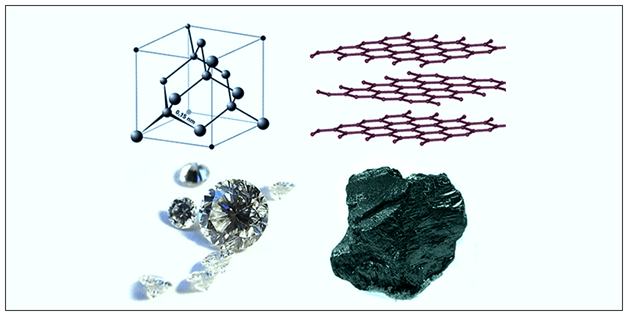
  • Giant molecular structures can be elements (e.g. graphite and diamond), and can be a compound, such as silicon oxide.

  • Diamond and graphite are different forms of the same element. Different crystalline or molecular forms of the same element are called allotropes.
Slide image

4

Multiple Choice

Question image

Define the term allotropes

1

Atoms with same proton number but different number of neutrons

2

Atoms with same proton number but different mass number

3

Atoms in different arrangement in structure

4

Atoms in different arrangement and different physical form

5

Graphite

  • In graphite, the carbon atoms are arranged in planar layers. Within the layers, the carbon atoms are arranged in hexagons. Each carbon atom is joined to three other carbon atoms by strong covalent bonds.

  • The fourth electron of each carbon atom occupies a p orbital. These p orbitals overlap sideways. A cloud of delocalised electrons is formed above and below the plane of the carbon rings.

  • The layers of carbon atoms are kept next to each other by weak van der Waals forces.

Slide image

6

Physical properties of graphite

  • High melting and boiling points: there is strong covalent bonding throughout the layers of carbon atoms. A lot of energy is needed to overcome these strong bonds.

  • Softness: graphite is easily scratched. The forces between the layers are weak. The layers of graphite can slide over each other when force is applied. The layers readily flakes off. This is why graphite is used in 'pencil leads' and feels slippery.

  • Good conductor and electricity: when a voltage is applied, the delocalised electrons (mobile electrons) can move along the layers.

7

Open Ended

Why graphite can conduct electricity?

8

Diamond

In diamond, each carbon atom forms four covalent bonds with other carbon atoms. The carbon atoms are tetrahedrally arranged around each other. The network of carbon atoms extends almost unbroken throughout the whole structure. The regular arrangement of the atoms gives diamond a crystalline structure.

Slide image

9

Physical properties of diamond

  • High melting and boiling points: there is strong covalent bonding throughout the whole structure. A lot of energy is needed to break these bonds and separate the atoms.

  • Hardness: diamond cannot be scratched easily because it is difficult to break the three-dimensional network of strong covalent bonds.

  • Does not conduct electricity or heat: each of the four outer electrons on every carbon atom is involved in covalent bonding. This means that there are no free electrons available to carry the electric current.

10

Multiple Choice

Which answer shows the correct number of C-C covalent bonds in its allotropes?

1

Diamond 3, Graphite 3

2

Diamond 4, Graphite 3

3

Diamond 3, Graphite 4

4

Diamond 4, Graphite 4

11

Silicon (IV) oxide, SiO2

There are several forms of silicon (IV) oxide. The silicon (IV) oxide found in mineral quartz has a structure similar to diamond.

Slide image

12

The structure of SiO2

Each silicon atom is bonded to four oxygen atoms but each oxygen atom is bonded to only two silicon atoms. So the formula for silicon (IV) oxide is SiO2.

Slide image

13

Physical properties of silicon (IV) oxide

Silicon dioxide has properties similar to that of diamond. It forms hard, colourless crystals with high melting and boiling points and it does not conduct electricity.


Sand is largely silicon (IV) oxide.

14

Multiple Choice

Silicon (IV) oxide has properties that similar to graphite.

1

TRUE

2

FALSE

Giant Molecular Structures

Cambridge AS Level Chemistry

Slide image

Show answer

Auto Play

Slide 1 / 14

SLIDE

