Search Header Logo
Newton's Three Laws of Motion

Newton's Three Laws of Motion

Assessment

Presentation

Physics

9th - 12th Grade

Hard

Created by

Joseph Anderson

FREE Resource

13 Slides • 33 Questions

1

Isaac Newton's Three Laws of Motion

2

INERTIA

3

4

Multiple Choice

According to the video, what is the first rule of physics regarding objects at rest?

1

   They will eventually move on their own.

2

They want to stay where they are unless acted upon by a force.

3

They have no effect on their surroundings.

5

Multiple Choice

What does the term "laziness" refer to in the context of the video?

1

The tendency of objects to stop moving.

2

  The effort required to change an object's state of motion.

3

   The unwillingness of objects to move.

6

Multiple Choice

What happens to a pebble when it is kicked in outer space, according to the video?

1

   It will stop moving immediately.

2

It will keep moving forever unless acted upon by another force.


3

It will start moving and then slow down.

7

Multiple Choice

Why do objects tend to resist changes in their state of motion?

1

  Because they are heavy.

2

Because they are made of solid materials.

3

   Because they have inertia.

8

Multiple Choice

What is the Latin term for "laziness" that physicists use, as mentioned in the video?

1

Inertia

2

Motus

3

Ta Ina

9

Multiple Choice

What is the first rule of physics is suggested in the video?

1

   Objects at rest will eventually move.

2

Objects want to keep doing what they are already doing.

3

Objects in motion will always stop eventually.

10

11

Newton's First Law of Motion
(Law of Inertia)

12

13

Multiple Choice

What does Newton's First Law of Motion primarily state?

1

   An object in motion will stay in motion unless acted upon by a balanced force.

2

   An object at rest will remain at rest unless acted upon by an unbalanced force.


3

 An object in motion will eventually come to a stop.

14

Multiple Choice

Which term is often used interchangeably with Newton's First Law of Motion?

1

   Law of Action

2

   Law of Energy

3

   Law of Inertia

15

Multiple Choice

What is an example of an object in motion?

1

   A book on a desk.

2

   A ball being thrown in a game of catch.

3

   -A car parked in a garage.

16

Multiple Choice

Which of the following factors increases an object's inertia?

1

   Decreasing its mass.

2

   Changing its shape.

3

  Increasing its mass.

17

Multiple Choice

What is the main difference between an object at rest and an object in motion according to Newton's First Law?

1

An object at rest will eventually move, while an object in motion will stop.

2

    An object at rest requires an unbalanced force to move, while an object in motion requires a balanced force to stop.

3

    Both require a unbalanced force to change their state.

18

Multiple Choice

In the context of Newton's First Law, what is an "unbalanced force"?

1

    A force that does not change the motion of an object.

2

    A force that causes a change in the motion of an object.

3

    A force that is equal to another force.

19

20

Newton's Second Law of Motion

Force, Mass and Acceleraton

21

22

Multiple Choice

What does Newton's second law of motion describe?

1

  The relationship between mass and weight.

2

   The relationship between force, mass, and acceleration.

3

   The effects of gravity on falling objects.

23

Multiple Choice

In the equation F = m × a, what does the "F" represent?

1

Friction

2

 Force

3

   Frequency

24

Multiple Choice

If an object has a larger mass, what can be inferred about the force needed to accelerate it?

1

   Less force is needed

2

   The same amount of force is needed

3

   More force is needed

25

Multiple Choice

Which of the following scenarios best illustrates the concept of acceleration?

1

   A car moving at a constant speed

2

   A ball rolling down a hill

3

A person pushing a stationary car to make it move

26

Multiple Choice

If two objects are pushed with the same force, but one object has a greater mass, what will happen to the acceleration of each object?

1

   Both will accelerate equally

2

   The object with greater mass will accelerate moreT

3

  The object with greater mass will accelerate less

27

28

Multiple Choice

Question image

A 20 kg bike accelerates at 10 m/s2. What was the force?

1

25 Newtons

2

20 Newtons

3

200 Newtons

29

Multiple Choice

Question image

A 50-kg crate is pushed with a horizontal acceleration of 20 m/s2. What net force is acting on the crate?

1

2.5 N

2

0.4 N

3

1000 N

30

Multiple Choice

Question image

The mass of a wagon is 40 kg. The wagon accelerates at 8 m/s2 . What is the force?

1

38.25 Kg

2

320N

3

5N

4

3.825Kg

31

Multiple Choice

Question image

A cat has a mass of 200 kg and accelerates at 3 m/s2 to catch a mouse. How much force would be needed to stop the cat?

1

300 N

2

500 N

3

600 N

32

Newton's Third Law of Motion
Action-Reaction Pairs

33

34

Multiple Choice

What does Newton's third law of motion state?

1

  An object at rest stays at rest.  

2

For every action, there is an equal and opposite reaction.  

3

The force of gravity acts on all objects. 

35

Multiple Choice

In the context of Newton's third law, what happens when a rocket fires its engines?

1

The rocket moves upward while the exhaust moves downward.  

2

Both the rocket and exhaust move upward.  

3

The rocket stays still.

36

Multiple Choice

If a boxer punches a punching bag with a force of 50 pounds, what force does the punching bag exert back on the boxer?  

1

100 pounds

2

25 pounds

3

50 pounds

37

Multiple Choice

Which of the following scenarios best illustrates Newton's third law of motion in everyday life? 

1


A person sitting on a chair.  

2

A swimmer pushing off the wall of a pool.  

3

A book falling off a table. 

38

Summary

39

Multiple Choice

Question image
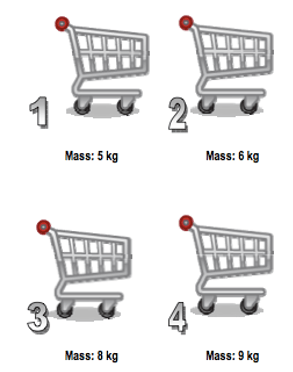
A force of 90N is applied to each cart below, which one will accelerate the fastest?
1
Cart 1
2
Cart 2
3
Cart 3 
4
Cart 4

40

Multiple Choice

Which of the following best describes Newton's 1st law?
1
Objects keep doing what they are doing unless a force is applied
2
Objects react to outside forces
3
Unbalanced forces on an object keep it at rest

41

Match

Match Newton's Laws with their definitions.

Newton's First Law

Newton's Second Law

Newton's Third Law

Law of Inertia

F = m x a

Action/Reaction

42

Dropdown

If a golf ball is accelerated at the same rate as a bowling ball, the ​
ball would be harder to stop due to it's larger ​
.​

43

Multiple Choice

True or False.  An increase in mass will result in an increase in the acceleration?
1
True
2
False

44

Multiple Choice

The larger the mass you have the _____ force you need to change its motion.
1
more
2
less

45

Multiple Choice

What is the equation for Newton's 2nd law?
1
a = bc
2
F = m/a
3
F = ma

46

Multiple Choice

Objects tendency to resist change
1
Friction
2
Inertia
3
Force

Isaac Newton's Three Laws of Motion

Show answer

Auto Play

Slide 1 / 46

SLIDE