
Chlorophyll

Presentation
•
Science
•
12th Grade
•
Hard

Joseph Anderson
FREE Resource
12 Slides • 18 Questions
1
KEY QUESTION: What role do pigments play in the process
of photosynthesis?
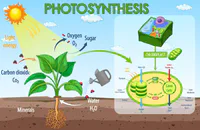
Our lives, and the lives of nearly every living thing on the surface of Earth, are made possible by the sun and the process of photosynthesis. In order for photosynthesis to occur, light energy from the sun must somehow be captured.
2
The sun’s energy travels to Earth in the form of light. Sunlight, which our eyes perceive as “white” light, is actually a mixture of different wavelengths. Our eyes see the different wavelengths of the visible spectrum as different colors: shades of red, orange, yellow, green, blue, indigo, and violet.
3
Light-absorbing compounds are known as pigments. Photosynthetic organisms primarily use the pigment chlorophyll to capture the energy in sunlight. The principal pigment of green plants is known as chlorophyll. Two types of chlorophyll, a and b, are found in plants, and are available to absorb different parts of the visible light spectrum, primarily blue-violet and red. Chlorophyll does not absorb the color green. Leaves appear green because they reflect these wavelengths. Plants also have red and orange carotene pigments, which we can only see when leaves begin to die during the fall.
4
The plant organelle known as a chloroplast is where photosynthesis takes place. Within chloroplasts are grana, which are stacks of thylakoids that contain chlorophyll. The rest of the fluid outside of this is called stroma. The number of chloroplasts per cell varies across different plants. Chloroplasts can sometimes move within plants, as well as duplicate themselves.
5
Multiple Choice
What role do pigments play in the process of photosynthesis?
6
Multiple Choice
What visible light does chlorophyll does not absorb?
This light is reflected, hence why plants have this color.
7
Multiple Choice
The main pigment of green plants is
8
Multiple Choice
What pigment is responsible for the red and orange color, which can be seen in the winter?
carotenoid (carotene)
9
Match
Match the following
Grana (granum)
Contains chlorophyll
Inner liquid of the chloroplast
Organelle for photosynthesis
Stacks of thylakoids
Thylakoids
Stroma
Chloroplast
Stacks of thylakoids
Thylakoids
Stroma
Chloroplast
10
Labeling
Label the chloroplast
Thylakoid
Stroma
Grana
11
The light energy collected by a cluster of pigments, including chlorophyll, is transferred to the reaction center in the center of the cluster where a particular chlorophyll molecule is excited and releases energized electrons. These high-energy electrons are vital to later steps of photosynthesis.
12
KEY QUESTION: What are electron carrier molecules?
Specific molecules called electron carriers are necessary to convey the highly reactive and high-energy electrons that are produced by chlorophyll. The electron carrier moves the electrons with their energy to other molecules where they are
needed. Nicotinamide adenine dinucleotide phosphate, or NADP+, is one such electron carrier. When it accepts two high-energy electrons, NADP+ also bonds a hydrogen ion, which turns it into NADPH. Now the captured energy can be moved to the location in the chloroplast where sugars are manufactured.
13
KEY QUESTION: What are the reactants and products of photosynthesis?
Photosynthesis uses the energy of sunlight to convert water and carbon dioxide (low-energy reactants) into high-energy sugars and oxygen (products).

14
The Light-dependent Reactions need sunlight. The sunlight energy is captured by pigments in the thylakoid membrane. The energy is used to convert ADP into ATP and NADP+ into NADPH. These sources of energy are important for other steps in photosynthesis. Also, water is split apart, which makes more electrons available, and produced oxygen (O2) and hydrogen ions (H+).
15

16
Multiple Choice
Where does the light dependant reaction take place?
17
Multiple Choice
What are the reactants (what is needed) of the light-dependent reaction of photosynthesis?
18
Multiple Choice
What are the products of the light-dependent reaction of photosynthesis?
ATP and NADPH (high energy molecules)
(oxygen as waste)
19
Multiple Choice
ADP is converted into what during the light-dependant reaction, and NADP+ is converted into what?
20
Multiple Choice
What is the primary goal of the light-dependent reaction of photosynthesis?
To convert light energy into chemical energy (high energy molecules)
21
The Light-independent Reactions (Calvin cycle) occur in the stroma and do not use sunlight. The energy in ATP and NADPH, produced in the light-dependent reactions, is used to “fix” carbon dioxide. That is, carbon dioxide (CO2) is combined with H+ to produce sugars, primarily glucose (C6H12O6).
The plant makes these sugars asfood for itself.
22

23
Multiple Choice
How is the light-independent reaction different from the light dependent reaction?
24
Multiple Choice
What is produced by the light-dependent reaction and used in the light-independent reaction to "fix" carbon dioxide into glucose?
25
Multiple Choice
What are the three reactants of the light-independent reaction?
26
Multiple Choice
What is the product of the light-independent reactions?
27
Labeling
Label the process of photosynthesis
Glucose (sugars)
Light
H20
O2
CO2
28
Multiple Choice
What are ATP and NADPH used for in photosynthesis?
29

30
Categorize
Occurs in Thylakoid
Occurs in Stroma
Requires light
Does not require light
Reactants: Water + Light / Products: Oxygen + NADPH + ATP
Reactants: CO2 + NADPH + ATP / Products: Sugars (Glucose)


Organize these options into the right categories
Determine the following as a light-dependent reaction or light-independent reaction.
KEY QUESTION: What role do pigments play in the process
of photosynthesis?
Our lives, and the lives of nearly every living thing on the surface of Earth, are made possible by the sun and the process of photosynthesis. In order for photosynthesis to occur, light energy from the sun must somehow be captured.
Show answer
Auto Play
Slide 1 / 30
SLIDE
Similar Resources on Wayground

25 questions
Newtons 3 laws
Presentation
•
KG - University
21 questions
Newton's First Law of Motion
Presentation
•
11th Grade
22 questions
快餐、中餐、早午晚餐、飲品
Presentation
•
12th Grade
23 questions
Renewable resources
Presentation
•
KG - University
25 questions
Articulations and Joints of the Body Notes
Presentation
•
12th Grade
23 questions
Solar System Review
Presentation
•
12th Grade
24 questions
Skeletal system: joints
Presentation
•
12th Grade
Popular Resources on Wayground
10 questions
How much do you know about our Portrait of an Eagle?

Quiz
•
10th Grade
10 questions
Fast Food Slogans
Quiz
•
6th - 8th Grade
21 questions
Continents and Oceans
Quiz
•
6th Grade
20 questions
Parts of Speech
Quiz
•
5th Grade
16 questions
Subject & Predicate
Quiz
•
5th Grade
25 questions
Multiplication Facts
Quiz
•
5th Grade
12 questions
Map Skills
Quiz
•
3rd Grade
22 questions
Continents and Oceans
Quiz
•
5th Grade
Discover more resources for Science
22 questions
Periodic Table Review
Quiz
•
9th - 12th Grade
7 questions
Newton's Laws Video Quiz

Interactive video
•
9th - 12th Grade
17 questions
Unit 3A: Cells Vocab
Quiz
•
9th - 12th Grade
89 questions
Unit 1 (Ch 2 & 3) Test Review - Water/Ocean Currents
Quiz
•
9th - 12th Grade
58 questions
Biomolecule Test Corrections
Quiz
•
9th - 12th Grade
20 questions
Unit 2: Cell Energy Review
Quiz
•
9th - 12th Grade
17 questions
Explore Newton's Laws of Motion
Quiz
•
8th - 12th Grade
35 questions
Directional Terms, Body Cavities, Body Planes
Quiz
•
11th - 12th Grade