
Comparing Poems, Plays, and Prose
Presentation
•
English
•
4th Grade
•
Hard

Joseph Anderson
FREE Resource
13 Slides • 16 Questions
1
Comparing Prose, Poetry, and Drama
2
3
Prose
Stories written in paragraphs
Written in complete sentences
Purpose: Persuade, inform, entertain
Dialogue in "quotations marks"
Series of events: beginning, middle, and end
Follows grammar rules
4
Poetry
Stories that are written as a verse
Purpose: express a mood or entertain
Written in lines and stanzas
Can have rhyme, rhythm, and meter
Doesn't follow grammar rules
Uses figurative language
5
Drama
Stories written as a script
Purpose: Express a mood or entertain
Meant to be performed
Has a cast of characters
Starts with a description and setting
Written in lines of dialogue (no "quotations marks")
Actions are written as stage directions
6
Read Angie's Solo
Then, answer the questions on the next slide.
7
Multiple Choice
What type of writing is this?
Drama
Prose
Poetry
8
Open Ended
What elements makes Angie's Solo a prose?
9
Read At the Concert
Then, answer the question on the next slide.
10
Multiple Choice
What type of writing is this?
Drama
Prose
Poetry
11
Open Ended
What elements makes At the Concert a poem?
12
Now, compare and contrast the elements of a prose and poem on the following slides.
Choose Prose, poem or both if the detail comes from them. Think about the elements of a prose and poem.
13
Multiple Choice
The night of his sister's solo (setting).
Poem
Prose
Both
14
Multiple Choice
Dialogue between two characters
Prose
Poem
Both
15
Multiple Choice
Rhyming words that help describe events
Prose
Poem
Both
16
Multiple Choice
Ideas grouped as stanzas
Prose
Poem
Both
17
Multiple Choice
Thoughts and feelings of the narrator.
Prose
Poem
Both
18
Multiple Choice
Ideas grouped as paragraphs.
Prose
Poem
Both
19
Let's practice some more!
20
Read the excert from Tuck Everlasting by Natalie Babbitt
Then, answer the following questions.
21
Multiple Choice
The sentences below are from paragraph 14 of the story.
She put her plate down carefully on the floor and stood up, straightening her skirts. Then she went to the kitchen and opened the door.
What element in the text of a play would most likely give this information to the reader?
cast of characters
setting
dialogue
stage directions
22
Multiple Choice
The setting is the time and place where the story happens. How does the reader know the setting in the story?
The author states the setting in the first paragraph.
The reader must infer the setting from clues in the text.
The author reveals the setting through the dialogue in paragraph 6.
The author doesn’t provide enough clues for the reader to know the setting.
23
Part 1: Read part 1 of the drama
24
Part 2: Read part 2 of the drama
25
Multiple Choice
Below is a line from the play of “Tuck Everlasting.”
JESSE: [looks at MILES] Oh? Where’s the fish, then? How come we got nothing but flapjacks?
What two features of a play does this line include?
cast of characters and stage directions
setting and dialogue
stage directions and dialogue
cast of characters and dialogue
26
Multiple Choice
Look at the table below. Which of the following correctly completes the table?
paragraphs, narration, and dialogue
cast of characters, paragraphs, and rhyme
stanzas, dialogue, and meter
verse, meter, and rhythm
27
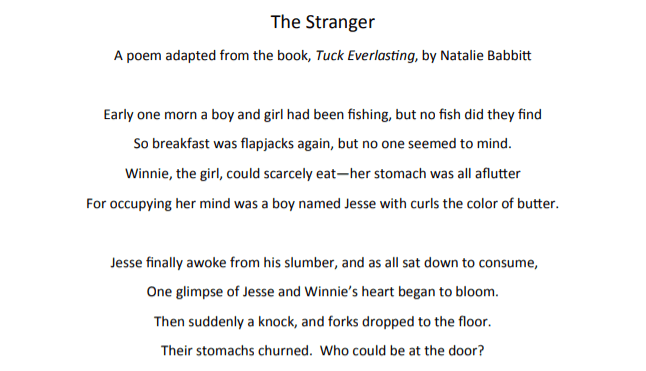
Read A poem adapted from the book, Tuck Everlasting, by Natalie Babbit
Then, answer the following questions
28
Multiple Choice
How does the mood of the poem change from the beginning to the end?
It changes from happiness to sadness.
It changes from anger to contentment.
It changes from calm to worry.
It changes from boredom to anger.
29
Multiple Choice
Look at the table. Which of the following completed the table?
stage directions, rhyme, and meter
narration, dialogue, and meter
description, stage directions, and dialogue
verse, meter, and rhythm
Comparing Prose, Poetry, and Drama
Show answer
Auto Play
Slide 1 / 29
SLIDE

Similar Resources on Wayground
21 questions
Comparing Prose, Drama, and Poems Small Groups
Presentation
•
4th Grade
20 questions
Compare and Contrast Themes and Topics
Presentation
•
4th Grade
20 questions
Grammar Review
Presentation
•
4th Grade
21 questions
Oro A1 Entrance Test
Presentation
•
KG
21 questions
Figurative Language
Presentation
•
4th - 5th Grade
19 questions
Protagonist and antagonist
Presentation
•
4th Grade
19 questions
Subject & Object Pronouns
Presentation
•
4th Grade
22 questions
Weather and Climate
Presentation
•
4th Grade
Popular Resources on Wayground
10 questions
Safety Day 2026 – Student Review
Quiz
•
9th Grade
21 questions
Continents and Oceans
Quiz
•
6th Grade
20 questions
Parts of Speech
Quiz
•
5th Grade
16 questions
Subject & Predicate
Quiz
•
5th Grade
25 questions
Multiplication Facts
Quiz
•
5th Grade
12 questions
Map Skills
Quiz
•
3rd Grade
22 questions
Continents and Oceans
Quiz
•
5th Grade
15 questions
Rounding Decimals
Quiz
•
5th Grade
Discover more resources for English
20 questions
Inferences
Quiz
•
4th Grade
15 questions
Subject/Verb agreement
Quiz
•
4th Grade
8 questions
Context Clues Practice
Quiz
•
4th Grade
15 questions
Singular and Plural Nouns
Quiz
•
4th Grade
12 questions
Figurative Language
Quiz
•
4th Grade
20 questions
4 Types of Sentences
Quiz
•
4th - 5th Grade
11 questions
Theme
Quiz
•
4th Grade
15 questions
Character Traits
Quiz
•
4th Grade