


Convection Currents and Plate Tectonics
Presentation
•
Science
•
6th - 8th Grade
•
Hard

Joseph Anderson
FREE Resource
7 Slides • 22 Questions
1
convection currents plate movement & newtons laws
2
We will explore how convection currents are the driving force behind the movement of Earth’s very big tectonic plates, and relate this movement to Newton’s laws of motion
I will draw a model to demonstrate where convection currents begin inside of the Earth and how these convection currents cause the lithospheric movement of our tectonic plates.
3
4
5
Multiple Choice
Which of these combines with changes in fluid's density and the force of gravity to set convection currents in motion?
freezing and melting of solid
evaporation of fluid
condensation of fluid
heating and cooling of fluid
6
Multiple Choice
When molten material is cooled in the mantle it becomes more dense.
True
False
7
Multiple Choice
When molten material is heated in the mantle it becomes ____?
More dense
Less dense
8
Multiple Choice
a current caused by the rising of heated fluid and sinking of cooled fluid
Electric Current
Convection Current
Conduction Current
Plate tectonic theory current
9
Multiple Choice
Most geologists think that the movement of Earth’s plates is caused by _______
convection.
continental drift.
subduction.
conduction.
10
Multiple Choice
The movement of the tectonic plates is caused by
the rotation of the Earth.
convection currents in the Asthenosphere
the gravity of the iron-nickel core.
the Moho discontinuity.
11
Multiple Choice
The movement of the tectonic plates is caused by
the rotation of the Earth.
convection currents in the Asthenosphere
the gravity of the iron-nickel core.
the Moho discontinuity.
12
Multiple Choice
13
Multiple Choice
14
Multiple Choice
15
Multiple Choice
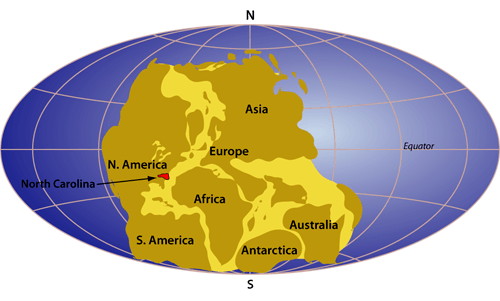
Wegener’s proposal of a supercontinent was supported by:
earthquake data
seafloor magnetism
rock, fossil, and climate data.
convection currents in the mantle.
16
Multiple Choice
The pacific plate is a convergent boundary that is fueled by the force of _________ deep in the asthenosphere (mantle).
convection currents
the sun
gravity
cheese crackers
17
18
Multiple Choice
Convection currents are the driving force of plate movement.
true
false
19
20
Multiple Choice
Objects in motion stay in motion at the same speed and in a straight line, and objects at rest will stay at rest unless an UNBALANCED force is applied.
newtons 1st law
newtons 2nd law
newtons 3rd law
21
Multiple Choice
For every action force there is an equal but opposite reaction force
newtons 1st law
newtons 2nd law
newtons 3rd law
22
Multiple Choice
The more mass an object has, the slower it will accelerate. The more force that is used, the faster the object will accelerate F= M x A
newtons 1st law
newtons 2nd law
newtons 3rd law
23
24
Multiple Choice
The Juan De Fuca Plate will remain at rest until an __________ force acts on it.
balanced
unbalanced
bobs burgers
25
Multiple Choice
What causes the force that makes the Juan de Fuca plate actually move? And where do we find it?
convection currents in the lithosphere (crust)
convection currents in the asthenosphere (mantle)
convection currents in the ocean
26
Multiple Choice
According to Newton’s first law of motion (inertia), the Juan de Fuca plate will remain in motion until what kind of force occurs?
balanced force
a puppy force
an unbalanced force
27
Multiple Choice
If the Juan de Fuca plate is already in motion, what is the force that causes it to change motion?
a balanced force of colliding with another plate
an unbalanced force of colliding with another plate
28
Multiple Choice
Major and Minor tectonic plates are categorized based on their size. Major tectonic plates are much larger than minor tectonic plates. With the same amount of force being used, this causes major tectonic plates to….
accelerate more
accelerate less
29
Multiple Choice
what would the force of the convection currents have to do in order to increase its speed?
increase the force
decrease the force
convection currents plate movement & newtons laws

Show answer
Auto Play
Slide 1 / 29
SLIDE

Similar Resources on Wayground
21 questions
Changes of Matter (feat. Law of Conservation)
Presentation
•
6th - 8th Grade
24 questions
Nervous System
Presentation
•
6th - 8th Grade
24 questions
The Muscular System
Presentation
•
6th - 8th Grade
24 questions
Mitosis and Meiosis
Presentation
•
6th - 8th Grade
22 questions
Reflection and Mirrors 7.P.10.2
Presentation
•
6th - 8th Grade
22 questions
Review of Plant and Animal Cells
Presentation
•
6th - 8th Grade
23 questions
Cluster 5 Day 1 Cells
Presentation
•
6th - 8th Grade
23 questions
Plate Motion
Presentation
•
6th - 8th Grade
Popular Resources on Wayground
16 questions
Grade 3 Simulation Assessment 2
Quiz
•
3rd Grade
19 questions
HCS Grade 5 Simulation Assessment_1 2526sy
Quiz
•
5th Grade
10 questions
Cinco de Mayo Trivia Questions
Interactive video
•
3rd - 5th Grade
17 questions
HCS Grade 4 Simulation Assessment_2 2526sy
Quiz
•
4th Grade
24 questions
HCS Grade 5 Simulation Assessment_2 2526sy
Quiz
•
5th Grade
13 questions
Cinco de mayo
Interactive video
•
6th - 8th Grade
20 questions
Math Review
Quiz
•
3rd Grade
30 questions
GVMS House Trivia 2026
Quiz
•
6th - 8th Grade
Discover more resources for Science
16 questions
Interactions within Ecosystems
Presentation
•
6th - 8th Grade
20 questions
Rocks and The Rock Cycle
Quiz
•
6th Grade
20 questions
genetics, punnett squares, heredity
Quiz
•
7th Grade
16 questions
Photosynthesis and Cellular Respiration Review
Quiz
•
7th Grade
30 questions
GMAS Physical Science Review
Quiz
•
8th Grade
20 questions
Human Body Systems
Quiz
•
6th Grade
15 questions
Punnett Squares
Quiz
•
6th Grade
20 questions
Food Webs + Energy Pyramids
Quiz
•
7th Grade