

Inverse, Converse, Contrapositive

Presentation
•
Mathematics
•
7th - 12th Grade
•
Hard

Joseph Anderson
FREE Resource
9 Slides • 7 Questions
1
Conditionals (if-then) and Related Conditionals
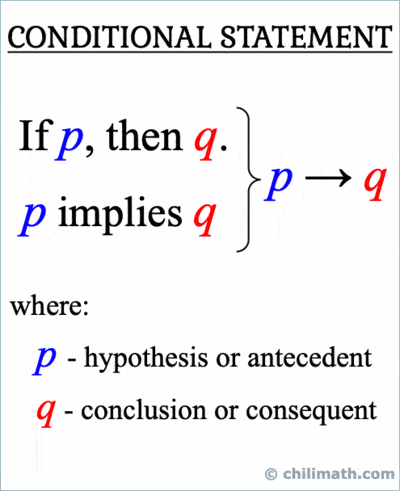
2
The first part of the conditional statement is the hypothesis. The hypothesis follows the word "if".
The second part of the conditional statement is the conclusion. The conclusion follows the word "then".
3
Vocabulary: conditional statement, hypothesis, conclusion, negation, converse, inverse, contrapositive, biconditional, logically equivalent.
To write the converse of a conditional statement, simply switch the hypothesis and conclusion.
To write the inverse of a conditional statement, negate (change to the opposite) both the hypothesis and the conclusion.
To write the contrapositive of a conditional statement, switch and negate the hypothesis and conclusion. The contrapositive is a combination of the converse and inverse.
4
Geometry textbook, p.122 Related Conditionals table

5
Geometry textbook, p.123, logically equivalent statements

6
p.123

7
A conditional statement and its contrapositive are always logically equivalent (have the same truth values).
The converse and inverse of a conditional statement are always logically equivalent.
8
Hypothesis: "you live in West Virginia"
Conclusion: "you live in the USA"
Notice that the hypothesis does NOT include the word "if".
Notice that the conclusion does NOT include the word "then".
9
Converse (if q, then p): If you live in the USA, then you live in WV.
Inverse (if not p, then not q): If you do not live in WV, then you do not live in the USA.
Contrapositive (if not q, then not p): If you do not live in the USA, then you do not live in WV.
Notice that the conditional statement and its contrapositive are both true statements, while the converse and inverse are both false statements (e.g., someone who lives in New York).
10
Multiple Choice
The negation of the statement "A week has 7 days" is:
(only 1 correct choice)
Hint: The negation of a statement is the opposite of the statement.
A week has 7 days
A week does not have 7 days
A week has fewer than 7 days
A week has more than 7 days
11
Multiple Choice
Identify the hypothesis of the conditional statement:
If an angle is right, then its measure is 90° .
Remember that the hypothesis does not include the word "if".
an angle is right
its measure is 90°
if an angle is right
then its measure is 90°
12
Multiple Choice
Identify the conclusion of the conditional statement:
If an angle is right, then its measure is 90° .
Remember that the conclusion does not include the word "then".
an angle is right
its measure is 90°
if an angle is right
then its measure is 90°
13
Multiple Choice
Identify the converse of the conditional statement:
If an angle is right, then its measure is 90° .
Hint: The converse of "If p, then q" is "If q, then p".
If an angle is right, then its measure is not 90° .
If an angle measures 90° , then it is right.
If an angle is not right, then its measure is not 90° .
If an angle does not measure 90° , then it is not right.
14
Multiple Choice
Identify the inverse of the conditional statement:
If an angle is right, then it measures 90° .
Hint: The inverse of "if p, then q" is "if not p, then not q".
If an angle is right, then it does not measure 90° .
If an angle measures 90° , then it is right.
If an angle is not right, then it does not measure 90° .
If an angle does not measure 90° , then it is not right.
15
Multiple Choice
Identify the contrapositive of the conditional statement:
If an angle is right, then it measures 90° .
Hint: The contrapositive of "if p, then q" is "if not q, then not p".
If an angle is right, then it does not measure 90° .
If an angle measures 90° , then it is right.
If an angle is not right, then it does not measure 90° .
If an angle does not measure 90° , then it is not right.
16
Multiple Choice
Consider the conditional statement "If today is Saturday, then it's the weekend".
This is a true statement because the weekend refers to Saturday and Sunday.
Identify the converse statement and its truth value.
[Hint: The converse of "If p, then q" is "If q, then p".]
The converse is "If today is not Saturday, then it's not the weekend" and is true.
The converse is "If today is not Saturday, then it's not the weekend" and is false because it could be Sunday.
The converse is "If it's the weekend, then today is Saturday" and is false because it could be Sunday.
The converse is "If it's not the weekend, then today is not Saturday and true.
Conditionals (if-then) and Related Conditionals
Show answer
Auto Play
Slide 1 / 16
SLIDE
Similar Resources on Wayground

13 questions
Argumentative Conclusions
Presentation
•
7th - 12th Grade
11 questions
Pythagorean Theorem
Presentation
•
8th - 12th Grade
12 questions
Systems of Equations
Presentation
•
8th - 11th Grade
11 questions
Algebra 1 STAAR Calculator Strategy #1 ~ Equivalent
Presentation
•
8th - 12th Grade
10 questions
Pythagorean Theorem Homework
Presentation
•
8th Grade
10 questions
History of Imaginary Numbers - Part 1
Presentation
•
8th - 12th Grade
10 questions
Dilation and Similarity
Presentation
•
8th - 12th Grade
Popular Resources on Wayground
21 questions
Continents and Oceans

Quiz
•
6th Grade
20 questions
Parts of Speech
Quiz
•
5th Grade
16 questions
Subject & Predicate
Quiz
•
5th Grade
25 questions
Multiplication Facts
Quiz
•
5th Grade
12 questions
Map Skills
Quiz
•
3rd Grade
22 questions
Continents and Oceans
Quiz
•
5th Grade
15 questions
Rounding Decimals
Quiz
•
5th Grade
20 questions
Brand Labels
Quiz
•
5th - 12th Grade
Discover more resources for Mathematics
20 questions
Rational and Irrational Numbers
Quiz
•
8th Grade
16 questions
Proportional and Non Proportional Relationships in Tables, Graphs, and Equations
Quiz
•
7th Grade
22 questions
Explore Rational Number Operations and Applications
Quiz
•
7th Grade
20 questions
Add and Subtract Integers
Quiz
•
6th - 8th Grade
25 questions
Linear vs Nonlinear Functions
Quiz
•
8th Grade
20 questions
Graphing Inequalities on a Number Line
Quiz
•
6th - 9th Grade
13 questions
Multi Step Solving Equations with Variables on Both Sides
Quiz
•
7th Grade
16 questions
Adding and Subtracting Integers
Quiz
•
7th Grade