Transformation and Symmetry
Presentation
•
Mathematics
•
9th - 12th Grade
•
Hard

Joseph Anderson
FREE Resource
10 Slides • 17 Questions
1
​
2
Size and shape stay the same.
Angle measures stay the same.
Area and perimeter stay the same.
Parallel segments or lines stay parallel.
Pre-image and image are congruent.
3
Sequences of transformations are performed by doing each transformation in the order listed. Perform the first transformation on the pre-image and each transformation after that on the image created by the previous transformation.
4
The blue trapezoid is translated 4 units right and then reflected over the x-axis to form the red trapezoid.
5
Square ABCD is rotated 90° counterclockwise and then reflected over the y-axis to form square A'B'C'D'.
6
Triangle ABC is rotated 180° about the origin, translated 5 units down, and then reflected over the x-axis to form ∆A'B'C'.
7
Multiple Choice
What sequence of transformations maps the red parallelogram to the green parallelogram?
A translation followed by a reflection.
A rotation followed by a translation.
A reflection followed by a translation.
A reflection followed by a rotation.
8
Multiple Choice
Which sequence could be used to transform hexagon C to hexagon D?
Translation 4 left and 2 down
a reflection over the x-axis and a translation 6 units right
a reflection over the y-axis and a translation 2 units down
a counter-clockwise rotation of 90 degrees about the origin
9
Multiple Choice

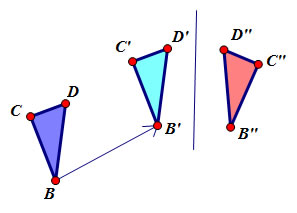
What sequence of transformations will get you from the blue triangle BCD to the red triangle B"C"D"?
Rotation, then Rotation
Rotation, then Dilation
Reflection, then Rotation
Translation, then Reflection
10
Multiple Choice
What sequence of transformations could map triangle ABC to triangle A"B"C"?
A dilation followed by a rotation.
A translation followed by a reflection.
A rotation about the origin followed by a translation.
A reflection followed by a rotation.
11
Multiple Choice
Which of the following describes the sequence of transformations shown?
Reflection followed by a rotation.
Rotation followed by a translation.
Reflection across the x-axis followed by a reflection across the y-axis.
Translation followed by a rotation.
12
13
When an object is exactly the same as another object even if it is moved, rotated or flipped.
Lots of real-world examples.
"Fold" the object in half and have it perfectly overlap. (oddly-satisfying!)
14
Poll
Symmetric?
Yes
No
15
Poll
Symmetric?
Yes
No
16
Poll
Symmetric?
Yes
No
17
Cutting an object in half with a line so that it creates symmetric parts. (Folded perfectly)
18
Multiple Choice
1
2
3
4
19
Multiple Choice
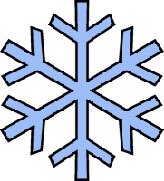
Determine the number of lines of symmetry for the figure.
0
1
3
6
20
Multiple Choice
1
2
3
4
21
When you rotate an object and it looks exactly the same.
Order of rotation: the number of times a object looks the same as it is being rotated 360 degrees (in a circle).
Magnitude of rotation: the angle of rotation in which the object looks the same as it goes around in a circle.
22
Multiple Choice
1
2
3
1,000
23
Multiple Choice
Determine the angle of rotational symmetry (magnitude) for the figure.
None
60°
120°
180°
24
Multiple Choice
What is the order and angle of rotation (magnitude) of the flag?
Order 2, 180 degrees
Order 4, 90 degrees
Order 3, 120 degrees
Order 1, 360 degrees
25
Multiple Choice
Determine whether the figure has line symmetry, rotational symmetry, both, or neither.
Rotational
Line
Both
Neither
26
Open Ended
What could be a potential test question on this topic?
27
Open Ended
Is there line symmetry, rotational symmetry, or both?
​
Show answer
Auto Play
Slide 1 / 27
SLIDE

Similar Resources on Wayground
22 questions
Triangle Congruence
Presentation
•
9th - 12th Grade
22 questions
HL Triangle Congruence
Presentation
•
9th - 12th Grade
19 questions
Digital Classroom Expectations
Presentation
•
KG - 12th Grade
19 questions
Angle & Segment Relationships
Presentation
•
9th - 12th Grade
19 questions
Segments in circles Lesson
Presentation
•
9th - 12th Grade
20 questions
Changing Percents to Decimals
Presentation
•
KG
20 questions
Increasing, Decreasing, Positive, and Negative Intervals
Presentation
•
8th - 12th Grade
20 questions
7.3: Exponential Growth and Decay
Presentation
•
9th - 12th Grade
Popular Resources on Wayground
21 questions
Continents and Oceans
Quiz
•
6th Grade
20 questions
Parts of Speech
Quiz
•
5th Grade
16 questions
Subject & Predicate
Quiz
•
5th Grade
25 questions
Multiplication Facts
Quiz
•
5th Grade
12 questions
Map Skills
Quiz
•
3rd Grade
22 questions
Continents and Oceans
Quiz
•
5th Grade
15 questions
Rounding Decimals
Quiz
•
5th Grade
20 questions
Brand Labels
Quiz
•
5th - 12th Grade
Discover more resources for Mathematics
20 questions
Graphing Inequalities on a Number Line
Quiz
•
6th - 9th Grade
20 questions
Exponent Rules
Quiz
•
8th - 9th Grade
12 questions
Absolute Value Equations
Quiz
•
9th Grade
20 questions
Function or Not a Function
Quiz
•
8th - 9th Grade
15 questions
Linear vs Nonlinear Functions
Quiz
•
8th - 9th Grade
20 questions
Rigid Transformations
Quiz
•
9th Grade
10 questions
Solving Absolute Value Equations
Quiz
•
9th Grade
10 questions
1.4 Distributive Property and Combining Like Terms Alg 1 V1
Quiz
•
9th Grade