Search Header Logo
Area of Parallelogram

Area of Parallelogram

Assessment

Presentation

Mathematics

6th Grade

Hard

Created by

Joseph Anderson

FREE Resource

16 Slides • 26 Questions

1

Area of Parallelograms

by Mrs. Kellany Bennett

2

Please actually watch the videos! If you don't have headphones or earbuds, read the closed captions. You REALLY ought to have some earbuds for school.

3

​Area in General

  • Area is the space contained inside a 2D shape

  • ​We use units like square inches (in2) and square meters (m2)to label area

  • ​Finding the area of a rectangle is like counting the squares in an array--find the product of the length and the width.

4

Multiple Choice

What does area mean?

1

the distance around a shape

2

half the distance around a shape

3

the amount of space outside a shape

4

the amount of space inside a shape

5

Multiple Choice

Question image

Find the area of the rectangle.

1

21 in2

2

10 in2

3

20 in2

6

Multiple Choice

Question image

Find the area of the rectangle.

BE CAREFUL: Area is always measured in SQUARE units.

1

11 yards

2

24 yards2

3

22 yards2

4

24 yards

7

Multiple Choice

Question image

Find the area of the square.

1

10 cm2

2

20 cm2

3

25 cm2

8

​What If It's Not a Rectangle?

  • You'd have to hope it has grids and start counting

    • ​​the green squares are wholes

    • ​the yellow parts are almost wholes

    • ​the pink parts are almost halves (count each 2 as 1)

    • ​then you'd add up the 3 numbers you got

    • ​Something like 26 for the total area

media

9

​Yeah, no... that takes too long!

  • ​Regular shapes have area formulas

  • ​Let's work on discovering those formulas!

media

10

​Parallelograms

  • ​By counting squares, try to estimate the area of this parallelogram...

    • ​Hold on to that guess!

  • ​The parallelogram is awfully close to a rectangle and we know a rectangle area formula...

  • ​Imagine how we could cut this apart and make a rectangle out of it!

media

11

​Parallelograms continued

  • ​What if we cut off the triangle from the left?

  • ​Now, slide that over to the right

  • ​It fits perfectly to the slanted part...

  • ​Now it's a rectangle!

  • ​A 7 by 6 rectangle has an area of 42 square units.

media

12

media

13

Multiple Choice

Question image

Find the area of the parallelogram by mentally decomposing, then rearranging into a rectangle.

1

6 square units

2

4 square units

3

5 square units

4

10 square units

14

Multiple Choice

Question image

Find the area of the parallelogram by mentally decomposing, then rearranging into a rectangle.

1

12 units2

2

10 units2

3

13 units2

4

6 units

15

Multiple Choice

Question image

Find the area of the parallelogram by mentally decomposing, then rearranging into a rectangle.

1

8 square units

2

10 square units

3

15 square units

4

18 square units

16

Multiple Choice

Question image

Find the area of the parallelogram by mentally decomposing, then rearranging into a rectangle.

1

5 square units

2

24 square units

3

10 square units

4

50 square units

17

Parallelograms

Parallelograms have a base and a height measurement. The height must have a 90 degree angle relating it to the base measurement, so the slanted sides are different from the height of the shape.

​It is important NOT to mix up the height and the slanted length.

media

18

Parallelograms

A parallelogram's height can sometimes be shown outside the shape, like in this example. The height is 4, the base is the 5 along the bottom, and the slanted 5 is not needed to calculate area.

media

19

Parallelogram Area

To find the are of a parallelogram - you multiply the base times the height. The formula is:

Area = base x height

media

20

Multiple Choice

Question image

What is the base of this parallelogram ?

1

5 cm

2

35 cm

3

7 cm

4

15 cm

21

Multiple Choice

Question image

If we were finding the area of this parallelogram, which value would we NOT use?

Hint: which is NOT the height or the base?

1

2 m

2

2.5 m

3

1.8 m

22

Multiple Choice

Question image

What is the height of this parallelogram?

1

7 cm

2

5 cm

3

15cm

4

12 cm

23

Multiple Choice

Question image

If you were finding the area of this parallelogram, what two values would you multiply? (In other words, what is the base and height?)

1

7 and 15

2

5 and 15

3

7 and 5

24

25

Parallelogram Area

Area = base * height

Area = 6 * 10

Area = 60 square centimeters

**Notice: we used 10 as the base and 6 as the height because they meet at a right angle; the slanted side (7) was not used to find the area.

​**Notice: base does not always mean bottom.

media

26

​Recap

  • ​To find the area of a parallelogram, we simply need to mentally decompose it into a rectangle.

  • ​Once we have a rectangle, we can find the area with the formula length times width.

  • ​However, since the measurements aren't a length and a width, we'll call them base (length) and height (width).

media

27

Parallelogram Area

To find the area of this parallelogram we multiply base * height.

Area = 7 x 4 = 28 square units

**Notice we did not use the slanted side (5) to find the area. The base and height must meet at a RIGHT angle.

media

28

​IMPORTANT!

  • ​If you are given the length of the slanted side of the parallelogram, NEVER use it to find the area!

  • ​In this example, the measurement of 6 inches would be helpful for finding the perimeter, but for the AREA we don't need it! Only the height, 5.

  • ​Height is often shown with a dotted line and right angle.

media

29

Multiple Choice

What does A stand for in the formula

A = bh

1

Area

2

base

3

height

4

perimeter

30

Multiple Choice

What does b stand for in the formula

A = bh

1

Area

2

base

3

height

4

perimeter

31

Multiple Choice

What does h stand for in the formula

A = bh

1

Area

2

base

3

height

4

perimeter

32

Multiple Choice

Question image

Find the height of the parallelogram.

1

5 cm

2

7 cm

3

15 cm

4

None of these

33

Multiple Choice

Question image

What is the area of this parallelogram?

1

20 square cm

2

25 square cm

3

15 square cm

4

50 square cm

34

Multiple Choice

Question image

What is the area of this parallelogram?

1

75 square in

2

60 square in

3

30 square in

4

50 square in

35

Multiple Choice

Question image

Find the area of this parallelogram

1

12cm2

2

35cm2

3

17.5cm2

4

30cm2

36

Multiple Choice

Question image

Find the area of the parallelogram.

1

20 in2

2

84 in2

3

40 in

4

84 cm2

37

Multiple Choice

Question image

Find the area of this parallelogram

BE CAREFUL--It's kind of turned sideways, but the base and height still meet at a RIGHT angle.

1

70cm2

2

35cm2

3

17cm2

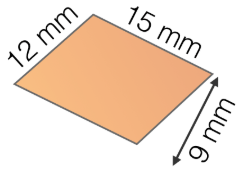
4

70cm

38

Multiple Choice

Question image

Find the area of this parallelogram.

BE CAREFUL--It's kind of turned sideways, but the base and height still meet at a RIGHT angle.

1

110cm2

2

100cm2

3

1100cm2

4

50cm2

39

Multiple Choice

Question image

Find the area of this parallelogram

BE CAREFUL--It's kind of turned sideways, but the base and height still meet at a RIGHT angle.

1

135mm2

2

180mm2

3

108mm2

4

1620mm2

40

Multiple Choice

Question image

Find the area of this parallelogram

BE CAREFUL--The base and height MUST meet at a right angle. This may alter which measurement you see as the base.

1

35m2

2

42m2

3

210m2

4

30m2

41

Multiple Choice

Question image

What is the area of this parallelogram?

1

75 square cm

2

35 square cm

3

15 square cm

4

105 square cm

42

Open Ended

Explain in your own words how to find the area of a parallelogram.

Don't hit the enter key until you are ready to submit your answer!

Area of Parallelograms

by Mrs. Kellany Bennett

Show answer

Auto Play

Slide 1 / 42

SLIDE