

Biconditional

Presentation
•
Mathematics
•
8th - 10th Grade
•
Hard

Joseph Anderson
FREE Resource
8 Slides • 7 Questions
1
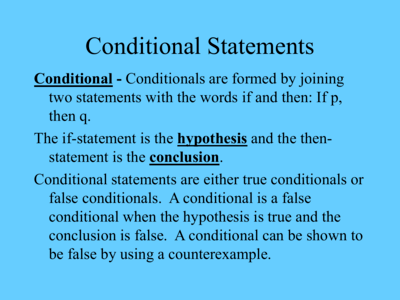
Conditional Statements
2
Example 1
Conditional: If two angles are adjacent, then they share a vertex and side.
Hypothesis: two angles are adjacent
Conclusion: they share a vertex and side
This is a true conditional statement because when we have adjacent angles, they do share a vertex and side.
3
Multiple Choice
If two angles are vertical angles, then they share a vertex.
What is the hypothesis?
two angles are vertical angles
they share a vertex
4
Multiple Choice
If two angles are vertical angles, then they share a vertex.
What is the conclusion?
two angles are vertical angles
they share a vertex
5
Multiple Choice
If two angles are vertical angles, then they share a vertex.
True or False?
True
False
6
Converse Statement
When writing the converse of a statement, you switch the hypothesis and conclusion.
Note: If the conditional and converse are true, then the statement is called biconditional. It can then be written in the "if and only if" form.
7
Example 2
Conditional: If a triangle is a right triangle, then it has two acute angles.
Converse: If a triangle has two acute angles, then it is a right triangle.
The conditional is true but the converse is false. So this is not a biconditional statement and it would not make sense to write this in the "if and only if" form.
8
Example 3
Conditional: If two lines are perpendicular, then they form a right angle.
Converse: If two lines form a right angle, then they are perpendicular.
Both the conditional and converse are true, so this is biconditional.
Biconditional: Two lines are perpendicular if and only if they form a right angle.
9
Open Ended
Write the converse of the statement and if both are true write as a biconditional.
Conditional: If a polygon is a hexagon, then it has six sides.
10
Answer
Converse: If a polygon has six sides, then it is a hexagon. True
Biconditonal: A polygon is a hexagon if and only if it has six sides.
OR: A polgyon has six sides if and only if it is a hexagon.
The biconditional can be written in either order since they are both true.
11
Open Ended
Write the converse of the statement and if both are true write as a biconditional.
Conditional: If x is even, then 2x is even.
12
Answer
Converse: If 2x is even, then x is even. False
Example: If 2x=6, then x=3. 3 is odd.
Not Biconditonal
13
Good Definition
A good definition should be biconditional. Such as the example about hexagons.
Examples
Two different lines are parallel if and only if they have the same slope. This is a good definition of parallel lines because it is biconditional.
Two angles are a linear pair if and only if the two angles are supplementary. This is a bad definition of linear pair because it is not biconditional. Supplementary angles don't have to be adjacent so they don't have to be a linear pair.
14
Multiple Choice
Determine if the following is a good or bad definition:
An equation is linear if and only if its graph forms a straight line.
good definition
bad definition
15
Multiple Choice
Determine if the following is a good or bad definition:
The converse of a conditional statement is true if and only if the conditional is true.
good definition
bad definition
Conditional Statements
Show answer
Auto Play
Slide 1 / 15
SLIDE
Similar Resources on Wayground

11 questions
1.3 Day 1 Solving Eq. with Variable on both Sides
Presentation
•
9th Grade
10 questions
1.02 (Distributive Property)
Presentation
•
9th Grade
10 questions
parallel lines cut by transversal
Presentation
•
8th - 10th Grade
11 questions
Systems of Equations Word Problems
Presentation
•
8th - 9th Grade
12 questions
Computations with Scientific Notation
Presentation
•
8th - 9th Grade
12 questions
Ch 5-1 Intro to Solving Systems of Equations with Graphing
Presentation
•
9th - 10th Grade
13 questions
Solving Inequalities
Presentation
•
8th - 9th Grade
11 questions
Linear Equation in two variable
Presentation
•
9th Grade
Popular Resources on Wayground
10 questions
HCS SCI 03 Summer School Assessment 1

Quiz
•
3rd Grade
15 questions
HCS SCI 05 Summer School Assessment 1 Review
Quiz
•
5th Grade
22 questions
Day 9 Equations and Inequalities Review
Quiz
•
9th Grade
10 questions
Writing and Identifying Ratios Practice
Quiz
•
5th - 6th Grade
7 questions
PYRAMID PERSPECTIVES part 1
Presentation
•
9th - 12th Grade
12 questions
Understanding the Fourth of July
Quiz
•
9th Grade
15 questions
Soccer World Cup Quiz Questions
Quiz
•
7th Grade