

Buoyant Force

Presentation
•
Physics
•
9th - 12th Grade
•
Hard

Joseph Anderson
FREE Resource
5 Slides • 9 Questions
1
Buoyant Force
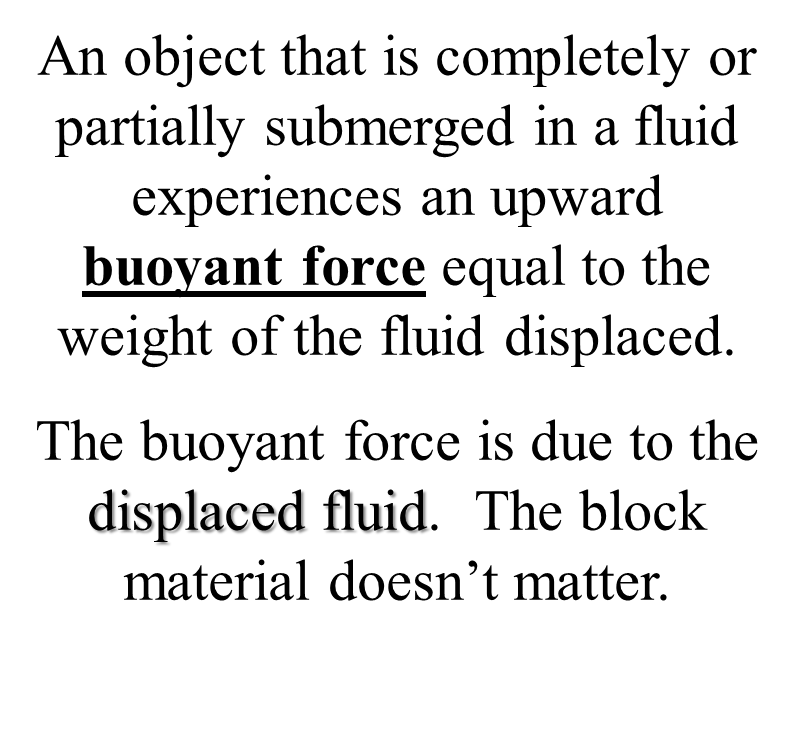
Archimedes' Principle

2
A buoyant force is an upward force exerted on an object by a fluid.
A floating object experiences a greater buoyant force than its own weight.

3
Multiple Choice
What is a buoyant force?
The force that makes an object sink
The density of the fluid an object is submerged.
An upward force exerted on an object by a fluid.
The depth to which an object is submerged in a fluid.
4

5

6
Multiple Choice
What will happen if the buoyant force is greater than the object's weight (gravity)?
The object will sink
The object will float
The object will get wet
The object will be under the surface of the fluid but will not touch the bottom.
7
Multiple Choice
What will happen if the buoyant force is lower than the object's weight (gravity)?
The object will sink
The object will float
The object will get wet
The object will be under the surface of the fluid but will not touch the bottom.
8
The magnitude of the buoyant force (FB) will depend of the density of the fluid (ρf) and the displaced volume of the fluid (Vf).


9
Multiple Choice
What does this symbol ρf represent?
density of the object
pressure of the fluid
density of the fluid
weight of the fluid
10
Multiple Choice
What does this symbol Vf represent?
displaced volume of the fluid
volume of the object
velocity of the fluid
weight of the fluid
11
Multiple Choice
What does this symbol g represent?
weight of the object
gravity's acceleration
force of gravity
shape of the object
12
Multiple Choice
If we put an object in a container with water and it sinks. Would we have the same result if we put it in a container with honey?
Yes, because the object weights too much
Yes, because the object is probably too big
No, because the density of honey is greater. The object might float.
There's no way to know.
13
Multiple Choice
What will happen if a solid object immersed in a fluid weighs more than the weight of the fluid it displaces?
The object will rise to the surface
The object will be neutrally buoyant
The object will move up and down in the fluid.
The object will sink to the bottom
14
Multiple Choice
The materials used to make a steel ship have a density greater than water. How is it possible that a ship floats in water?
Helium and hydrogen is mixed with the steel
The steel is made of many layers pressed together rather than solid sheets of steel
Steel ships are shaped to displace an amount of water with a weight that is greater than the weight of the ship
The steel is raised to a high heat first to make it less dense before it is solidified for shipbuilding
Buoyant Force
Archimedes' Principle
Show answer
Auto Play
Slide 1 / 14
SLIDE
Similar Resources on Wayground

11 questions
Map Skills In History
Presentation
•
9th - 12th Grade
11 questions
Physics 1.12: 3.3 Motors, Generators, and Transformers
Presentation
•
9th - 12th Grade
10 questions
Surface Area
Presentation
•
9th - 12th Grade
10 questions
Grammar and Punctuation Review #1
Presentation
•
9th - 12th Grade
9 questions
Logarithms
Presentation
•
9th - 12th Grade
11 questions
Teenager 5 Session 22: Pronunciation & Speaking
Presentation
•
KG
11 questions
Spanish-speaking countries
Presentation
•
9th - 12th Grade
11 questions
Inverse Trig Functions
Presentation
•
9th - 12th Grade
Popular Resources on Wayground
10 questions
Safety Day 2026 – Student Review

Quiz
•
9th Grade
21 questions
Continents and Oceans
Quiz
•
6th Grade
20 questions
Parts of Speech
Quiz
•
5th Grade
16 questions
Subject & Predicate
Quiz
•
5th Grade
25 questions
Multiplication Facts
Quiz
•
5th Grade
12 questions
Map Skills
Quiz
•
3rd Grade
22 questions
Continents and Oceans
Quiz
•
5th Grade
15 questions
Rounding Decimals
Quiz
•
5th Grade
Discover more resources for Physics
20 questions
Position vs. Time Graphs
Quiz
•
9th Grade
10 questions
Exit Check 5.1 - Forms of Energy
Quiz
•
9th Grade
11 questions
Electricity Explained

Interactive video
•
9th - 12th Grade
87 questions
25-26 Unit 1.2 Review - Radioactivity & Earth's Age
Quiz
•
8th - 10th Grade
15 questions
Position vs. Time and Velocity vs. Time Graphs
Quiz
•
10th - 12th Grade
18 questions
Quiz #8 Practice: Forces on an Incline
Quiz
•
9th Grade
25 questions
Newton's Laws of Motion
Quiz
•
9th Grade