

Cell Respiration AP Bio

Presentation
•
Biology
•
11th Grade
•
Hard

Joseph Anderson
FREE Resource
28 Slides • 28 Questions
1

Cellular
Respiration
Why We Live and Breathe
2

Food contains carbs, lipids and proteins (remember them?) The energy in these is stored in the chemical bonds. There’s more energy in these bonds than you think.
So, what would happen if your body didn’t
digest this food slowly? You would release all of that energy at one time and you'd explode!
3

Cellular respiration
The process of breaking the bonds in food in order to release the energy from the food. Your body then uses this energy to do work.
4
Coordinated step of redox reactions
Reduced - gains electrons/atoms
Oxidized - loses electrons/atoms
Glucose is oxidized as atoms are stripped from it. This results in the release of carbon dioxide.
Electrons and hydrogens released by glucose are picked up by electron carriers (NAD+ and FAD+)
These electrons & hydrogens will be added to oxygen to create water. Oxygen is reduced in this reaction.
The chemical energy that is released from the glucose molecule is stored as chemical energy in the ATP molecule.
5

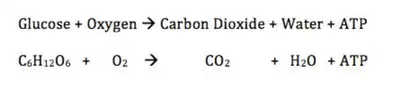
Equation
You get glucose from the food you eat. It is released during the process of digestion
in your stomach and small intestine.
Oxygen is inhaled.
Carbon dioxide is exhaled. Water stays in your cells
ATP is your body’s energy storage molecule.
6

What is ATP?
ATP is the energy molecule in your body. Your body uses the energy from food to
make ATP molecules. These molecules are then sent to the cells in your body so that
they can use them to do work.
7

The ATP-ADP Cycle
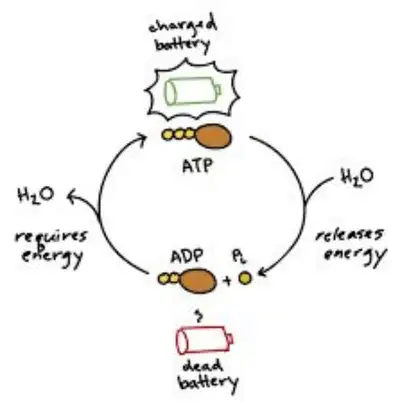
Food gives you the
energy to recharge
the ATP battery.
The charged ATP
battery releases
energy in your cells
so that they can do
work.
The energy is
stored in the
triphosphate tail of
the ATP molecule.
Breaking off a
phosphate releases
the energy.
8

Releasing Energy
●To release the energy stored in ATP molecules,
bonds between their phosphate groups are broken
through hydrolysis.
●Hydrolysis is a chemical reaction in which a water
molecule splits another molecule.
● As a result of hydrolysis, energy is released and
ATP loses a phosphate to become ADP (Adenosine
diphosphate).
9
Multiple Choice

10
Multiple Choice
11
Multiple Choice
12


So how do you get the energy from the food?
Cellular respiration!
This process actually occurs in 3 steps:
1.
Glycolysis
2.
Citric Acid Cycle (aka. Kreb’s cycle)
3.
Electron transport chain
13

14

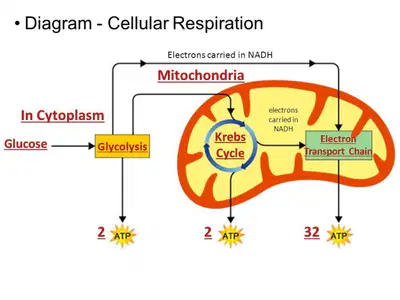
3 Processes Chart
Glycolysis
Citric Acid Cycle (Kreb's)
Electron Transport
Chain
Happens in cytoplasm
(anerobic)
Happens in mitochondria
(matrix)
(aerobic pathway)
Happens in mitochondria
(across inner
membrane) (aerobic)
Begins breaking down
glucose
Makes 2 ATP
Collects electrons &
hydrogens (NAD)
Completely oxidizes glucose & releases carbon dioxide
Collects electrons &
hydrogens (NAD & FAD)
Makes 2 ATP
Uses the flow of
hydrogens to make ATP
Oxygen fuels the chain by pulling e- towards it
Makes 32 ATP
So, you breathe in oxygen so that you can break down your food and make ATP
energy for your body. If you don’t get enough oxygen, you don’t make enough energy and you die.
15
Glycolysis
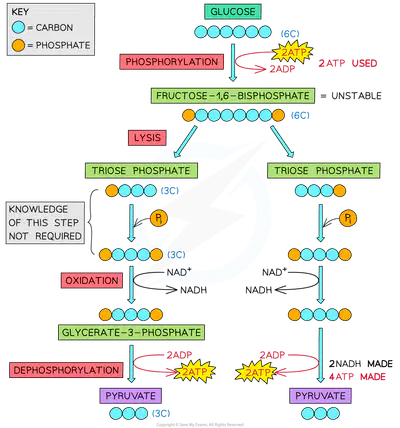
Breaks a 6-carbon glucose into 2, 3-carbon pyruvate molecules.
NAD+ is reduced as it picks up H+ and e- released from glucose oxidation to become 2 molecules of NADH.
2 ATP a required in the input phase to get the process started.
4 ATP are created, but since 2 were used to start the process, we say that glycolysis has a net gain of 2 ATP.
16
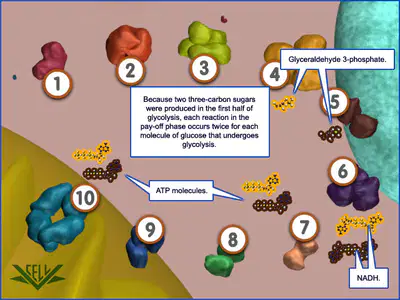
Glycolysis is an evolutionarily conserved process. In other words, it's been around for a long time and originated in a common ancestor.
Evidence:
Anaerobic process (early Earht's atmosphere was anaerobic)
Occurs in cytoplasm (all cells have cytoplasm)
Enzymes used in the process are similiar in all organisms. The genes that encode these enzymes are very similar across different organism types.
Glycolysis & Evolution
17
Multiple Choice
What is the main function of glycolysis?
To rearrange the glucose molecule to be broken down
To recreated acetyl CoA for the Krebs cycle
To absorb and store energy in the ATP molecules
To split the glucose molecule to release energy
18
Multiple Choice
What are the products of glycolysis?
2 ATP; 2 NADH; 2 pyruvate
2 ATP; 2 NADPH; 2 pyruvate
2 ADP; 2 NADH; 2 pyruvate
2 ADP; 2 NADPH; 2 pyruvate
19
Multiple Choice
How does glycolysis lead to ATP synthesis?
Glucose provides the phosphate to ADP to synthesize ATP
Acetyl CoA is synthesized for the Krebs cycle
Glycolysis splits the glucose molecule to create G3P
High energy electrons are stored in NADH for the ETC
20
Multiple Choice
Justify that glycolysis evolved before oxygen was present in the atmosphere?
Glycolysis splits a glucose molecule into 2 pyruvate molecules which does not require oxygen
Glycolysis does not take place in the mitochondria and thus does not require oxygen
Glycolysis does not require oxygen which represents that it evolved prior to free oxygen in the atmosphere
Glycolysis takes place in all living organisms which means it evolved prior to free oxygen in the atmosphere
21
Multiple Choice
Where does glycolysis take place?
Thylakoid
Cytosol
Mitochondrial matrix
Cristae
22
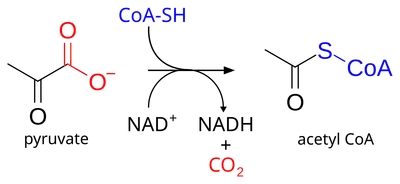
The Intermediate Reaction (aka. pyruvate oxidation)
Occurs in the cytoplasm after glycolysis has taken place
Used to shuttle the carbons from glucose into the mitochondria
Co enzyme A oxidizes the pyruvate created in glycolysis into 2 molecules of Acetyl-CoA
Two CO2 molecules are released
NAD+ picks up the H+ and e- released from pyruvate oxidation to become NADH
*This process is outside of the scope of the AP Bio curriculum. It's just good to know that the carbons from glucose don't magically appear in the mitochondria.
23
24

25

26
Multiple Choice
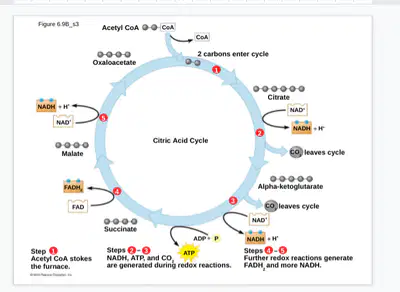
Krebs Cycle takes place in the:
cytosol
matrix
intermembrane space
27
Multiple Choice
The waste product produced during the Krebs cycle is...
oxygen
carbon dioxide
water
ATP
28
Multiple Choice
The Krebs cycle is anaerobic.
true
false
29
Multiple Select
The Kreb's Cycle
results in the total oxidation of glucose
creates 2 ATP
is also known as the Calvin cycle
uses NADH and FADH2 to store high energy e- and H+
30
Multiple Choice
Which of the following is not an end product of the Kreb's cycle?
FADH2
CO2
ATP
pyruvate
31

Transfer of electrons between carriers in the electron transport chain in the membrane of the cristae is coupled to proton pumping
Electron Transport Chain
32

The inner membrane is arranged into folds cristae, which increases the surface area available for the transport chain
The Third Stage of AEROBIC respiration
33

The hydrogen carriers (NADH and FADH2) are moving along and release high energy electrons and protons
The electrons are transferred to the electron transport chain, which consists of several transmembrane carrier I proteins
Step 1: Generating a Proton Motive Force
34

As electrons pass through the chain, they lose energy – which is used by the chain to pump protons (H+ ions) from the matrix
|
The accumulation of H+ ions within the intermembrane space creates an electrochemical gradient (or a proton motive force)
Step 1: Generating a Proton Motive Force
Highlight the electrons and the Hydrogen Ions!
35
The proton motive force will cause H+ ions to move down their electrochemical gradient and diffuse back into the matrix
(high to low concentration)
Step 2: ATP Synthesis via Chemiosmosis
Highlight the electrons and the Hydrogen Ions!
36

This diffusion of protons is called chemiosmosis and is facilitated by the transmembrane enzyme ATP synthase
As the H+ ions move through ATP synthase they trigger the molecular rotation of the enzyme, synthesizing ATP
Step 2: ATP Synthesis via Chemiosmosis

37

In order for the electron transport chain to continue functioning, the de-energised electrons must be removed
Oxygen acts as the final electron acceptor, removing the de-energised electrons to prevent the chain from becoming blocked
Step Three: Reduction of Oxygen
38
Oxygen also binds with free protons in the matrix to form water – removing matrix protons maintains the hydrogen gradient
In the absence of oxygen, hydrogen carriers cannot transfer energized electrons to the chain, and ATP production is halted
Step Three: Reduction of Oxygen
39
Multiple Choice
In what part of the mitchondria does the electron transport chain occur?
Inner mitochondrial membrane (folds of the mitochondria)
Outer mitochondrial membrane
Cytoplasm
Ribosomes
40
Multiple Choice
True or False: Water is produced as a byproduct during this stage of cellular respiration.
True
False
41
Multiple Choice
ATP synthesis by ATP synthase is driven by
H+ movement
electron movement
NADH movement
FADH2 movement
42
Multiple Choice
43
Multiple Choice
When protons are pumped outside the matrix, across the inner membrane...
water is made
a concentration gradient of H+ ions (protons) is created
NADH gets reduced
CO2 is produced
44
Multiple Choice
Oxidative phosphorylation results in the formation of
Oxygen
ADP
ATP + H2O
NADH
45
Multiple Choice
What will happen if there is a leakage in the inner membrane of mitochondria.
no proton-motive force will be created
chemiosmosis will be delayed
no ATP will be produced
no H2O will be produced
46
Multiple Choice
Why ETC must occur first before chemiosmosis?
to produce H2O
to produce ATP
to create proton-motive force
47
Multiple Choice
What is the definition of electron transport chain.
The process in which ATP is form as a result of the transfer of electrons from NADH and FADH2 occurs at the inner membrane of the mitochondrion of eukaryotes by a series of electron carriers.
A sequence of electron carrier molecules embedded in inner membrane of mitochondria that shuttle electrons down a series of redox reactions that release energy used to make ATP.
Energy-coupling mechanism that uses energy stored in the form of an H+ gradient across a membrane to drive cellular work.
High concentration of proton (H+) in the intermembrane space of mitochondria resulting in proton gradient across the membrane known as proton-motive force.
48
Let's Review some Vocab...
Chemiosmosis - the flow of ions down their concentration gradient. (In the case of the ETC, this is the flow of H+ ions).
Oxidative phosphorylation - the creation of ATP using the electron transport chain in cell respiration
Proton motive force - the potential energy generated by a difference in proton concentration across a membrane
49
Phosphorylation
Adding a phosphate group to a molecule
Substrate-level phosphorylation: Adding a phosphate directy to a molecule. Kinases are a group of enzymes that perform this reaction. In cell respiration, this occurs during glycolysis and the Kreb's cycle.
Oxidative phosphorylation: An electron transport chain (ETC) is used to create a proton motive force. These protons then flow through the enzyme ATP synthase, which then creates ATP. The movement of e- is driven by oxygen, who is the final e- acceptor.
Photophosphorlation: An ETC is usd to create a proton motive force. These protons then flow through the enzyme ATP synthase, which then creates ATP. These e- are excited when light energy (photons) hits chlorophyll pigments in photosystems 1 & 2.
50
Match
Match the types of phosphorylation with their definition.
Substrate level
Oxidative Phosphorylation
Photophosphorylation
Phosphate added directly to ADP
Involves ETC, ATP synthase & O2; CR
Involves ETC, ATP synthase & light; PS
Phosphate added directly to ADP
Involves ETC, ATP synthase & O2; CR
Involves ETC, ATP synthase & light; PS
51
Multiple Choice
The complete oxdiation of glucose in aerobic respiration occurs through which of the following sequences of metabolic rections?
Glycolysis, ETC, Kreb's, pyruvate oxidation
ETC, pyruvate oxidation, glycolysis, Kreb's
Glycolysis, pyrvuate oxidation, Kreb's, ETC
Pyrvuate oxidation, glycolysis, Kreb's, ETC
52
Multiple Choice
In the complete reactions of aerobic respiration, the energy for the majority of ATP synthesis is provided by
splittng water to produce oxygen.
high-energy phosphate bones from organic molecule intermediates in the CAC.
a proton gradient across a membrane.
the production of carbon dioxide and oxygen in the ETC.
53
Multiple Choice
What is the source of oxygen used to form water in teh compelte reactions of cellular respiration?
glucose
carbon dioxide (CO2)
molecular oxygen (O2)
pyruvate
54
Multiple Select
Which of the following statements are correct about an oxidation-reduction (redox) reaction?
The molecule that is reduced gains electrons.
The moelcule that is reduced loses elextrons.
The molecule that is oxidized loses electrons.
The molecule that is oxidized gains electrons.
55
Multiple Choice
Which process in eukaryotic cells will proceed normally wheterh oxygen is present or absent?
glycolysis
electron transport
the Kreb's cycle
chemiosmosis
56

Cellular
Respiration
Why We Live and Breathe
Show answer
Auto Play
Slide 1 / 56
SLIDE
Similar Resources on Wayground

51 questions
Introduction to the Nervous System
Presentation
•
11th - 12th Grade
51 questions
Introduction to Nervous System
Presentation
•
11th - 12th Grade
52 questions
APB Unit 8.3 - Ecology
Presentation
•
11th - 12th Grade
52 questions
Endogenic Processes I
Presentation
•
11th Grade
51 questions
Natural Disaster
Presentation
•
11th Grade
51 questions
EmTechWk2Lesson1.2
Presentation
•
11th - 12th Grade
48 questions
Cell Nucleus
Presentation
•
11th Grade
48 questions
Biological Classification
Presentation
•
11th Grade
Popular Resources on Wayground
11 questions
Hallway & Bathroom Expectations

Quiz
•
6th - 8th Grade
10 questions
HCS SCI 03 Summer School Assessment 2
Quiz
•
3rd Grade
11 questions
Home Scope
Quiz
•
7th - 8th Grade
12 questions
2026 TAP Technology in the Classroom
Presentation
•
Professional Development
15 questions
HCS SCI 05 Summer School Assessment 2 Review
Quiz
•
5th Grade
15 questions
HCS SCI 04 Summer School Review 2
Quiz
•
4th Grade
59 questions
Geometry Unit 3 Review
Quiz
•
9th - 12th Grade
14 questions
FAST ELA READING SMAPLE TEST MATERIALS

Passage
•
3rd Grade