Chemical Kinetics Lesson
Presentation
•
Science
•
10th - 12th Grade
•
Hard

Joseph Anderson
FREE Resource
18 Slides • 18 Questions
1
By Andrew Baldwin
2
3
4
5
6
7
8
Multiple Choice
9
10
11
12
13
14
15
16
17
18
19
Multiple Choice
What criteria must be met for reactant collisions to result in a successful product?
The reactants must collide with each other
The reactants must collide with enough energy and be in the right positions
The reactants must have enough energy to form the activated complex
20
Multiple Choice
21
Multiple Choice
22
Multiple Choice
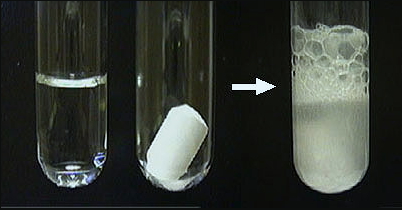
How could we make this reaction happen more quickly?
Decrease the concentration of the acid
crush the chalk to increase the surface area
Put the test tube in an ice bath
23
Multiple Choice
When surface area is decreased the rate of reaction...
Decreases, because there are LESS possible sites for correct collisions
Increases, because there are LESS possible sites for correct collisions
Decreases, because there are MORE possible sites for correct collisions
Increases, because there are MORE possible sites for correct collisions
24
Multiple Choice
How does a catalyst work in speeding up a reaction?
By lowering the activation energy or reaction
by giving them more energy
by making them more available
25
Multiple Choice
26
Multiple Choice
27
28
Multiple Choice
29
Multiple Choice
How are the exponents n and m determined?
30
Multiple Choice
31
Multiple Choice
(CH3)3CBr(aq) + OH-(aq) → (CH3)3COH(aq) + Br-(aq)
What will the initial rate (in mol/L*s) be in Experiment 4?
32
Multiple Choice
33
Multiple Choice
If you quadruple the concentration and the rate quadruples, what order is this reaction?
zero
first
second
34
Multiple Choice
The particles under the purple curve (middle) have an average Kinetic Energy that is proportional to of 500K
True
False
35
Multiple Choice
___________ are produced in one step and used up in a later step and __________________ are present and unchanged in the reactants and the products
intermediates, catalysts
catalysts, intermediates
36
Multiple Choice
If a “reaction profile” has a taller ‘hill’ (or activation energy) then the reaction is ____________________?
Faster
Slower
By Andrew Baldwin
Show answer
Auto Play
Slide 1 / 36
SLIDE

Similar Resources on Wayground
30 questions
Unit 2.6: Fossil Fuels
Presentation
•
9th - 12th Grade
30 questions
Ohm's Law in Series and Parallel Circuits
Presentation
•
9th - 12th Grade
30 questions
5.1 Plate Tectonics
Presentation
•
9th - 12th Grade
29 questions
Absolute/Comparative Advantage
Presentation
•
10th - 12th Grade
35 questions
Nuclear fission vs fusion
Presentation
•
9th - 12th Grade
35 questions
Regulating the Cell Cycle + Cancer (part 3)
Presentation
•
9th - 12th Grade
33 questions
Section 1: Observing the universe
Presentation
•
10th - 12th Grade
Popular Resources on Wayground
10 questions
How much do you know about our Portrait of an Eagle?
Quiz
•
10th Grade
10 questions
Fast Food Slogans
Quiz
•
6th - 8th Grade
21 questions
Continents and Oceans
Quiz
•
6th Grade
20 questions
Parts of Speech
Quiz
•
5th Grade
16 questions
Subject & Predicate
Quiz
•
5th Grade
25 questions
Multiplication Facts
Quiz
•
5th Grade
12 questions
Map Skills
Quiz
•
3rd Grade
22 questions
Continents and Oceans
Quiz
•
5th Grade
Discover more resources for Science
10 questions
Exploring Chemical and Physical Changes
Interactive video
•
6th - 10th Grade
10 questions
Decoding the Periodic Table of Elements
Interactive video
•
6th - 10th Grade
10 questions
Exploring the Periodic Table
Interactive video
•
6th - 10th Grade
14 questions
Physical and Chemical Changes
Quiz
•
10th Grade
22 questions
Periodic Table Review
Quiz
•
9th - 12th Grade
14 questions
Periodic Trends
Interactive video
•
11th Grade
10 questions
Exploring the States of Matter
Interactive video
•
6th - 10th Grade
10 questions
Exploring Physical and Chemical Changes
Interactive video
•
6th - 10th Grade