

Classification of Waves

Presentation
•
Physics
•
10th Grade
•
Hard

Joseph Anderson
FREE Resource
10 Slides • 14 Questions
1
Waves
At the end of this session students will be able to
Define a wave as a means of transferring energy.
Differentiate between types of waves based on their topology, movement of particles and their net transfer of energy.
Identify parameters associated with a sinusoidal wave; height, amplitude, trough and crest.
2
Materials
Basin of water
small rock
table tennis ball
slinky


3
Imagine the following Scenario
Waves is the transfer of energy from one point in space to another point in space that begins with a vibration.
a. Fill a basin with water and place it to rest on a level surface.
b. Place a table tennis ball in the water and allow it to settle (The water is stagnant and the ball will not be moving in the water.)
c. Drop a small pebble in the water a short distance away from the ball
d. Observe what happens and to give an explanation of what took place;
4
What is a wave?
Waves is the transfer of energy from one point in space to another point in space that begins with a vibration.
5
Classification of Waves.
Waves can be classified based on their topology ( how they look)


6
Classification of Waves.
2.Waves can be classified based on their
movement of particles


7
Classification of Waves.
Waves can be classified based on their net energy transfer.


8
Parts of a transverse waves.

.
Crest - The highest point on the wave from its rest position.
Trough - The lowest point on the wave from its rest position.
Wave Height - The vertical distance between crest and trough.
Wavelength - The horizontal distance between successive crests or troughs.
Wave Period - The time it takes for one complete wave to pass a particular point.
Amplitude - One-half the wave height or the distance from either the crest or the trough to the rest position.
Direction of Propagation - the direction in which a wave is travelling.
Medium is the substance through which the wave travels
9
Parts of a longitudinal waves.

Rarefaction in a longitudinal wave is an area where the particles are spread apart, as opposed to compression in a longitudinal wave, when the particles are closest together.
10
Consolidation
1. Recall the definition of a wave.
2. Differentiate between a standing/stationary wave or progressive/travelling wave.
3. Differentiate between a transverse and longitudinal wave.
4. Identify the crest, trough, amplitude, wavelength on a sinusoidal wave

11
Fill in the Blanks
A
12
Multiple Choice

Trough
Equilibrium
Crest
Wavelength
13
Multiple Choice

14
Multiple Choice
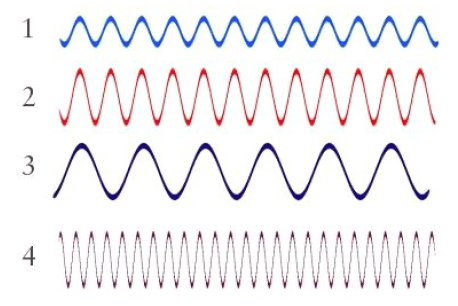
the measurement from one wave's crest to another crest or it's trough to another trough
crest
trough
amplitude
wavelength
15
Multiple Choice
16
Multiple Choice

17
Multiple Choice

18
Multiple Choice

What do waves carry and transfer?
Nothing
Only Sound
Only sunlight
Energy
19
Multiple Choice

The bottom part of the wave is called trough.
True
False
20
Multiple Choice
The red dot represents a point on a rope. As a transverse wave moves through the rope, which picture shows how the dot will move?
21
Multiple Choice
Which one of the diagrams represents the greatest amplitude?
22
Multiple Select
Select the two statements that are true
Transverse wave: particle motion is perpendicular to wave motion
Transverse wave: particle motion is parallel to wave motion
Longitudinal wave: particle motion is perpendicular to wave motion
Longitudinal wave: particle motion is parallel to wave motion
23
Multiple Choice

How many wavelengths does this wave have?
4 and a quarter
8 and a half
1
7
24
Multiple Choice

Waves
At the end of this session students will be able to
Define a wave as a means of transferring energy.
Differentiate between types of waves based on their topology, movement of particles and their net transfer of energy.
Identify parameters associated with a sinusoidal wave; height, amplitude, trough and crest.
Show answer
Auto Play
Slide 1 / 24
SLIDE
Similar Resources on Wayground

18 questions
Pengukuran
Presentation
•
10th Grade
19 questions
History of the Cell Theory
Presentation
•
10th Grade
19 questions
Subject -Verb Agreement
Presentation
•
10th Grade
18 questions
Direct and Indirect Speech
Presentation
•
10th Grade
20 questions
Descriptive Text
Presentation
•
10th Grade
20 questions
Classifying and Naming Angles
Presentation
•
10th Grade
18 questions
Age of Revolutions Wrap up
Presentation
•
10th Grade
19 questions
Radioactive Decay
Presentation
•
10th Grade
Popular Resources on Wayground
6 questions
PRIDE Always and Everywhere
Presentation
•
12th Grade
20 questions
Lab Safety Quiz

Quiz
•
6th Grade
26 questions
KOR Review Kahoot Questions
Quiz
•
8th Grade
21 questions
Continents and Oceans
Quiz
•
6th Grade
12 questions
Unit Zero lesson 2 cafeteria
Presentation
•
9th - 12th Grade
20 questions
Parts of Speech
Quiz
•
5th Grade
10 questions
Riddles Riddles fun Riddles
Quiz
•
6th - 12th Grade
16 questions
Subject & Predicate
Quiz
•
5th Grade