Search Header Logo
Cloud Formation

Cloud Formation

Assessment

Presentation

Science

6th - 11th Grade

Hard

Created by

Joseph Anderson

FREE Resource

10 Slides • 41 Questions

1

CLOUDS

By Jason King

SUMMER SCHOOL

2

Cloud Formation

When air rises, it expands and cools adiabatically. If air is lifted sufficiently high, it will eventually cool to its dew-point temperature, and clouds will develop. Condensation occurs when water vapor is cooled enough to change to a liquid

3

Lifting Condensation Level

The altitude at which a parcel reaches saturation and cloud formation begins is called the lifting condensation level (LCL). Level of Clouds.

4

Cloud Formation

Condensation occurs when water vapor changes to a liquid. For condensation to take place, the air must be saturated and there must be a surface on which the vapor can condense. In the air above the ground, tiny particles known as (Cloud) condensation nuclei serve as the surfaces on which water vapor can condense

5

Multiple Choice

Occurs when warmer, less dense air is forced over cooler, denser air.

1

Orographic Lifting

2

Frontal Wedging

3

Convergence

4

Localized Convective Lifting

6

Multiple Choice

Occurs when horizontal air flow is pushed up vertically.

1

Orographic Lifting

2

Frontal Wedging

3

Convergence

4

Localized Convective Lifting

7

Multiple Choice

When thermals are created due to the unequal heating of the Earth we call this...
1
orographic lifting
2
frontal wedging
3
convergence
4
localized convective lifting

8

Multiple Choice

Question image
when air is lifted because mountains act as barriers we call this
1
orographic lifting
2
frontal wedging
3
convergence
4
localized convective lifting

9

10

media

11

Cloud Names

Puffy clouds are called cumulus or have the prefix “cumulo.”

Clouds that form a layer are called stratus or have the prefix “strato.”

Clouds that are made up of ice crystals are called cirrus or have the prefix “cirro.”

Clouds that produce precipitation are called nimbus or have the prefix “nimbo.”

12

Cloud Names

Puffy clouds are called cumulus; however, if the cumulus clouds form a layer, they are called stratocumulus. If those puffy cumulus clouds grow upward high into the sky and produce rain, they are called cumulonimbus clouds.

13

Clouds Formation

High in the atmosphere where temperatures are very, very cold, most clouds are made of tiny ice crystals. Closer to the ground, the clouds that we see are made of tiny water droplets.

14

Clouds Formation

In general, there are two ways clouds form. In both cases, though, the clouds form because the air is cooling. In the atmosphere, rising air cools and sinking air warms. In most cases, the clouds that you see are caused by rising air.

15

Multiple Choice

Types of Low Clouds

1

Altocumulus

Altostratus

2

Cirrus

Cirrostratus

Cirrocumulus

3

Stratocumulus

Cumulus

Stratus

Nimbostratus

16

Multiple Choice

Question image

______ clouds often form a blanket of low clouds near the ground. They give the sky a dull, gray appearance.

1

Altocumulus

2

Cirrocumulus

3

Stratocumulus

4

Stratus

17

Multiple Choice

Question image

If you’ve ever been in fog, you’ve been inside a ______ cloud.

1

Cumulonimbus

2

Stratus

3

Stratocumulus

4

Cirrostratus

18

Multiple Choice

Question image

These clouds are producing rain.

1

Altocumulus

2

Nimbostratus

3

Stratocumulus

4

Cirrostratus

19

Multiple Choice

Question image

These puffy, low clouds are ______ clouds.

They have distinct bottoms and edges and often form on sunny days as air rises in the atmosphere.

1

Cumulus

2

Nimbostratus

3

Stratocumulus

4

Cirrostratus

20

Multiple Choice

Question image

When cumulus clouds form a layer, we call them _______ clouds.

1

Cumulonimbus

2

Nimbostratus

3

Stratocumulus

4

Cirrostratus

21

Multiple Choice

Question image

These puffy clouds are also cumulus clouds. However, because they are at mid-levels in the sky, we call them ________ clouds.

1

Cumulonimbus

2

Altocumulus

3

Stratocumulus

4

Cirrostratus

22

Multiple Choice

Question image

These mid-level clouds are forming a layer across the sky and are called _______ clouds. Often, you can see the dim sunshine through this type of clouds.

1

Altostratus

2

Altocumulus

3

Stratocumulus

4

Cirrostratus

23

Multiple Choice

Question image

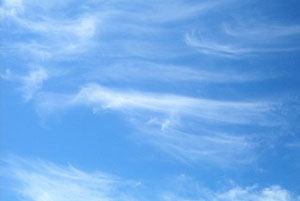
These wispy, high clouds are cirrus clouds. This type of clouds are made up of tiny ice crystals.

1

Nimbostratus

2

Cirrus

3

Stratus

4

Cirrocumulus

24

Multiple Choice

Question image

Sometimes ______ clouds cause a halo around the sun or moon, which can be an indication of an approaching storm.

1

Cirrostratus

2

Cirrus

3

Stratus

4

Cirrocumulus

25

Multiple Choice

Question image

Jets can also cause ______ clouds to form. The exhaust from the jet engines adds moisture to the air and, under certain conditions, that moisture will form streaks of ice crystals that we call contrails.

1

Cirrostratus

2

Cirrus

3

Stratus

4

Cirrocumulus

26

Multiple Choice

Question image

When cumulus clouds grow high into the atmosphere, they can produce, lightning, thunder and heavy rain. We call thunderstorm clouds _________ clouds.

1

Cumulonimbus

2

Cumulus

3

Stratus

4

Cirrocumulus

27

Multiple Choice

When water vapor changes to a liquid state we call this .....
1
evaporation
2
condensation
3
sublimation
4
deposition

28

Multiple Choice

The rate of cooling or heating (10⁰F for every 1000 m) that only applies to unsaturated air is called the

1

Wet Adiabatic Rate

2

Dry Adiabatic Rate

3

Atmospheric Lapse Rate

4

Temperature-pressure Causal Rate

29

Multiple Choice

Occurs when horizontal air flow is pushed up vertically.

1

Orographic Lifting

2

Frontal Wedging

3

Convergence

4

Localized Convective Lifting

30

Multiple Choice

In an adiabatic process there is no _________ transfer between the gas and the surroundings.

1

Kinetic Energy

2

Work

3

Thermal Energy

31

Multiple Choice

The amount of matter in a given volume

1

climate

2

weather

3

density

4

convection

32

Multiple Choice

_______ causes the Coriolis Effect

1

Earth's rotation

2

gravity

3

wind

4

density

33

Multiple Choice

Jack has a rock. The rock has a mass of 30g and a volume of 2cm3. What is the density of the rock?

1

7 g/cm3

2

15 g/cm3

3
28 g/cm3
4
1/7 g/cm3

34

Multiple Select

Why does the atmosphere help sustain and protect life on the earth's surface?

1

Greenhouse gases warm the air near the surface.

2

The ozone layer shields us from harmful UV radiation.

3

Oxygen is a major component of the atmosphere.

4

None of the other options

35

Multiple Choice

What happens to the density (thickness)/air pressure of the air as you increase in altitude?

1

density decreases

2

density increases

3

density stays the same

4

density disappears

36

Multiple Select

The temperature decreases with altitude in the:

1

Troposphere

2

Stratosphere

3

Mesosphere

4

Thermosphere

5

Exosphere

37

Multiple Choice

Satellites orbit this layer of the atmosphere

1

Troposphere

2

Exosphere

3

Stratosphere

4

Thermosphere

38

Multiple Choice

What is the definition of Radiation?

1

The movement of heat by actual motion of matter

2

The transfer of energy with the help of electromagnetic waves

3

The reflection of light waves.

4

The transfer of heat energy by direct contact

39

Multiple Choice

Light in vacuum always moves at roughly _____M/S

1

300 000

2

300 000 000

3

3 000

4

343

40

Multiple Choice

Question image

True or false -Cool air pushes warm air upward.

1

true

2

false

41

Multiple Choice

Question image

Cool air will...

1

sink

2

rise

42

Multiple Choice

Question image
This type of cloud is thin, wispy, and made of ice crystals
1
cumulus cloud
2
stratus cloud
3
cirrus cloud
4
cumulonimbus cloud

43

Multiple Choice

Question image

Clouds form during the process of...

1

evaporation

2

condensation

3

precipitation

4

runoff

44

Multiple Choice

What type of clouds are called "fair weather clouds" and look like floating cotton?
1
Cumulus
2
Stratus
3
Nimbus
4
Cumulonimbus

45

Multiple Choice

Name the two types of low level clouds
1
Altostratus and Altocumulus
2
Cirrus and Cumulus
3
Cirrocumulus and Cumulonimbus
4
Stratus and Nimbostratus

46

Multiple Choice

Are stratus clouds or cirrus clouds found closer to the ground?
1
Cirrus
2
Stratus

47

Multiple Choice

Which type of cloud is highest in the sky?

1

Cirrus

2

Cumulus

3

Stratus

48

Multiple Choice

Which type of cloud is lowest in the sky?

1

Cirrus

2

Cumulus

3

Stratus

49

Multiple Choice

Which statement about clouds is true?

1

Cumulus clouds mean a change of weather is coming in the next 24 hours.

2

There is only one kind of cloud in the sky at a time.

3

Fog is not a cloud.

4

Cirrus clouds are the highest in the sky.

50

Multiple Choice

What are clouds made out of?

1

Molecules of pure oxygen

2

ozone and carbon dioxide

3

water droplets, dust, and smoke particles

4

78% nitrogen, 21% oxygen, and 1% other gases

51

Multiple Choice

The dew point is

1

the point at which water vapor evaporates.

2

the point at which water vapor condenses.

3

the point at which hail starts.

4

the point that water vapor becomes saturated.

CLOUDS

By Jason King

SUMMER SCHOOL

Show answer

Auto Play

Slide 1 / 51

SLIDE