

Comet, Kepler Belt and the Oort Cloud

Presentation
•
Science
•
9th - 12th Grade
•
Hard

Joseph Anderson
FREE Resource
7 Slides • 4 Questions
1
These slides are based on the information found at spaceplace.nasa.
LINK to Original Page
2
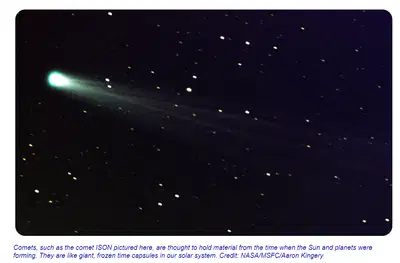
Comets are large objects made of dust and ice that orbit the Sun. Best known for their long, streaming tails, these ancient objects are leftovers from the formation of the solar system 4.6 billion years ago..
What Is a Comet?
3
Comets are mostly found way out in the solar system. Some exist in a wide disk beyond the orbit of Neptune called the Kuiper Belt. We call these short-period comets. They take less than 200 years to orbit the Sun.
Other comets live in the Oort Cloud, the sphere-shaped, outer edge of the solar system that is about 50 times farther away from the Sun than the Kuiper Belt. These are called long-period comets because they take much longer to orbit the Sun. The comet with the longest known orbit takes more than 250,000 years to make just one trip around the Sun!
Where do comets come from?

4
Categorize
Wide disk shape
sphere shape
home to short period comets
comets from here take less than 200 years to orbit the sun
on the outer edge of the solar system
long period comets come from here
One known comet from here takes over 250,000 years to orbit the sun
Match the phrase with the location they are associated with.
5
The gravity of a planet or star can pull comets from their homes in the Kuiper Belt or Oort Cloud. This tug can redirect a comet toward the Sun. The paths of these redirected comets look like long, stretched ovals.
As the comet is pulled faster and faster toward the Sun, it swings around behind the Sun, then heads back toward where it came from. Some comets dive right into the Sun, never to be seen again. When the comet is in the inner solar system, either coming or going, that's when we may see it in our skies.
What brings comets near Earth so we can see them?

6
Multiple Choice
What pulls comets out of their location in the Kuiper belt or Oort cloud and sends them toward the sun?
Gravity
7
At the heart of every comet is a solid, frozen core called the nucleus. This ball of dust and ice is usually less than 10 miles (16 kilometers) across – about the size of a small town. When comets are out in the Kuiper Belt or Oort Cloud, scientists believe that’s pretty much all there is to them – just frozen nuclei.
But when a comet gets close to the Sun, it starts heating up. Eventually, the ice begins to turn to gas. This can also cause jets of gas to burst out of the comet, bringing dust with it. The gas and dust create a huge, fuzzy cloud around the nucleus called the coma.
What are the parts of a comet?

8
Labelling
Label the parts of the comet.
ion tail
dust tail
nucleus
coma
direction the comet is moving
direction to the sun
9
As dust and gases stream away from the nucleus, sunlight and particles coming from the Sun push them into a bright tail that stretches behind the comet for millions of miles.
When astronomers look closely, they find that comets actually have two separate tails. One looks white and is made of dust. This dust tail traces a broad, gently curving path behind the comet. The other tail is bluish and is made up of electrically charged gas molecules, or ions. The ion tail always points directly away from the Sun.
Why do comets have tails?

10
Multiple Choice

In this diagram, what color is the ion tail?
blue
yellow
11
People have been interested in comets for thousands of years. But it wasn't possible to get a good view of a comet nucleus from Earth since it is shrouded by the gas and dust of the coma. In recent years, though, several spacecraft have had the chance to study comets up close.
NASA’s Stardust mission collected samples from Comet Wild 2 (prounounced like “Vilt two”) and brought them back to Earth. Scientists found those particles to be rich in hydrocarbons, which are chemicals we consider the “building blocks” of life.
Rosetta, a mission of the European Space Agency that had several NASA instruments onboard, studied Comet 67P Churyumov-Gerasimenko. Rosetta dropped a lander on the nucleus, then orbited the comet for two years. Rosetta detected building blocks of life on this comet, too. And images showed Comet 67P to be a rugged object with lots of activity shaping its surface.
Thanks to these missions and others like them, we now know a lot more about the structure of comets and the types of chemicals found on and around them. We’ve even learned a bit more about the formation of our solar system!
How do we learn about comets?

These slides are based on the information found at spaceplace.nasa.
LINK to Original Page
Show answer
Auto Play
Slide 1 / 11
SLIDE
Similar Resources on Wayground

10 questions
session 7
Presentation
•
9th - 12th Grade
10 questions
Karyotypes
Presentation
•
9th - 12th Grade
10 questions
Adobe Photoshop Shortcut Keys
Presentation
•
9th - 12th Grade
10 questions
Computer Network
Presentation
•
9th - 12th Grade
9 questions
Mutations
Presentation
•
9th - 11th Grade
8 questions
Toxicity Practice
Presentation
•
9th - 12th Grade
12 questions
Ecological Succession
Presentation
•
9th - 12th Grade
12 questions
Tragedy of the Commons
Presentation
•
9th - 12th Grade
Popular Resources on Wayground
6 questions
Secondary Safety Quiz
Presentation
•
9th - 12th Grade
10 questions
Afterschool Activities & Sports

Quiz
•
6th - 8th Grade
19 questions
ROAR Week 2026
Quiz
•
9th - 12th Grade
20 questions
Lab Safety Quiz
Quiz
•
6th Grade
15 questions
Cool Tool:Chromebook
Quiz
•
6th - 8th Grade
22 questions
would you rather
Quiz
•
3rd - 11th Grade
21 questions
Continents and Oceans
Quiz
•
6th Grade
20 questions
Parts of Speech
Quiz
•
5th Grade
Discover more resources for Science
10 questions
Scientific Method (The scientific method)

Interactive video
•
9th Grade
9 questions
Scientific method
Interactive video
•
9th - 12th Grade
10 questions
Lab Safety Essentials
Interactive video
•
6th - 10th Grade
10 questions
Essential Guidelines for Science Lab Safety
Interactive video
•
6th - 10th Grade
20 questions
States of Matter Quick Check
Quiz
•
9th Grade
14 questions
Flinn Lab Safety
Quiz
•
9th - 12th Grade
10 questions
Exploring the Steps of the Scientific Method for Kids
Interactive video
•
6th - 10th Grade
35 questions
Flinn Lab Safety
Quiz
•
11th Grade