Comparing Anatomical Patterns in Organisms
Presentation
•
Science
•
8th Grade
•
Hard

Joseph Anderson
FREE Resource
16 Slides • 17 Questions
1
8.L.4.1 & 8.L.4.2 Review
2
Multiple Choice
The diagram below represents possible genetic relationships between groups of organisms.
Which statement is a valid conclusion that can be drawn from the diagram?
Insects are more complex than mammals.
Earthworms and sea stars have a common ancestor.
Snails appeared on Earth before corals.
Sponges were the last new species to appear on Earth.
3
8.L.4.1
Summarize the use of evidence drawn from geology, fossils, and comparative anatomy to form the basis for biological classifications systems and the theory of evolution
4
8.L.4.2
Explain the relationship between genetic variation and an organism's ability to adapt to its environment
5
Multiple Choice
The process by which different kinds of living organisms are thought to have developed and diversified from earlier forms during the history of the earth.
species
Darwin
evolution
taxonomy
6
7
Multiple Choice
Which fact provides the best evidence for the biological theory of evolution?
Most fossils are found in sedimentary rock.
Most species of life on Earth have become extinct.
Characteristics of simpler life forms can be found in more complex life forms.
Only a small percentage of living things have been preserved in fossils.
8
9
10
11
Multiple Choice
Structures derived from a common ancestor or same evolutionary or developmental origin
homologous structures
homosapien
analogous structures
atoms
12
Multiple Choice
A vestigial organ is present in modern-day species, but its utility is lost. The presence of hip bones in modern whales is an example of a vestigial organ. Which statement can be concluded about the ancestors of whales?
Ancestors of whales lived on land.
Ancestors of whales lived in deep oceans.
Ancestors of whales were fish-like organisms.
Ancestors of whales were dependent on the sea for food.
13
Multiple Choice
Body parts that function like each other, but are different in structure.
embryos
homologous structures
analogous structures
vestigial structures
14
15
16
Multiple Choice
The embryos of two different organisms are observed to have similar features. What is the most reasonable conclusion that can be drawn from this observation?
The organisms will share these same features as adults.
These organisms will have the same role in the same habitat.
These organisms will take the same amount of time to develop.
These organisms are related by a shared common ancestor.
17
Multiple Choice
Comparing the embryos of different animals can show relationships that can’t be seen when comparing the fully formed animals. Why is this the case?
Each embryo is unique; even embryos of animals of the same species can be different.
When observing embryos, microscopes can be used to reveal more detail.
Embryos can have parts that are not present in the fully formed animals.
Fully formed animals are sometimes missing limbs or other body parts.
18
19
20
21
22
Multiple Choice
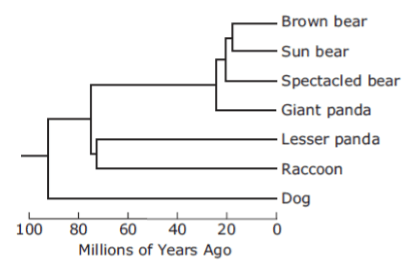
Who is the closest relative to the brown bear?
Giant panda
Dog
Lesser panda
Sun bear
23
Multiple Choice
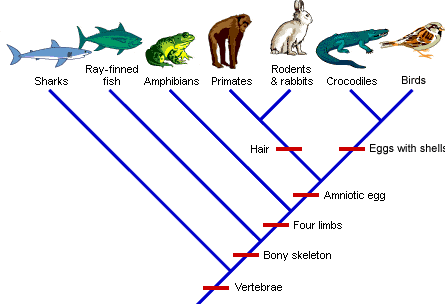
According to this cladogram, sharks are MOST closely related to which organism?
Amphibians
Ray finned fish
Crocodiles
Birds
24
Multiple Choice
The branch of science concerned with classification, especially of organisms
taxonomy
law of conservation of mass
evolution
genetics
25
26
Multiple Choice
Erosion to mountaintops is an evidence of __________________. Erosion is caused by gradual changes to Earth's surface due to wind, water, and ice.
Catastrophism
Uniformity
27
Multiple Choice
The meteor that caused dinosaurs to go extinct is an example of ___________________. Meteors are examples of one-time events that cause change to Earth's surface.
Catastrophism
Uniformity
28
29
30
Multiple Choice
What evidence supports the theory that continents were once a large landmass?
The continents share a similar climate.
Similar fossils have been found on different continents.
Minerals like gold and copper are found worldwide.
Coconut trees are found on coastlines.
31
Multiple Choice
Which statement supports the theory of natural selection
All organisms produce more offspring than can survive.
Organisms live in harmony with one another despite limited resources.
Organisms with favorable traits are more likely to die.
Over time advantageous traits will be found in more of the population.
32
Multiple Choice
What role does genetic variation play in the evolution of species?
It reduces the chance that species will possess characteristics well-suited for a changing environment.
It increases the chance that species will possess characteristics well-suited for a changing environment.
It allows multicellular organisms to change their traits during their lifetimes.
It allows unicellular organisms to change their DNA after they die.
33
Multiple Choice
Trilobite fossils from different time periods show small changes in appearance. What might account for the changes?
catastrophic geologic events
weathering and erosion
increase in greenhouse gases
response to environmental changes
8.L.4.1 & 8.L.4.2 Review
Show answer
Auto Play
Slide 1 / 33
SLIDE

Similar Resources on Wayground
26 questions
Rotation and Revolution
Presentation
•
8th Grade
27 questions
Introduction to Waves
Presentation
•
8th Grade
27 questions
Balanced and Unbalanced Forces
Presentation
•
8th Grade
25 questions
Atomic Structure Lesson
Presentation
•
8th Grade
28 questions
Levels of Ecology Lesson
Presentation
•
8th Grade
24 questions
Classification of matter
Presentation
•
8th Grade
26 questions
Earth's Changing Surface Review
Presentation
•
7th - 8th Grade
27 questions
Atoms, Elements, Molecules, & Compounds
Presentation
•
7th - 8th Grade
Popular Resources on Wayground
10 questions
5.P.1.3 Distance/Time Graphs
Quiz
•
5th Grade
10 questions
Fire Drill
Quiz
•
2nd - 5th Grade
20 questions
Equivalent Fractions
Quiz
•
3rd Grade
22 questions
School Wide Vocab Group 1 Master
Quiz
•
6th - 8th Grade
20 questions
Main Idea and Details
Quiz
•
5th Grade
20 questions
Context Clues
Quiz
•
6th Grade
20 questions
Inferences
Quiz
•
4th Grade
12 questions
What makes Nebraska's government unique?
Quiz
•
4th - 5th Grade
Discover more resources for Science
8 questions
Amoeba Sister Asexual vs Sexual Reproduction
Interactive video
•
8th Grade
19 questions
Introduction to Properties of Waves
Presentation
•
6th - 8th Grade
16 questions
Interactions within Ecosystems
Presentation
•
6th - 8th Grade
10 questions
Exploring the Layers of the Earth
Interactive video
•
6th - 10th Grade
20 questions
Energy Transformations
Quiz
•
6th - 8th Grade
46 questions
8th Science STAAR Review
Quiz
•
8th Grade
20 questions
Cell Organelles and Functions
Quiz
•
6th - 8th Grade
20 questions
Moon Phases and Eclipses
Quiz
•
6th - 8th Grade