
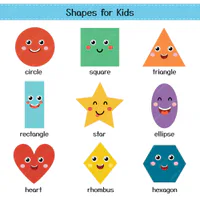
Comparing Shapes

Presentation
•
Mathematics
•
1st - 5th Grade
•
Hard

Joseph Anderson
FREE Resource
11 Slides • 5 Questions
1
Discovering the Attributes of Shapes
2
Non-defining Attributes of Shapes
3
Multiple Choice
Which of the following attributes do not affect the basic identity of a shape?
Shape
Color
Texture
Size
4
Irrelevant Attribute
Trivia: The color of a shape does not affect its basic identity. Other attributes like shape, texture, and size play a significant role in defining a shape. Color is merely a visual characteristic that can be changed without altering the shape itself.
5
Attributes of Shapes
6
Multiple Choice
What are axes of symmetry?
The straight lines that make up the shape
The points where the sides meet
Lines that divide the shape into two equal parts
The measure of the corners formed by the sides
7
Axes of Symmetry
Trivia: Did you know that axes of symmetry are also known as lines of symmetry? They divide a shape into two equal parts. These lines can be vertical, horizontal, or diagonal. Some shapes, like circles, have an infinite number of axes of symmetry.
8
Identifying Shapes by Sides
9
Multiple Choice
How many sides does a hexagon have?
3
4
6
8
10
Hexagon Fun Facts
11
Identifying Shapes by Corners
12
Multiple Choice
How many corners does a triangle have?
1
2
3
4
13
Triangle Corners
A triangle has 3 sides and 3 angles, but it actually has 4 corners! Despite its name, a triangle has one more corner than its sides. This is because each corner is formed by the intersection of two sides, resulting in a total of 4 corners. So, don't be fooled by the name!
14
Sorting Shapes by Size
15
Multiple Choice
What skill can be developed by arranging shapes based on their size?
Spatial awareness
Critical thinking skills
Problem-solving skills
Creativity
16
Critical Thinking Skills
Did you know? Developing critical thinking skills can be enhanced by arranging shapes based on their size. This activity helps individuals analyze, compare, and evaluate information, leading to improved problem-solving abilities. It also enhances spatial awareness and fosters creativity. So, let's start arranging shapes and boost our critical thinking skills!
Discovering the Attributes of Shapes
Show answer
Auto Play
Slide 1 / 16
SLIDE
Similar Resources on Wayground

13 questions
Analyze Line Plots
Presentation
•
2nd - 4th Grade
10 questions
Using a Dictionary
Presentation
•
1st - 5th Grade
10 questions
Continents
Presentation
•
1st - 5th Grade
10 questions
Pythagorean Theorem Homework
Presentation
•
8th Grade
12 questions
K5 More Lesson.
Presentation
•
KG
10 questions
Lesson Dime
Presentation
•
KG
10 questions
Math Learning
Presentation
•
1st - 5th Grade
Popular Resources on Wayground
10 questions
How much do you know about our Portrait of an Eagle?

Quiz
•
10th Grade
10 questions
Fast Food Slogans
Quiz
•
6th - 8th Grade
21 questions
Continents and Oceans
Quiz
•
6th Grade
20 questions
Parts of Speech
Quiz
•
5th Grade
16 questions
Subject & Predicate
Quiz
•
5th Grade
25 questions
Multiplication Facts
Quiz
•
5th Grade
12 questions
Map Skills
Quiz
•
3rd Grade
22 questions
Continents and Oceans
Quiz
•
5th Grade
Discover more resources for Mathematics
25 questions
Multiplication Facts
Quiz
•
5th Grade
15 questions
Rounding Decimals
Quiz
•
5th Grade
100 questions
100 multiplication facts
Quiz
•
3rd Grade
10 questions
Input Output Tables
Quiz
•
4th Grade
20 questions
Decimal Place Value
Quiz
•
4th - 6th Grade
20 questions
Place Value
Quiz
•
4th Grade
20 questions
Multiplication and Division Facts
Quiz
•
4th Grade
20 questions
addition facts
Quiz
•
2nd Grade