


Distributive Property Using GCF
Presentation
•
Mathematics
•
6th Grade
•
Hard

Joseph Anderson
FREE Resource
15 Slides • 5 Questions
1
6NS4 GCF/LCM/Distributive Property Review
2
Multiples
Multiples are when you count by a number
Example: the first 5 multiples of 5 are 5, 10, 15, 20, 25
3
Multiple Choice
What are the first 5 multiples of 11?
11, 12, 13, 14, 15
11, 22, 33, 44, 55
11, 20, 31, 40, 51
4
Factors
Factors are numbers we multiply to get another number.
Example: The first 5 factors of 12 are 1, 2, 3, 4, 6 because 1x12 = 12, 2x6 = 12, 3x4 = 12
5
Multiple Choice
What are the first 5 factors of 36?
36, 72, 108, 144, 180
2, 3, 9, 12, 15
1, 2, 3, 4, 6
6
Greatest Common Factor (GCF)
The Greatest Common Factor (GCF) of a set of numbers is the largest number that divides evenly into each number in the set.
7
GCF Steps
Step 1 - Find the prime factors of both numbers by using a prime factor tree.
Step 2 - Line up the prime factors horizontally.
Step 3 - Circle the prime factors that both numbers have in common (hence, greatest COMMON factor). The common prime factor is the GCF.
Step 4 - If there is more than one common prime factor, take one number from each of those common pairs and multiply them together to get your GCF. If there is no common factor, the GCF of the two numbers is 1.
8
9
10
Multiple Choice
What is the GCF of 24 and 36?
12
6
4
11
Least Common Multiple (LCM)
The Least Common Multiple (LCM) is the smallest multiple of two numbers.
12
LCM Steps
Step 1 - Find the prime factors of both numbers by using a prime factor tree.
Step 2 - Line up the prime factors horizontally.
Step 3 - Circle the prime factors that both numbers have in common and box the remaining numbers.
Step 4 - To calculate the LCM, take one number from the common pairs and multiply them with the box numbers.
13
14
15
Multiple Choice
What is the LCM of 14 & 6?
28
42
20
16
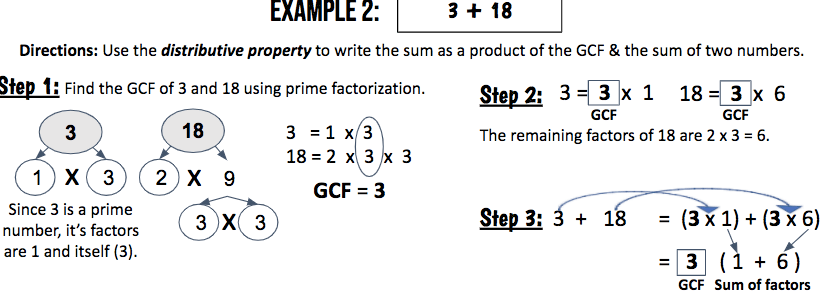
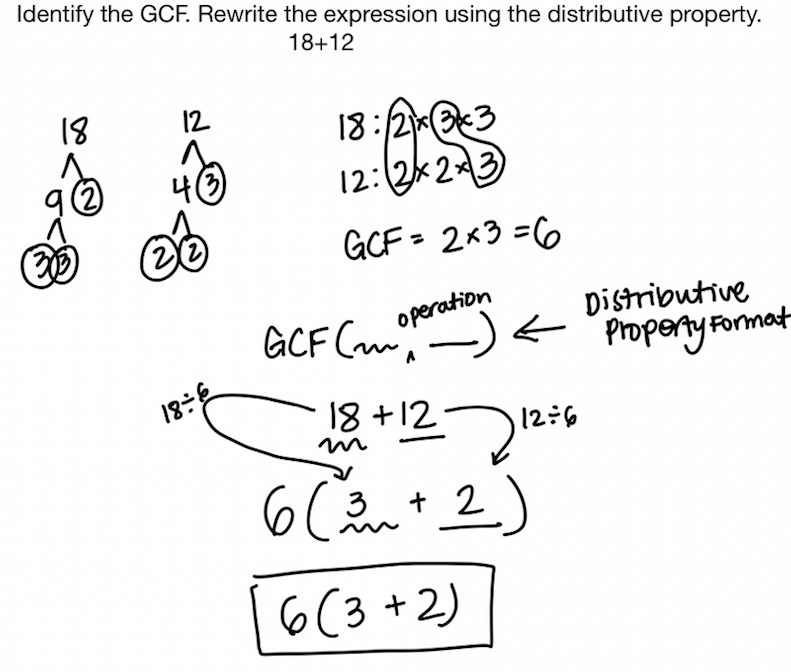
Distributive Property
When you distribute something, you are dividing it into parts. In math, the distributive property helps simplify difficult problems because it breaks down expressions into the sum or difference of two numbers.
17
18
19
Multiple Choice
Identify the GCF. Rewrite the expression using the distributive property. 20 + 35
5(4+7)
55
5(6+5)
20
The End
Now that you've done a full review of standard 6.NS.4, go back and review the lessons that you struggled with. Great job today!
6NS4 GCF/LCM/Distributive Property Review

Show answer
Auto Play
Slide 1 / 20
SLIDE

Similar Resources on Wayground
15 questions
Evaluating Algebraic Expressions
Presentation
•
6th Grade
15 questions
Basic Ratios
Presentation
•
6th Grade
14 questions
(5th) Introduction to Exponents Lesson
Presentation
•
6th Grade
16 questions
6.G.1: Area Review
Presentation
•
6th Grade
16 questions
10.5 Dot Plots, Stem-and-Leaf Plots
Presentation
•
6th Grade
16 questions
Input Output Tables
Presentation
•
6th Grade
16 questions
Distributive property/ expressions
Presentation
•
6th Grade
16 questions
Fraction/Decimal/Percent Conversion
Presentation
•
6th Grade
Popular Resources on Wayground
20 questions
Math Review
Quiz
•
3rd Grade
15 questions
Fast food
Quiz
•
7th Grade
20 questions
Context Clues
Quiz
•
6th Grade
20 questions
Inferences
Quiz
•
4th Grade
19 questions
Classifying Quadrilaterals
Quiz
•
3rd Grade
20 questions
Figurative Language Review
Quiz
•
6th Grade
20 questions
Equivalent Fractions
Quiz
•
3rd Grade
10 questions
Identify Fractions, Mixed Numbers & Improper Fractions
Quiz
•
3rd - 4th Grade
Discover more resources for Mathematics
22 questions
Dot Plots and Histograms
Quiz
•
6th Grade
15 questions
Histograms
Quiz
•
6th Grade
23 questions
6th Grade Math Review
Quiz
•
6th Grade
70 questions
Multiplication Facts
Quiz
•
3rd - 6th Grade
21 questions
5th-Grade Math Review
Presentation
•
5th - 6th Grade
10 questions
Test Your Knowledge with 15 Fun Trivia Questions
Interactive video
•
6th - 10th Grade
15 questions
One- Step Equations
Quiz
•
6th Grade
52 questions
6th grade Math EOG Review
Quiz
•
6th Grade