Elastic, Chemical, and Gravitational Energy
Presentation
•
Physics
•
10th - 11th Grade
•
Hard

Joseph Anderson
FREE Resource
9 Slides • 17 Questions
1
Energy
0625 Physics
2
Learning Objective 1
Identify changes in kinetic, gravitational potential, chemical, elastic (strain), nuclear and internal energy that have occurred as a result of an event or process.
3
Multiple Choice
Every moving object has energy in this energy store
Kinetic
Elastic
Chemical
Nuclear
4
Multiple Choice
Two magnets close together have energy in this energy store.
Chemical
Elastic
Magnetic
Gravitational Potential
5
Multiple Choice
Two negatively charged particles which are close together have energy in this energy store
Electrostatic
Magnetic
Nuclear
Elastic
6
Multiple Choice
A stretched rubber band has energy in this energy store
Magnetic
Electrostatic
Elastic
Nuclear
7
Multiple Choice
Food, fuels and batteries have energy in this energy store
Chemical
Thermal
Gravitational Potential
Elastic
8
Multiple Choice
A roller coaster at the top of a hill has energy in this energy store.
Gravitational Potential
Thermal
Elastic Potential
Chemical
9
Learning Objective 2
Recognise that energy is transferred during events and processes, including examples of transfer by forces (mechanical working), by electrical currents (electrical working), by heating and by waves
10
Multiple Choice
Energy which is transferred due to temperature difference caused electrically or by a chemical reaction.
Mechanically
Electrically
By Radiation
By Heating
11
Multiple Choice
Energy which is transferred by a force moving an object through a distance
Mechanically
Electrically
By Radiation
By Heating
12
Multiple Choice
Energy which is transferred by charges moving due to a potential difference (voltage)
Mechanically
Electrically
By Radiation
By Heating
13
Multiple Choice
Energy which is transferred as a wave, for example light.
Mechanically
Electrically
By Radiation
By Heating
14
Learning Objective 3
Recall and use the expressions kinetic energy = ½mv 2 and change in gravitational potential energy = mg∆h
15
Gravitational Potential Energy
mass x gravitational field strength x height
16
Kinetic Energy
21 x mass x Speed2
17
Multiple Choice
An Olympic high jumper, with a mass of 82 kg, has a maximum gravitational potential energy of 1970 J. How high was the jump?
Let g = 9.8N/kg
24 m
161,540 m
2.5 m
201 m
18
Multiple Choice
How could you increase the gravitational potential energy of an object without changing its mass and gravity?
Make the object larger
Lower the object towards the ground
Raise the object farther off the ground
Allow the object to roll on the ground
19
Multiple Choice
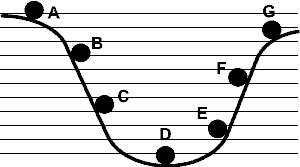
At which point does the ball has the greatest gravitational potential energy (GPE)?
A
G
D
C
G
20
Multiple Choice
What is the mass of a moving object that has 100 Joules of KE and moves at a velocity of 2 m/s?
50 kg
200 kg
25 kg
100 kg
21
Multiple Choice
What two factors affect an object's kinetic energy?
area and volume
mass and weight
weight and height
mass and speed
22
Learning Objectives 4
Apply the principle of conservation of energy to simple examples
Apply the principle of conservation of energy to examples involving multiple stages
Explain that in any event or process the energy tends to become more spread out among the objects and surroundings (dissipated)
23
Energy transferred as the skier rade down the hill
GPE to KE
24
Skier in a downhill race
Energy Lost= Energy Gained
mgh= 21 mv2
Assuming no energy is dissipated as heat or sound energy
25
Multiple Choice
What does the Law of Conservation of Energy state?
Energy cannot be created or destroyed
Nothing can exchange energy
Energy will increase over time.
Energy will decrease over time.
26
Multiple Choice
A 40 kg crate is picked up by a crane to a height of 50m. The crate falls. What is the velocity of the crate just before it hits the ground?
2000 Joules
19,600 Joules
19,600 m/s
31.3 m/s
Energy
0625 Physics

Show answer
Auto Play
Slide 1 / 26
SLIDE

Similar Resources on Wayground
21 questions
Exponent Properties
Presentation
•
10th - 11th Grade
18 questions
Interpreting Motion Graphs
Presentation
•
9th - 12th Grade
20 questions
Work, Energy and Power
Presentation
•
10th - 12th Grade
20 questions
Momentum
Presentation
•
9th - 11th Grade
22 questions
P.7C Transverse vs Longitudinal Behaviors Part 1
Presentation
•
11th Grade
22 questions
Radioactivity and Half life
Presentation
•
10th - 12th Grade
20 questions
Series and parallel circuits
Presentation
•
10th - 12th Grade
20 questions
Triangle Inequality
Presentation
•
10th - 11th Grade
Popular Resources on Wayground
20 questions
STAAR Review Quiz #3
Quiz
•
8th Grade
20 questions
Equivalent Fractions
Quiz
•
3rd Grade
6 questions
Marshmallow Farm Quiz
Quiz
•
2nd - 5th Grade
20 questions
Main Idea and Details
Quiz
•
5th Grade
20 questions
Context Clues
Quiz
•
6th Grade
20 questions
Inferences
Quiz
•
4th Grade
19 questions
Classifying Quadrilaterals
Quiz
•
3rd Grade
12 questions
What makes Nebraska's government unique?
Quiz
•
4th - 5th Grade