
Electromagnets, Generators, and Motors

Presentation
•
Physics
•
9th - 12th Grade
•
Hard

Joseph Anderson
FREE Resource
9 Slides • 7 Questions
1
2


Magnetism and Electric Current
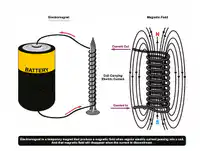
⚫ A solenoid is a coil
of wire with an
electric current in
it.
⚫
The electric
current creates a
magnetic field
around each loop of
the wire.
◼
more loops = more
magnetic force
◼
more current =
more magnetic
force
3


Magnetism and Electric Current
⚫
The magnetic
force of a solenoid
can also be
strengthened by
adding a soft iron
core to its center.
⚫
This is called an
electromagnet.
4
5
Multiple Choice
All electric current generate ___ fields
Thermal
magnetic
Radio
Kinetic
6
Multiple Select
To increase the power of an electromagnet you can (more than one answer)
increase the current
increase the number of metal coils
Decrease the current
decrease the number of turns
7


Creating Electric Current
⚫
Faraday’s Lawof
Induction describes
the production of a
current in a
conducting circuit by
a change in the
strength, position, or
orientation of an
external magnet.
8
9
Multiple Choice
In 1831, Michael Faraday was the first to realize that an electric current could be induced by passing a magnet through a coil of copper wire. Which factor is MOST essential for the induction of the electric current?
The use of strong magnets for the process
The movement of the magnet relative to the coil
The use of very long coils for the process
The use of magnetic material to make the coil.
10


Creating Electric Current
⚫
Electrical generators change mechanical
energy to electrical energy using
electromagnetic induction.
In a commercial generator, an electric current is
produced when a large coil of wire is rotated
through a strong magnetic field.
11


Using Electric Current
⚫
Electric Motors
convert electrical
energy into
mechanical energy by
using magnets to
create motion.
⚫
Inside an electric
motor, the
attracting and
repelling forces of
two magnets create
a rotational motion.
12
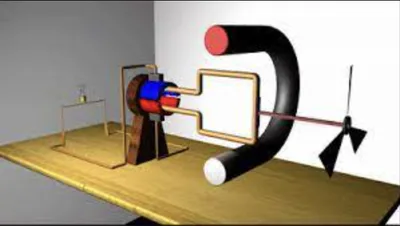
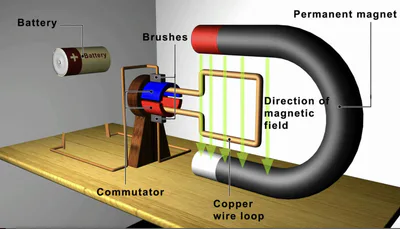
A generator is a device that converts mechanical energy into electrical energy.
Most of the electrical energy we use comes from generators
Generators
Electric motors convert electrical energy into mechanical energy that is used to do work. Examples of motors include those in many household appliances, such as blenders and washing machines
Motors
13
Multiple Choice
Fields can exist that exert force on objects, even when objects are not touching.
True
False
14
Multiple Choice
Current produced when a coil of wire is moved
through a magnetic field
Circuit
Electromagnetic Induction
Solenoid
Electric Motor
15
Multiple Choice
Which of the following DOES NOT have an effect on the strength of magnetic and electric charge?
Amount of resistance in a material
Size or loops of a solenoid
Increased current
Amount of neutrons in an atom.
16
Multiple Choice
_________ produce temporary magnetic fields while ________ have permanent magnetic fields
Permanent Magnets, Electromagnets
Electromagnets, Permanent Magnets
Electromagnets, Currents
Permanent Magnets, Solenoids
Show answer
Auto Play
Slide 1 / 16
SLIDE
Similar Resources on Wayground

10 questions
Modeling with Quadratic
Presentation
•
9th - 12th Grade
14 questions
Archimedes' Principle
Presentation
•
9th - 12th Grade
11 questions
Equations of Circles
Presentation
•
9th - 12th Grade
12 questions
What is Science?
Presentation
•
KG - 12th Grade
12 questions
Counterarguments and Rebuttals
Presentation
•
9th - 12th Grade
10 questions
Summarizing
Presentation
•
9th - 12th Grade
12 questions
Discriminant
Presentation
•
9th - 12th Grade
12 questions
Unit 7 Review
Presentation
•
9th - 12th Grade
Popular Resources on Wayground
10 questions
Safety Day 2026 – Student Review

Quiz
•
9th Grade
21 questions
Continents and Oceans
Quiz
•
6th Grade
20 questions
Parts of Speech
Quiz
•
5th Grade
16 questions
Subject & Predicate
Quiz
•
5th Grade
25 questions
Multiplication Facts
Quiz
•
5th Grade
12 questions
Map Skills
Quiz
•
3rd Grade
22 questions
Continents and Oceans
Quiz
•
5th Grade
15 questions
Rounding Decimals
Quiz
•
5th Grade
Discover more resources for Physics
20 questions
Position vs. Time Graphs
Quiz
•
9th Grade
10 questions
Exit Check 5.1 - Forms of Energy
Quiz
•
9th Grade
11 questions
Electricity Explained

Interactive video
•
9th - 12th Grade
87 questions
25-26 Unit 1.2 Review - Radioactivity & Earth's Age
Quiz
•
8th - 10th Grade
15 questions
Position vs. Time and Velocity vs. Time Graphs
Quiz
•
10th - 12th Grade
18 questions
Quiz #8 Practice: Forces on an Incline
Quiz
•
9th Grade
25 questions
Newton's Laws of Motion
Quiz
•
9th Grade