

Gas Law Review

Presentation
•
Chemistry
•
12th Grade
•
Hard

Joseph Anderson
FREE Resource
12 Slides • 10 Questions
1
Units 9-10
Some text here about the topic of discussion
2
Major Content:
Kinetic Molecular Theory
Gas Law Formulas
Real vs. Ideal Gases
Gas Stoichiometry
Some text here about the topic of discussion
3
Assumptions:
Gas molecules move in random lines and maintain their speed even during collisions
Gas motion is determined by
temperature of molecules
molar mass of molecules
4
Multiple Choice
As the temperature of a substance increases:
The speed, and average kinetic energy of the particles, both increase.
The speed, and average kinetic energy of the particles, both decrease.
The speed of the particles increases, but the average kinetic energy of the particles decreases.
The speed of the particles decreases, but the average kinetic energy of the particles increases.
5
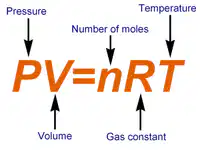
Gas Variables
pressure
volume
temperature
moles
ideal gas constant, R
Gas Laws
Boyle's Law
Charles' Law
Gay-Lussac's Law
Combined Gas Law
Ideal Gas Law
6
Multiple Choice
A gas sample is held at constant pressure. The gas occupies 3.62 L of volume when the temperature is 21.6°C. Determine the temperature at which the volume of the gas is 3.42 L.
312K
278K
20.4K
295K
552K
7
No gas actually behaves 'ideally'
deviates from ideal behavior at high pressures and low temperatures
due to interaction of molecules and how much space they occupy
8
Multiple Choice
7.18 L
7.80 L
4.63 L
4.36 L
9

10
Multiple Choice
Mg3N2 + 3H2O → 3MgO + 2NH3
If 10.3 g of magnesium nitride is used, what volume of ammonia gas would be collected at 20.0°C and 0.989 atm?
14.5 L NH3
4.96 L NH3
0.261 L NH3
24.9 L NH3
11
Major Content:
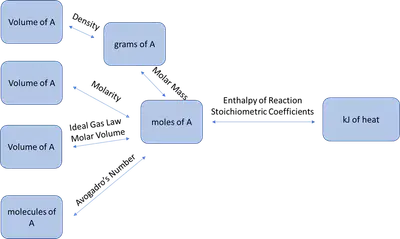
Thermochemical equations and stoichiometry
Calculating Enthalpy
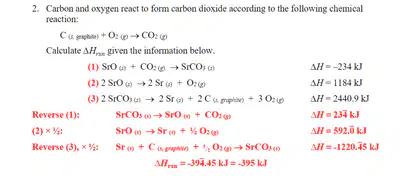
Hess's Law
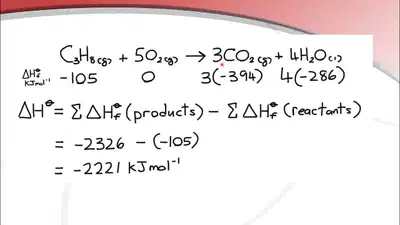
Standard Enthalpy of Formation
Bond Energies
Calorimetry
12
13
Multiple Choice
P4 + 6Cl2 --> 4PCl3 + 2439 kJ
25.43 g
563.0 g
2.421 g
300.0 g
14
Manipulating given reactions (and their enthalpies) so that when the combine, the form a desired reaction
15
Multiple Choice
Consider the following equations.
Mg(s) + O2(g) → MgO(s) ∆H = –602 kJ
H2(g) + O2(g) → H2O(g) ∆H = –242 kJ
What is the ∆H value (in kJ) for the following reaction?
MgO(s) + H2(g) → Mg(s) + H2O(g)
-844
-360
+360
+844
16
1. Multiply the given ΔHf values of each reactant and product by how many appear in the given reaction
Sum the total values of enthalpy on the reactant and products side
ΔHrxn is found by subtracting the product total - reactant total
17
Multiple Choice
Calculate the enthalpy of reaction (ΔH).
4CO2 (g) + 6H2O (g) → 2C2H6 (g) + 7O2 (g)
ΔHfo [CO2(g)] = -393.5 kJ
ΔHfo [H2O(g)] = -241.8 kJ
ΔHfo [C2H6(g)] = -84.7 kJ
ΔHfo [O2(g)] = 0 kJ
550.647 KJ/mol
2855.584 KJ/mol
-550.647 KJ/mol
-2855.584 KJ/mol
18
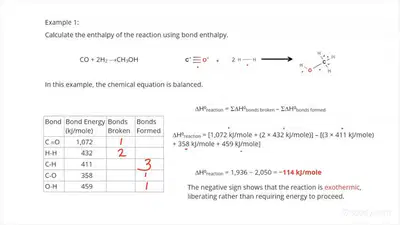
Energy of bonds broken - energy of bonds formed
19
Multiple Choice

20
21
Fill in the Blanks
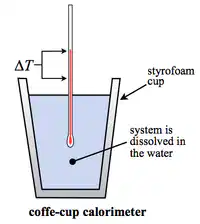
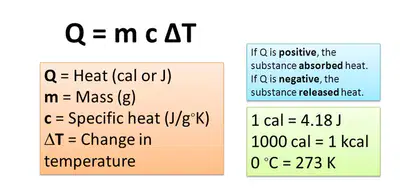
A sample of iron receives 50.J of heat energy that raises the temperature of the iron by 25.0°C. If iron has a specific heat of 0.10 J/g°C, what is the mass of the iron sample?
22
Multiple Choice
15.0 gram sample of a metal at 200C is added to 100 grams of water (S= 4.184) at 25C. The ending temperature of both species is 28C.
What is the specific heat of the metal?
1.255
0.836
0.489
0.211
Units 9-10
Some text here about the topic of discussion
Show answer
Auto Play
Slide 1 / 22
SLIDE
Similar Resources on Wayground

19 questions
Outdoor Safety Overview
Presentation
•
12th Grade
15 questions
Integumentary System
Presentation
•
12th Grade
19 questions
GASES
Presentation
•
11th Grade
18 questions
Sel Elektrolisis dan Hukum Faraday
Presentation
•
12th Grade
18 questions
Fractions Intro
Presentation
•
KG - 12th Grade
16 questions
Cristianismo
Presentation
•
12th Grade
14 questions
Percent Yield
Presentation
•
12th Grade
17 questions
Enlace Químico.
Presentation
•
12th Grade
Popular Resources on Wayground
10 questions
Safety Day 2026 – Student Review

Quiz
•
9th Grade
21 questions
Continents and Oceans
Quiz
•
6th Grade
20 questions
Parts of Speech
Quiz
•
5th Grade
16 questions
Subject & Predicate
Quiz
•
5th Grade
25 questions
Multiplication Facts
Quiz
•
5th Grade
12 questions
Map Skills
Quiz
•
3rd Grade
22 questions
Continents and Oceans
Quiz
•
5th Grade
15 questions
Rounding Decimals
Quiz
•
5th Grade
Discover more resources for Chemistry
20 questions
electron configurations and orbital notation
Quiz
•
9th - 12th Grade
20 questions
Physical or Chemical Change/Phases
Quiz
•
8th Grade - University
15 questions
Periodicity Module Exam Practice Quiz
Quiz
•
9th - 12th Grade
8 questions
Label Energy Diagram
Quiz
•
9th - 12th Grade
10 questions
Endothermic/Exothermic
Quiz
•
9th - 12th Grade
6 questions
Energy Change
Quiz
•
9th - 12th Grade
20 questions
Physical & Chemical Properties & Changes
Quiz
•
9th - 12th Grade
6 questions
Collision Theory
Quiz
•
9th - 12th Grade