


Intramolecular Force and Polarity
Presentation
•
Chemistry
•
10th Grade
•
Hard

Joseph Anderson
FREE Resource
9 Slides • 8 Questions
1
Polarity and Intermolecular Forces
2
Polar vs Nonpolar
A polar molecule is sharing electrons unequally (two different poles, one positive and the other negative)
A nonpolar is sharing electrons equally (tug of war with two trucks pulling with the exact same force)
3
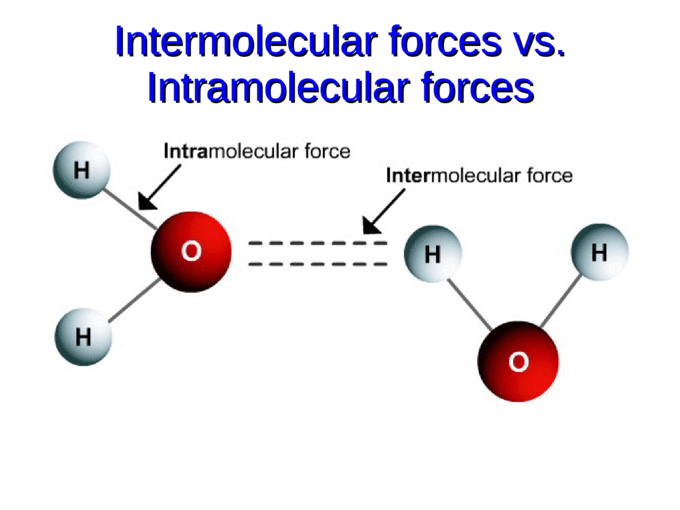
INTRAmolecular VS INTERmolecular Forces
INTRAmolecular forces are the bonds that occur inside or within a single moelcule.
INTERmolecular forces (IMF) exist between two or more molecules
4
Multiple Choice
Intermolecular Forces are the forces that exist
Between two or more molecules
Within a single molecule
Only in molecules containing carbon
In all molecules
5
INTERmolecular Forces
Examples of intermolecular forces include london dispersion (LDF), dipole/dipole, and hydrogen bonding
6
7
Multiple Choice
Examples of an intermolecular force include
london disperson
hydrogen bonding
dipole dipole
all of the above
8
Multiple Choice
Which type of intermolecular force is the strongest?
LDF
dipole-dipole
Hydrogen bonding
Covalent bonding
9
London Dispersion Force (LDF)
The weakest force
Occurs between ALL MOLECULES
If a molecule is nonpolar then the only force present will be LDF
10
Dipole Dipole Forces
Occurs between all polar molecules
The attraction of the positive end of one molecule to the negative end of another
11
Hydrogen Bonding
Must have a hydrogen directly bonded to a F, N or O.
Strongest type of intermolecular force
12
Multiple Choice
For hydrogen bonding to occur, a molecule must have a hydrogen bonded to
carbon
another hydrogen
Fluorine, Chlorine or Oxygen
Fluorine, Nitrogen or Oxygen
13
Polar and Nonpolar
Nonpolar molecules will contain only london dispersion forces
Polar molecules will contain london dispersion and dipole dipole
Molecules with hydrogen bonding will contain all three types of forces
14
Multiple Choice
Which of the following is an example of a polar molecule
water
propane
methane
carbon dioxide
15
Multiple Choice
Is methane (CH4) polar or nonpolar?
polar
nonpolar
16
Multiple Choice
What forces are present in methane (CH4)?
LDF
dipol-dipole
Hydrogen bonding
All of the above
17
Multiple Choice
Does this molecule contain hydrogen bonding?
yes
no
Polarity and Intermolecular Forces

Show answer
Auto Play
Slide 1 / 17
SLIDE

Similar Resources on Wayground
11 questions
Ch. 8.2 - The Nature of Covalent Bonding PART 1
Lesson
•
9th - 11th Grade
14 questions
Properties of Ionic Compounds
Lesson
•
10th Grade
9 questions
Limiting reactants and Percentage yield
Lesson
•
10th Grade
13 questions
Text Structure
Lesson
•
10th Grade
10 questions
Inter Molecular forces of attractions IMF'S
Lesson
•
10th Grade
15 questions
Dehydration Synthesis and Hydrolysis
Lesson
•
10th Grade
10 questions
Lab: Hydrates
Lesson
•
10th Grade
10 questions
Empirical Formula of a Hydrate
Lesson
•
10th Grade
Popular Resources on Wayground
10 questions
5.P.1.3 Distance/Time Graphs
Quiz
•
5th Grade
10 questions
Fire Drill
Quiz
•
2nd - 5th Grade
20 questions
Equivalent Fractions
Quiz
•
3rd Grade
15 questions
Hargrett House Quiz: Community & Service
Quiz
•
5th Grade
20 questions
Main Idea and Details
Quiz
•
5th Grade
20 questions
Context Clues
Quiz
•
6th Grade
20 questions
Inferences
Quiz
•
4th Grade
15 questions
Equivalent Fractions
Quiz
•
4th Grade
Discover more resources for Chemistry
20 questions
Acids and Bases
Quiz
•
10th Grade
30 questions
Element compound mixture review quiz
Quiz
•
10th - 12th Grade
10 questions
Determining Protons, Neutrons, and Electrons from the Periodic Table
Interactive video
•
6th - 10th Grade
10 questions
Identifying Types of Chemical Reactions
Interactive video
•
6th - 10th Grade
20 questions
U4 Reaction Types
Quiz
•
10th - 12th Grade
10 questions
Exploring Types of Chemical Reactions
Interactive video
•
6th - 10th Grade
20 questions
Elements, Compounds, and Mixtures
Quiz
•
10th Grade
5 questions
DOL REC: Solubility Rules and Precipitation Reactions
Quiz
•
10th - 12th Grade