

Marine Zones

Presentation
•
Science
•
8th Grade
•
Hard

Joseph Anderson
FREE Resource
11 Slides • 15 Questions
1
2
3
Fill in the Blanks
Type answer...
4
Multiple Choice
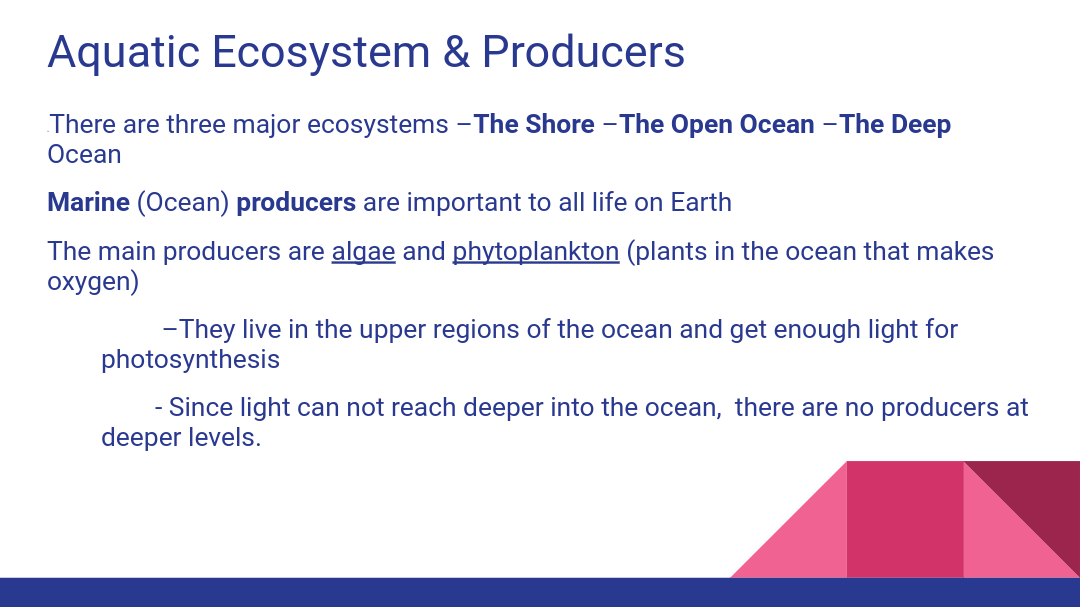
The main producers are algae and _______ (plants in the ocean that makes oxygen)
algal bloom
fish
phytoplankton
5
6
Poll
If you could live in any part of the ocean where would you live?
Up top near the sunlight so you could stick your neck out of the water
In the middle just swimming
In the deep depths of the dark sea where no one would be able to see you
7

8

9
Multiple Choice
This is the zone where no light or very little light penetrates.
Photic
Aphotic
10
Multiple Choice
Which zone is where a primarily of photosynthesis in the ocean occurs?
Photic zone
Aphotic Zone
11

12

13
Multiple Choice
In which oceanic zone do the land and ocean meet and clams and crabs survive by burrowing (make holes) in the sand?
oceanic
intertidal
deep ocean
open ocean
14

15
Fill in the Blanks
The Abyssal Zone can also be called the
Type answer...
16

17
Multiple Choice
Which contributes most in supporting life on the deep ocean floor?
cold water temperatures
extreme water pressures
hydrothermal vents
lack of preators
18
Multiple Choice
Quick review: What percentage of earth's water is found in the oceans? What percentage is freshwater?
97% is ocean water
3% is freshwater
I don't remember
70% is ocean water
3% is freshwater
50% is ocean
50% is freshwater
19
Multiple Choice

Quick Review: Which is Earth's largest source of drinkable water?
Lakes
rivers
oceans
aquifers
20
The bringing of nutrients and cold water from deep in the ocean floor to the surface.
Increases aquatic life
Increases fishing industry
Increases productivity

21
Multiple Choice
An ocean current that brings cold, nutrient rich water to the surface is a
salinity
upwelling
coastal current
downwelling
22
Multiple Choice
Upwellings...
increase productivity
draw in aquatic life for feeding
increase fishing
all of the above
23
Where fresh and salt water meet
Contain brackish water
24
Multiple Choice
True or False:
Estuaries are some of the most productive ecosystems in the world.
True
False
25
Multiple Choice
A mix of salt and fresh water
salinity
brackish
pH
turbidity
26
Multiple Choice
Why are estuaries so important for life?
Filter out pollutants and prevent erosion
Act as a home for many types of wildlife
Provide nurseries for marine life
All of the above
Show answer
Auto Play
Slide 1 / 26
SLIDE
Similar Resources on Wayground

19 questions
Light Interactions with Matter
Presentation
•
8th Grade
19 questions
Element's Identity & Valence Electrons
Presentation
•
8th Grade
21 questions
Specific heat Capacity
Presentation
•
8th Grade
18 questions
Cellular respiration vs photosynthesis
Presentation
•
8th Grade
20 questions
How does DNA affect traits?
Presentation
•
8th Grade
21 questions
Solar System Vocabulary
Presentation
•
8th Grade
21 questions
Net Force Review
Presentation
•
8th Grade
19 questions
Taxonomy
Presentation
•
8th Grade
Popular Resources on Wayground
10 questions
Safety Day 2026 – Student Review

Quiz
•
9th Grade
21 questions
Continents and Oceans
Quiz
•
6th Grade
20 questions
Parts of Speech
Quiz
•
5th Grade
16 questions
Subject & Predicate
Quiz
•
5th Grade
25 questions
Multiplication Facts
Quiz
•
5th Grade
12 questions
Map Skills
Quiz
•
3rd Grade
22 questions
Continents and Oceans
Quiz
•
5th Grade
15 questions
Rounding Decimals
Quiz
•
5th Grade
Discover more resources for Science
20 questions
Newton's Laws of Motion
Quiz
•
8th Grade
15 questions
potential and kinetic energy
Quiz
•
8th Grade
21 questions
Newton's Laws of Motion
Quiz
•
8th Grade
20 questions
Elements, Compounds and Mixtures
Quiz
•
8th Grade
10 questions
Exploring Chemical and Physical Changes

Interactive video
•
6th - 10th Grade
20 questions
Physical vs Chemical Changes
Quiz
•
8th Grade
20 questions
Conduction, convection, and Radiation Practice
Quiz
•
8th Grade
21 questions
Waves and Wave Properties
Quiz
•
6th - 8th Grade