Oceanic Convection Currents
Presentation
•
Science
•
8th Grade
•
Hard

Joseph Anderson
FREE Resource
14 Slides • 13 Questions
1
Convection currents and Hurricane formation
2
Feb. 3, 2021
Today you will be going over ocean currents, convection currents and how Hurricanes are formed.
You need to take notes on the convection and Hurricanes.
3
The next two slides are weather front review questions.
4
Multiple Choice
Based on the weather map, what will most likely happen to the weather in the North western area of Texas
Clear skies and warmer
Dry air and sunny
Thunderstorms and lower temperatures
Calm breezes
5
Multiple Choice
A cold front is approaching Minneapolis. What will happen to the air temperature?
stay the same
increase
decrease
6
On the next slide you will be shown a video about convection currents.
Pay attention on how it moves. The circulation pattern for hot and cold waters.
7
8
Multiple Choice
Warm air is __________ dense than cold air and rises creating convection currents.
more
less
9
Multiple Choice
Warm air rises and the cool air sinks demonstrates this type of heat transfer.
conduction
convection
radiation
Insolation
10
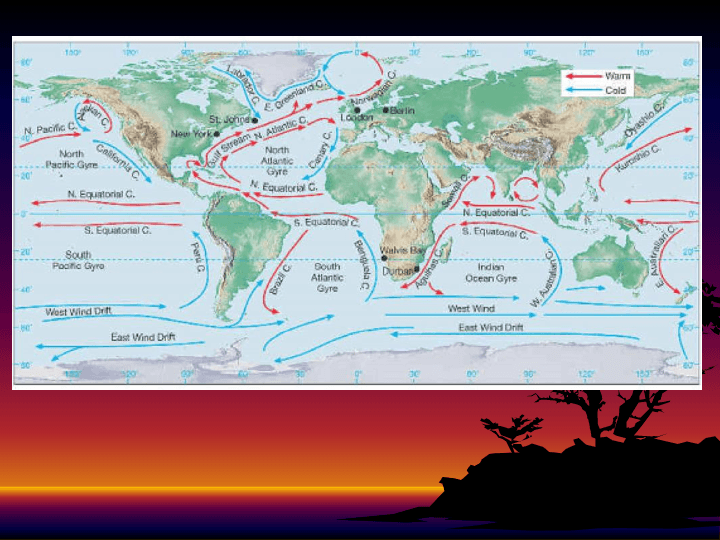
Ocean Currents
Movement of water from Cold to warm places on Earth.
Okay that is too simple.
11
12
13
14
Multiple Choice
15
Multiple Choice
16
Multiple Choice
The Gulf Stream is a current that brings warm ocean water from the south to the north. What type of heat transfer is this?
conduction
convection
radiation
Insolation
17
Multiple Choice
Look at the picture. Which of the following statements best explains why the city of Hopedale is cooler than the city of Stornoway?
Hopedale has a longer duration of isolation each day.
Hopedale is influenced by a cold ocean current.
Stornoway is farther from the equator
Stornoway is on a different continent
18
19
20
21
22
23
Multiple Choice
Which situation would reduce the strength of a hurricane?
the formation of a low-pressure area
the formation of a high-pressure area
warm water moving into the area
cool water moving into the area
24
Multiple Choice
View the colored diagram. Which area of the map would produce the most hurricanes and violent storms?
the gray areas - over warm land
the gray areas - over cool land
near the equator
near the poles
25
Multiple Choice
What makes hurricanes go away?
They move out to sea.
They begin to spin in a spiral motion.
hey get moisture from warm ocean waters.
They move over land or cold water and lose energy.
26
Multiple Choice
Which of the following is a true statement?
hurricane is a triangle-shaped storm.
Thunderstorms last longer than hurricanes.
It's common to see hurricanes in January and February.
Hurricanes form in warm weather.
27
Multiple Choice
What is the “fuel” that “feeds” a hurricane
cold air
dry air
warm and moist air
warm and dry air
Convection currents and Hurricane formation
Show answer
Auto Play
Slide 1 / 27
SLIDE

Similar Resources on Wayground
21 questions
Natural Selection & Adaptation
Lesson
•
8th Grade
21 questions
Big Bang Theory
Lesson
•
8th Grade
22 questions
Day/Night and Seasons
Lesson
•
8th Grade
22 questions
Module H-Conduction, Convection, & Radiation
Lesson
•
8th Grade
19 questions
law of superposition
Lesson
•
8th Grade
19 questions
1.3 Microscopes
Lesson
•
8th Grade
23 questions
Chemical and Physical Properties
Lesson
•
8th Grade
23 questions
Intro to Environmental Changes 8.11B
Lesson
•
8th Grade
Popular Resources on Wayground
10 questions
5.P.1.3 Distance/Time Graphs
Quiz
•
5th Grade
10 questions
Fire Drill
Quiz
•
2nd - 5th Grade
20 questions
Equivalent Fractions
Quiz
•
3rd Grade
15 questions
Hargrett House Quiz: Community & Service
Quiz
•
5th Grade
20 questions
Main Idea and Details
Quiz
•
5th Grade
20 questions
Context Clues
Quiz
•
6th Grade
20 questions
Inferences
Quiz
•
4th Grade
15 questions
Equivalent Fractions
Quiz
•
4th Grade
Discover more resources for Science
20 questions
Recognizing Violence and Being an Upstander
Quiz
•
8th Grade
19 questions
Introduction to Properties of Waves
Lesson
•
6th - 8th Grade
16 questions
Interactions within Ecosystems
Lesson
•
6th - 8th Grade
10 questions
Exploring the Layers of the Earth
Interactive video
•
6th - 10th Grade
20 questions
Newton's Laws of Motion
Quiz
•
8th Grade
46 questions
8th Science STAAR Review
Quiz
•
8th Grade
10 questions
Exploring the Dynamics of Ocean Currents
Interactive video
•
6th - 10th Grade
23 questions
Newton's 3 Laws of Motion
Quiz
•
8th Grade