
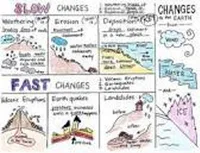
Rapid Changes to the Earth's Surface

Presentation
•
Science
•
5th Grade
•
Hard

Joseph Anderson
FREE Resource
9 Slides • 4 Questions
1
Understanding the dynamic transformations occurring on our planet's crust and landscape.
Exploring the forces and processes that shape the Earth's surface over time.
2
Slow Changes in Earth's Surface
Weathering: The process of breaking down rocks, soil, and minerals through exposure to the atmosphere and environmental factors.
Erosion: The movement of weathered materials by wind, water, ice, or gravity.
Deposition: The settling or laying down of eroded materials in a new location.
3
Multiple Choice

What is the process of breaking down rocks, soil, and minerals through exposure to the atmosphere and environmental factors?
Weathering
Erosion
Deposition
None of the above
4
Weathering
Weathering is the process of breaking down rocks, soil, and minerals through exposure to the atmosphere and environmental factors. It is a slow but continuous process that shapes the Earth's surface over time. Weathering can be physical, such as freeze-thaw cycles, or chemical, like acid rain. It plays a crucial role in the formation of soil and the creation of landscapes.
5
changes in Earth's Surface
Erosion: The process of wearing away the Earth's surface by wind, water, or ice.
Deposition: The process of depositing sediment or soil in a new location.
Fast Changes: Rapid alterations in the Earth's surface caused by natural events like earthquakes or volcanic eruptions.
Fu
6
Multiple Choice
Which process is responsible for rapid alterations in the Earth's surface caused by natural events like earthquakes or volcanic eruptions?
Erosion
Deposition
Fast Changes
Fu
7
Fast Changes
Fast changes in the Earth's surface caused by natural events like earthquakes or volcanic eruptions are known as geological hazards. These hazards can have significant impacts on the environment and human populations. Some examples include tsunamis, landslides, and volcanic ash clouds. Understanding and managing these hazards is crucial for ensuring the safety and well-being of communities worldwide.
8
Changes in Earth's Surface
Earthquakes: Sudden shaking of the Earth's surface caused by tectonic plate movements.
Erosion: Process of wearing away rocks and soil by wind, water, or ice.
Volcanic Activity: Eruption of molten rock, ash, and gases from a volcano.
Landforms: Natural features on the Earth's surface, such as mountains, valleys, and plains.
9
Multiple Choice
Which process is responsible for the wearing away of rocks and soil by wind, water, or ice?
Earthquakes
Erosion
Volcanic Activity
Landforms
10
Erosion:
Erosion is the process responsible for the wearing away of rocks and soil by wind, water, or ice. It shapes our landscapes and creates stunning natural formations like the Grand Canyon. Erosion can take thousands of years to create these remarkable features. It is a powerful force of nature that constantly shapes and changes our world.
11
Changes in Earth's Surface
CHANGES: Refers to the dynamic alterations occurring on the Earth's surface over time.
CARTH: Stands for Continental Drift, which explains how continents have moved and changed their positions.
AUSER: Represents Erosion, the process of wearing away rocks and soil by natural forces like wind, water, and ice.
KE: Denotes Weathering, the breakdown of rocks into smaller pieces due to exposure to elements like temperature changes and chemical reactions.
12
KE - Weathering
Weathering is the process of breaking down rocks into smaller pieces. It occurs due to exposure to elements like temperature changes and chemical reactions. Weathering plays a crucial role in shaping the Earth's surface over time. Fun Fact: The Grand Canyon was formed by weathering and erosion over millions of years.
13
Multiple Choice
What does the term 'KE' represent in the context of changes in the Earth's surface?
Refers to the dynamic alterations occurring on the Earth's surface over time.
Stands for Continental Drift, which explains how continents have moved and changed their positions.
Represents Erosion, the process of wearing away rocks and soil by natural forces like wind, water, and ice.
Denotes Weathering, the breakdown of rocks into smaller pieces due to exposure to elements like temperature changes and chemical reactions.
Understanding the dynamic transformations occurring on our planet's crust and landscape.
Exploring the forces and processes that shape the Earth's surface over time.
Show answer
Auto Play
Slide 1 / 13
SLIDE
Similar Resources on Wayground

10 questions
Light Energy
Presentation
•
5th Grade
11 questions
Force 5.6D
Presentation
•
5th Grade
11 questions
Qualitative/Quantitative Observations
Presentation
•
5th Grade
10 questions
Sun, Earth & Moon
Presentation
•
5th Grade
11 questions
Newton's Third Law of Motion
Presentation
•
5th Grade
8 questions
SS Week 17 Urbanization
Presentation
•
5th Grade
10 questions
Matter
Presentation
•
5th Grade
13 questions
Newton's First Law
Presentation
•
5th Grade
Popular Resources on Wayground
21 questions
Continents and Oceans

Quiz
•
6th Grade
20 questions
Parts of Speech
Quiz
•
5th Grade
16 questions
Subject & Predicate
Quiz
•
5th Grade
25 questions
Multiplication Facts
Quiz
•
5th Grade
12 questions
Map Skills
Quiz
•
3rd Grade
22 questions
Continents and Oceans
Quiz
•
5th Grade
15 questions
Rounding Decimals
Quiz
•
5th Grade
20 questions
Brand Labels
Quiz
•
5th - 12th Grade
Discover more resources for Science
16 questions
Fast Focus Science - Standard 5.8.A
Quiz
•
5th Grade
20 questions
Mixtures and Solutions Practice
Quiz
•
5th Grade
20 questions
Force and Motion Task Cards
Quiz
•
5th Grade
20 questions
Food Chains and Food Webs Review
Quiz
•
5th Grade
15 questions
Force and Motion
Presentation
•
5th Grade
10 questions
Law of Conservation of Mass
Quiz
•
5th Grade
25 questions
Chemical and Physical Changes in Matter
Quiz
•
5th Grade
20 questions
Food Webs
Quiz
•
5th Grade