
TCI Genetics

Presentation
•
Science
•
6th - 8th Grade
•
Hard

Joseph Anderson
FREE Resource
10 Slides • 22 Questions
1


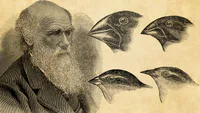
Darwin's Theory of evolution
through natural selection
2
Multiple Choice
Darwin
Mendel
Newton
Einstein
3

Vocabulary
Trait - a characteristic of an organism
Adaptation - an inherited trait evolved through natural selection that makes a population well suited to living
and reproducing in its environment
Evolution - the inherited changes that occur in a population over time
Natural Selection - the process through which individuals in a population with certain inherited traits
are more likely to survive and reproduce than individuals with less favorable traits in a specific environment
Population - a group of individuals of the same species that live and reproduce in the same place
Genetic Variation - differences in the inherited traits of different individuals
4
Multiple Choice
mutation
adaptation
variations
evolution
5
Multiple Choice
homologous
vestigial
variation
adaptation
6
Multiple Choice
Which of the following is the correct definition of natural selection?
The idea that organisms less equipped for their environment tend to survive longer
The idea that organisms more well equipped for their environment tend to survive longer
The idea that organisms more well equipped for their environment tend to not survive
None.
7
Multiple Choice

Populations consist of
a group of individuals of the same species that live and reproduce in the same place
multiple species
the biotic and abiotic factors of an environment
a grouping of ecosystems
8


0. Introduction
-In the 1830 a young, gentleman naturalist
- Charles Darwin - sailed around the
world on the HMS Beagle...this voyage
and his observation had world changing
effects
-Before Darwin, many believed life was
created and never changed
-After Dawin people understand life
evolves and is ever changing
9
Reorder
Organize the places Darwin Stopped in the the correct order:
England
Mainland South America
The Galapagos Islands
Australia
South Africa
10


1. Darwin’s Voyage on the Beagle
-Darwin was always interested in nature and science -
he tried to study medicine and theology but did not like
either
-1831, At 22 took internship on the ship (boat) HMS
Beagle, a mapping ship; looking at the coast of south
america (no satellites at this time or cell phones)
-The voyage took 5 years...and Darwin learned he gets
very Sea Sick, but he did have lots of reading time
-Influential book:
-Geologist Charles Lyell Book- the earth changes slowly over time and is
older then people (at this time) think
-This was on Darwin's mind as he experienced to events:
a.A large earthquake that caused a section of ground to lift up
b.Discovered ocean fossils at the top of some mountains
11
Multiple Choice
The idea that the earth is millions of years old gave Darwin the idea that evolution of species could happen.
Charles Lyell
(and John Hutton )
Thomas Malthus
Alfred Russel Wallace
John Baptiste LaMarck
12


2. Darwin Visits the Galápagos Islands
-In 1835, the Beagle arrived at the Galápagos
Islands, located in the Pacific Ocean about 1,000
kilometers from the coast of South America.
-Darwin saw many Galápagos species resembled
mainland South American species, he felt they
somehow traveled from South America to the
Galápagos and then changed… producing a new
Galápagos species
Example finches: Galápagos finches varied in the
size and shape of their beaks - each beak for a
different diet
a.finches that ate seeds had large, thick beaks for
cracking seeds open
b.finches that ate insects had narrow beaks for
grasping insects.
Finches and Iguanas from both locations
13
Multiple Choice
What islands did Darwin do most of his research on?
Hawaiian Islands
Malta Islands
Galapagos Islands
Indonesia Archipelagos
14
Multiple Choice
have the ability to interbreed. have the ability to interbreed.
acquired traits through use and disuse.
all eat the same type of food.
descended from a common ancestor.
15


3. Darwin Develops a Theory
-On the voyage Darwin considered the work of
two other individuals:
a.Lamarck - proposed animals changed...before Darwin...but
he had the wrong mechanism - he did allow the idea of
organism changing to be debated by scientists
b.Malthus - (The principles of population) -an economist who
describe the phenomena of exponential population growth
and the danger of it as compared with the available food
for people (he did not allow for technology increasing food
amounts)
-Darwin realize many creatures on Islands
look like slightly different version of mainland
organisms...he realizes they came from
mainland then changes on islands...this is an
ah hah moment
16
Multiple Choice

Who am I? I wrote about human populations. Darwin built off of my research and came up with the idea of natural selection.
John Hutton
Charles Lyell
Alfred Russel Wallace
John Baptiste LaMarck
Thomas Malthus
17
Multiple Choice

Who am I? My idea was called the inheritance of acquired traits. Darwin disagreed with me but did believe traits could be passed down.
John Hutton
Charles Lyell
Alfred Russel Wallace
John Baptiste LaMarck
Thomas Malthus
18


3. Darwin Develops a Theory (Continued)
-Darwin's thinking
1.
knows organism change from Lamarck and
others (fossiles, specimen collection, see's
similar but different organism in south
america and galapagos→
2.
realize change takes a long time (with help
from Lyell's ideas on geology and fossils) →
3.
realizes from Malthus that all Life
overproduces and some will die →
4.
leads to NATURAL SELECTION
19
Multiple Choice
evolution
speciation
adaptation
natural selection
20


4. Darwin’s Idea of Natural Selection
Natural selection acts on POPULATIONS not individuals
-individuals produce far more offspring than can possibly survive
-not enough resources for every living thing to survive and reproduce
-creates “struggle for existence”
-Populations have variation...the better variation are more likely to
survive and be passed on
-As the trait accululatem and becomes more exaggerated in a population
we call it an ADAPTATION
-The process occurring over many generations is called EVOLUTION
Example: Cactus finches have long beaks to help them eat...their
ancestor (and cousins...other finches do not)
Peppered moths in
non polluted
environment
Peppered moths
in polluted
environment
21
Multiple Choice
artificial selection
adaptation
acquired characteristics
tendency towards perfection
22
Multiple Choice
It is where the fittest die out and therefore reproduce and pass on their genes
It is where the fittest die out and therefore can't reproduce and pass on their genes
It is where the fittest don't die out and therefore can't reproduce and pass on their genes
It is where the fittest don't die out and therefore reproduce and pass on their genes
23


Evolution Through Natural Selection (copy into notes)
1. Genetic variation (different individuals
have different inherited traits)
2. Natural selection (individuals with
certain inherited traits are more likely to
survive and reproduce than those with
less favorable traits in a specific
environment)
3. Evolution (inherited changes occur in
a population over time).
24
Hotspot
What adaptation did Darwin notice about the birds (finches) of the Galapagos? Click on the correct adaptation on the picture.
25
Multiple Choice
What characteristic does "survival of the fittest" need for survival of a species.
Genetic Variation
Speed
Beak shape
Biodiversity
26
Multiple Choice
Which factor most directly influenced the evolution of the diverse types of beaks of these finches?
predation by humans
available food sources
oceanic storms
lack of available niches
27


5. Darwin Publishes His Work
-Darwin waited many years to publish
his book:
-Worried about the reaction due to
conflict with peoples beliefs
-Gathered more evidence to make
ideas difficult to argue against
-Wallace independently (on his own)
verifies Darwin's ideas...they present
Natural Selection together in 1858
-Darwin publish On the Origin of Species by
Means of Natural Selection in 1859
28
Multiple Choice
Why did Darwin finally publish his results?
He wanted to go on another voyage and the only way to do that was to show he found something during his first one.
He needed to make money and thought that his book would be a huge success.
His daughter found his book and told him that he need to publish it.
A friend of his, Alfred Wallace, sent him a document with similar findings. Also, Captain Fitzroy published his account of the voyage.
29
Multiple Choice

Who am I? I wrote Darwin about my theory of natural selection. He decided to publish his book before I could.
John Hutton
Charles Lyell
Alfred Russel Wallace
John Baptiste LaMarck
Thomas Malthus
30
Multiple Choice
What was the name of the book Darwin published?
How it is we evolved.
What is evolution?
The Origin of Species.
The Starting Point of All Life.
31
Multiple Choice

This picture would be an example of....
adapation
selection
variation
32
Multiple Choice

Darwin's Theory of evolution
through natural selection
Show answer
Auto Play
Slide 1 / 32
SLIDE
Similar Resources on Wayground

26 questions
Forces (Contact and Non-Contact)
Presentation
•
6th - 8th Grade
27 questions
MS-PS1-2: Chemical Interactions
Presentation
•
6th - 8th Grade
23 questions
Ecosystem Vocabulary
Presentation
•
6th - 8th Grade
23 questions
Scientific Method
Presentation
•
6th - 8th Grade
25 questions
Nature of Science
Presentation
•
6th - 8th Grade
25 questions
Physical and Chemical Changes Review
Presentation
•
8th Grade
27 questions
Unit 1: Nature of Science Review
Presentation
•
6th - 8th Grade
27 questions
Structure of Matter
Presentation
•
6th - 8th Grade
Popular Resources on Wayground
10 questions
How much do you know about our Portrait of an Eagle?

Quiz
•
10th Grade
10 questions
Fast Food Slogans
Quiz
•
6th - 8th Grade
21 questions
Continents and Oceans
Quiz
•
6th Grade
20 questions
Parts of Speech
Quiz
•
5th Grade
16 questions
Subject & Predicate
Quiz
•
5th Grade
25 questions
Multiplication Facts
Quiz
•
5th Grade
12 questions
Map Skills
Quiz
•
3rd Grade
22 questions
Continents and Oceans
Quiz
•
5th Grade
Discover more resources for Science
17 questions
7.6D Aqueous Solutions
Quiz
•
7th Grade
20 questions
Scientific Method and Variables
Quiz
•
8th Grade
20 questions
Scientific method and variables
Quiz
•
8th Grade
27 questions
Counting Atoms - Subscripts
Quiz
•
8th Grade
10 questions
6.6D - Relative Density Review
Quiz
•
6th Grade
20 questions
Claim, Evidence and Reasoning (CER)
Quiz
•
6th - 8th Grade
18 questions
Counting Atoms
Quiz
•
7th - 8th Grade
20 questions
Density
Quiz
•
6th Grade