
The Comanche Lesson

Presentation
•
Social Studies
•
4th Grade
•
Hard

Joseph Anderson
FREE Resource
10 Slides • 8 Questions
1

2
Article 2: Origins of Texas Tribes
Many American Indian tribes throughout history have called Texas their home. Some tribes are indigenous, or native, to Texas. These include the Caddo, Karankawa, Apache, Lipan Apache, Jumano, Comanche, and Wichita tribes. Each tribe lived in a different region of Texas and used the natural resources found in their region to survive. Other tribes came to Texas later. Some of these included the Alabama-Coushatta, Ysleta Del Sur Pueblo, and Kickapoo tribes. These tribes left their homelands due to an influx of American settlers, wars, and government policy that forced them out of their lands.
3
Multiple Choice
1. Which of the following is NOT one of the tribes in Texas before European exploration?
Caddo
Cherokee
Comanche
Wichita
4
Each tribe had their own language, customs, and cultural beliefs. Many American Indian languages that were once spoken in Texas are now extinct. Tribes followed specific customs and traditions. For example, one of the customs of the Jumano people was to tattoo their faces with distinct patterns. This made them easily recognizable to other tribes and, eventually, settlers in Texas.
5
Multiple Choice
True or False: Each tribe had their own language, customs, and cultural beliefs.
True
False
6
Apache: Lipan Apache
Before the Comanche arrived, the Apache lived throughout the southwest. Apache is the Zuni word for "enemy." The Lipan were an eastern Apache band. In the 1600s, they found horses. They were one of the first tribes to make horses an important part of their way of life. The Lipan hunted bison from the panhandle to central Texas. In the spring, they set up camps where the women planted corn, squash, beans, and pumpkins. After the harvest, they moved on. The Lipan made a journey once a year to trade with pueblo villages in the west.
7
Fill in the Blanks
Apache is the Zuni word for
8
When the Comanche came to Texas in the 1700s, the Lipan were no match for their warriors. The Lipan retreated to west Texas, where life was more difficult. The women did not know how to grow crops there. The Lipan once captured a boy named Frank Buckelew. The women asked if he knew how to plant crops. Much of what we know about the Lipan comes from Buckelew.
9
Multiple Choice
Who made the Lipan Apache retreat to West Texas?
European settlers
Spanish explorers
the American army
Comanche warriors
10
Many Lipan men had a unique hairstyle. The hair on the left side of their heads was cut short enough that it barely touched their ears. They let the hair on the right grow as long as possible, sometimes to the ground. Long hair could get in the way. They usually tied it up so it only reached their shoulders. Like the Comanche, Lipan men did not like facial hair. They even plucked out their eyebrows. Then they painted their faces and other parts of their bodies.

11
The Fierce Comanche
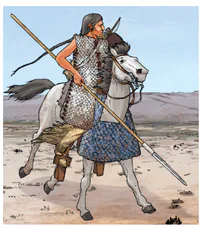
The Comanche lived in bands throughout the Plains of Texas. They were among the first American Indian groups to find and tame wild horses. Comanche warriors were taught at an early age how to ride and fight on horseback. The fearless Comanche warriors forced other tribes off their land and controlled much of the southern Plains. Comanche were nomads who survived by hunting bison throughout the year. They used the bison for food, clothing, tools and shelter.
12
Fill in the Blanks
Comanche were
13
The Comanche and settlers in the area often opposed each other over land and resources. Allies of the Comanche included the Wichita and Kiowa Indians. The Comanche faced other challenges in the 1800s. Many Comanche Indians died from diseases like smallpox and cholera. White settlers hunted the buffalo to near extinction. This made it difficult for the Comanche to survive, too. After many battles with the U.S. Army, most remaining Comanche moved to U.S. government reservations.
14
Multiple Choice
Allies of the Comanche included the ____ and _____Indians.
Caddo and Jumano
Wichita and Kiowa
Lipan Apache and Karanawas
15
Wichita Tribe
The Wichita moved into north Texas during the mid-1700s. The Wichita were dark-skinned people who called themselves the "Kitikiti'sh." This means "raccoon-eyed." Wichita men and women tattooed their faces heavily. The men even tattooed the area around their eyes. This made their eyes look like a raccoon's.

16
Multiple Choice
What is the meaning of the word Kitikiti'sh?
bison-toed
wolf-eared
raccoon-eyed
bear-headed
17
The Wichita had two kinds of houses. They lived in cone-shaped, straw huts during farming season. After the harvest, they hunted bison and lived in tepees.
In the 1800s, disease and fighting with the white settlers killed many of the Wichita. While fighting between native peoples and white settlers continued, the Wichita moved away from the conflicts. Today, the Wichita live in Oklahoma.
18
Fill in the Blanks
Today, the Wichita live in
Show answer
Auto Play
Slide 1 / 18
SLIDE
Similar Resources on Wayground

12 questions
Government Intro
Presentation
•
4th - 5th Grade
13 questions
New Jersey's climate
Presentation
•
4th Grade
13 questions
North Carolina Native Americans: Mountain Region
Presentation
•
4th Grade
13 questions
Events Leading to the American Revolution: Vocabulary
Presentation
•
5th Grade
13 questions
Voting Rights Amendments
Presentation
•
5th Grade
12 questions
NJ Industry and Technology
Presentation
•
4th Grade
15 questions
Sons & Daughters of Liberty
Presentation
•
4th Grade
15 questions
Where is New Jersey?
Presentation
•
4th Grade
Popular Resources on Wayground
21 questions
Continents and Oceans

Quiz
•
6th Grade
20 questions
Parts of Speech
Quiz
•
5th Grade
16 questions
Subject & Predicate
Quiz
•
5th Grade
25 questions
Multiplication Facts
Quiz
•
5th Grade
12 questions
Map Skills
Quiz
•
3rd Grade
22 questions
Continents and Oceans
Quiz
•
5th Grade
15 questions
Rounding Decimals
Quiz
•
5th Grade
20 questions
Brand Labels
Quiz
•
5th - 12th Grade
Discover more resources for Social Studies
14 questions
Age of Exploration
Quiz
•
4th Grade
26 questions
VA Studies Ch 2 Virginia's First Peoples
Quiz
•
4th Grade
16 questions
Native Americans of Texas
Quiz
•
4th Grade
12 questions
Personal Finance- GCPS
Quiz
•
4th Grade
24 questions
Chapter 1 Test
Quiz
•
4th Grade
26 questions
2024-2025 1st 9-weeks 4th Grade Social Studies Review
Quiz
•
4th Grade
20 questions
Virginia’s Indigenous Nations
Quiz
•
4th Grade
20 questions
Causes of the American Revolution
Quiz
•
4th Grade