
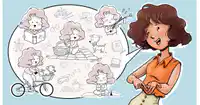
Time Expressions

Presentation
•
English
•
1st - 5th Grade
•
Hard

Joseph Anderson
FREE Resource
9 Slides • 4 Questions
1
Learn how to effectively use time expressions to enhance your communication skills and improve your understanding of time-related concepts. Explore various time expressions and their usage in different contexts.
2
Mastering Time Expressions
3
Multiple Choice
What are time expressions?
Words or phrases that indicate when an action or event occurs
Words or phrases that indicate the duration of actions
Words or phrases that indicate the sequence of events
Words or phrases that indicate the understanding of timelines
4
Time Expressions
5
Mastering Time Expressions
6
Multiple Choice
What are some common time expressions used to talk about present actions and habits?
always, usually, often, sometimes, rarely, never
yesterday, today, tomorrow
in the morning, in the afternoon, in the evening
now, later, soon
7
Present Time Expressions
8
Mastering Time Expressions
Use time expressions in past tense to accurately describe past events.
9
Multiple Choice
Which time expression should be used to refer to the week before the current one?
yesterday
last week
in 2010
last Tuesday
10
Last Week
Last week refers to the week before the current one. It is a common time expression used to talk about events or activities that occurred in the previous week. It is often used in conversations, schedules, and planning. Remember, last week is not the same as yesterday or in 2010. Stay up to date with the current week!
11
Mastering Time Expressions
Use time expressions in future tense to accurately convey future events. Examples include:
12
Multiple Choice
What is the purpose of using time expressions in future tense?
To accurately convey future events
To describe past events
To express present actions
To indicate uncertain events
13
Future Tense:
Learn how to effectively use time expressions to enhance your communication skills and improve your understanding of time-related concepts. Explore various time expressions and their usage in different contexts.
Show answer
Auto Play
Slide 1 / 13
SLIDE
Similar Resources on Wayground

9 questions
What is Fluency?
Presentation
•
1st - 5th Grade
10 questions
Using a Dictionary
Presentation
•
1st - 5th Grade
11 questions
QUESTION TAGS
Presentation
•
2nd - 5th Grade
10 questions
Emergent Reader Quiz
Presentation
•
1st - 5th Grade
9 questions
Untitled Lesson
Presentation
•
KG
10 questions
SPELLING BEE_LEVEL C_ SCHOOL DICTATION ROUND
Presentation
•
1st - 5th Grade
9 questions
Can and can't
Presentation
•
1st - 5th Grade
8 questions
Adverbs of Manner
Presentation
•
2nd - 5th Grade
Popular Resources on Wayground
10 questions
Safety Day 2026 – Student Review

Quiz
•
9th Grade
21 questions
Continents and Oceans
Quiz
•
6th Grade
20 questions
Parts of Speech
Quiz
•
5th Grade
16 questions
Subject & Predicate
Quiz
•
5th Grade
25 questions
Multiplication Facts
Quiz
•
5th Grade
12 questions
Map Skills
Quiz
•
3rd Grade
22 questions
Continents and Oceans
Quiz
•
5th Grade
15 questions
Rounding Decimals
Quiz
•
5th Grade
Discover more resources for English
20 questions
Parts of Speech
Quiz
•
5th Grade
16 questions
Subject & Predicate
Quiz
•
5th Grade
20 questions
Inferences
Quiz
•
4th Grade
15 questions
Subject/Verb agreement
Quiz
•
4th Grade
8 questions
Context Clues Practice
Quiz
•
4th Grade
15 questions
Singular and Plural Nouns
Quiz
•
4th Grade
13 questions
Subjects & Predicate
Quiz
•
3rd Grade
12 questions
Figurative Language Review

Interactive video
•
5th Grade