Wave Property
Presentation
•
Physics
•
12th Grade
•
Hard

Joseph Anderson
FREE Resource
14 Slides • 16 Questions
1
T3L1- Properties of Waves
by PAE 4
2
Recap: The parts of a wave
3
Multiple Choice
Name the missing part of the wave
Amplitude
Wavelength
4
Multiple Choice
Name the missing part of the wave ....?
Wavelength
Amplitude
5
The wavelength is the length of a complete wave cycle. Here it is the distance between the crests.
The period ,(T) is the time it takes to complete one wavelength.
Can you measure the period here? What's the best way?
6
Here are two types of waves... can you remember what they are called?
7
Multiple Choice
This type of wave is called a...
Longitudinal wave, because it's particle motion is parallel to direction of wave travel
Transverse wave, because it's particle motion is perpendicular to the direction of wave travel
8
Multiple Choice
This type of wave is called a...
Longitudinal wave, because it's particle motion is parallel to direction of wave travel
Transverse wave, because it's particle motion is perpendicular to the direction of wave travel
9
Frequency is a measure of how often something happens in a given time period.
For example, if you go shopping every Monday. Your frequency of shopping is once per week.
If you go shopping every Monday and Friday, then your frequency is twice per week.
Let's talk about frequency...
10
A wave's frequency (f) is the amount of wavelengths that pass a point in a certain amount of time.
It is most often represented in units of 'per second' or '1/second' or Hertz (Hz)
So, if 1 complete wavelength passes a point at every second, its frequency is '1 per second' or '1 Hertz'.
And if 320 wavelengths pass a point at every second, its frequency is 320 Hz.
11
A wave's frequency (f) is the amount of wavelengths (λ) that pass a point in a certain amount of time.
It is most often represented in units of 'per second' or '1/second' or Hertz (Hz)
So, if 1 complete wavelength passes a point at every second, its frequency is '1 per second' or '1 Hertz'.
And if 320 wavelengths pass a point at every second, its frequency is 320 Hz.
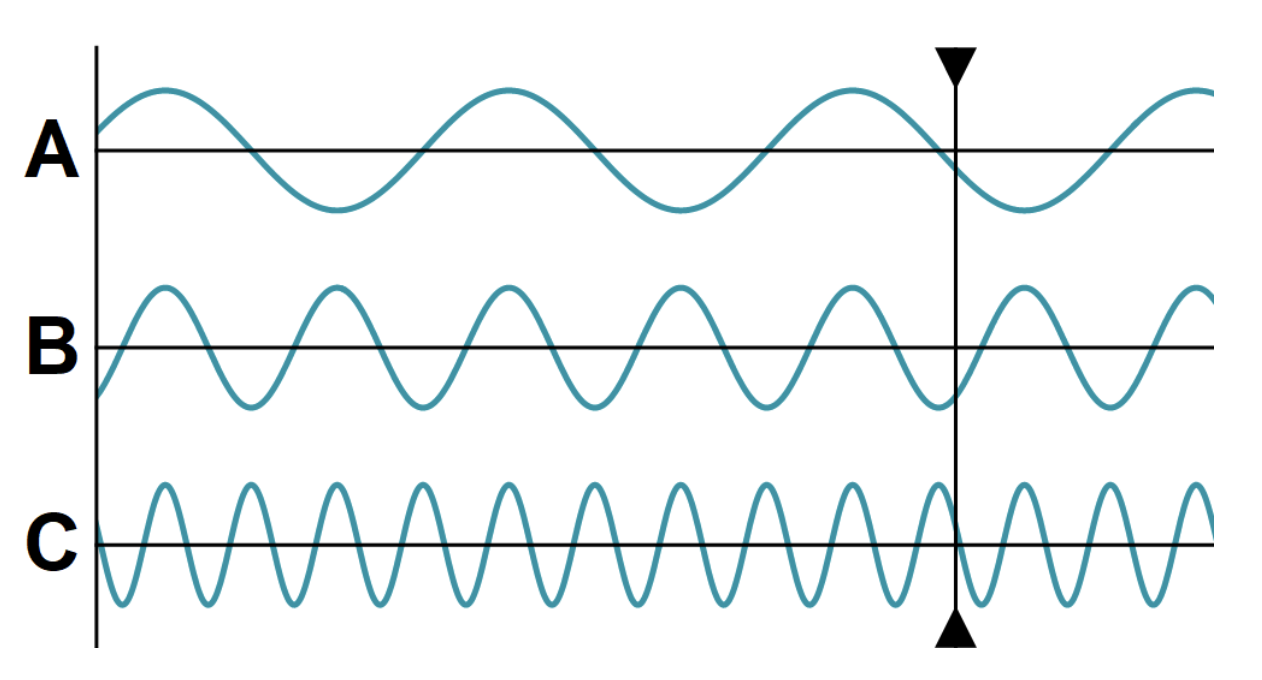
12
Multiple Choice
Which of the following travelling waves has a higher frequency?
A
B
C
13
There is an important relationship between, speed, wavelength and frequency.
Suppose that the 2 lanes above are moving with the same velocity. Will there be more cars or trucks passing the arrow after a given amount of time?
14
Like the cars and trucks, these waves are propagating at the same speed.
What can you conclude about the relationship between wavelength, λ and frequency, f ?
15
Multiple Choice
What can you conclude about the relationship between wavelength and frequency by observing them?
Wavelength and frequency are unrelated
When wavelength increases, the frequency decreases.
When wavelength increases, the frequency also increases.
16
The speed that a wave propagates is called the wave speed, v
Wave speed
How could we represent the wave speed using wavelength λ and period T?
17
Multiple Choice
How could we represent the wave speed using wavelength λ and period T?
v=Tλ
v=λT
v=λ⋅T
18
So, now... we know that wave speed is:
From the previous slides, we also know that frequency f is the number of waves that pass a point per unit time. And that it is represented by '1/sec' or Hz.
But now, if instead of seconds, we replaced the time with the period T, the frequency f becomes...
Now we can replace the period T in the formula for wave speed with frequency f ...
19
That's a wrap...
20
Use the following image to answer questions 3-6
21
Multiple Choice
What is labeled "A" in Gabriella's model?
Amplitude
Crest
Trough
Wavelength
22
Multiple Choice
What is labeled "B" in Gabriella's model?
Amplitude
Wavelength
Trough
Crest
23
Multiple Choice
What is labeled "C" in Gabriella's model?
Amplitude
Wavelength
Trough
Crest
24
Multiple Choice
What is labeled "D" in Gabriella's model?
Amplitude
Wavelength
Trough
Crest
25
Multiple Choice
When modeling waves, a transverse wave moves______ to the particle motion. A longitudinal wave moves in the same direction as the particle in motion
parallel
perpendicular
26
Multiple Choice
When modeling waves, a transverse wave moves perpendicular to the particle motion. A _____ wave moves in the same direction as the particle in motion
taller
longitudinal
27
Use the following chart to answer questions 10-15
28
Multiple Choice
Armando used yarn to create waves on sheets of graph paper. He recorded his wave data in the table.
Which heading in the table describes wavelength?
Wave
Number of crests
distance between crests
height of crests
29
Multiple Choice
The height of the crest represents the____ of a wave. Based on the evidence in the table, the height of the wave is not dependent on the frequency
frequency
wavelength
amplitude
30
Multiple Choice
The height of the crest represents the amplitude of a wave. Based on the evidence in the table, the height of the wave is not dependent on the ____.
wave speed
frequency
T3L1- Properties of Waves
by PAE 4
Show answer
Auto Play
Slide 1 / 30
SLIDE

Similar Resources on Wayground
23 questions
Law of Demand
Lesson
•
12th Grade
26 questions
Circuits and Symbols
Lesson
•
9th - 12th Grade
20 questions
Work, Power and Energy
Lesson
•
12th Grade
24 questions
Motion Graph Lesson
Lesson
•
11th - 12th Grade
21 questions
Redistricting and Gerrymandering
Lesson
•
12th Grade
24 questions
Matrices Review
Lesson
•
11th - 12th Grade
24 questions
Ser LESSON
Lesson
•
KG - University
20 questions
Vocabulary Things Fall Apart
Lesson
•
KG
Popular Resources on Wayground
15 questions
Fractions on a Number Line
Quiz
•
3rd Grade
14 questions
Boundaries & Healthy Relationships
Lesson
•
6th - 8th Grade
13 questions
SMS Cafeteria Expectations Quiz
Quiz
•
6th - 8th Grade
20 questions
Equivalent Fractions
Quiz
•
3rd Grade
25 questions
Multiplication Facts
Quiz
•
5th Grade
12 questions
SMS Restroom Expectations Quiz
Quiz
•
6th - 8th Grade
20 questions
Main Idea and Details
Quiz
•
5th Grade
10 questions
Pi Day Trivia!
Quiz
•
6th - 9th Grade