

Writing a Creative Story

Presentation
•
English
•
11th Grade
•
Hard

Joseph Anderson
FREE Resource
24 Slides • 2 Questions
1
Fiction Part 2
Setting Plot
2-1 Due Dates 2/26
2-2 Due Dates 2/28
2-3 Due Dates 3/01
2-4 Due Dates 3/06
2.5.2 CST & 2.5.3 TST Due Date 3/07

2
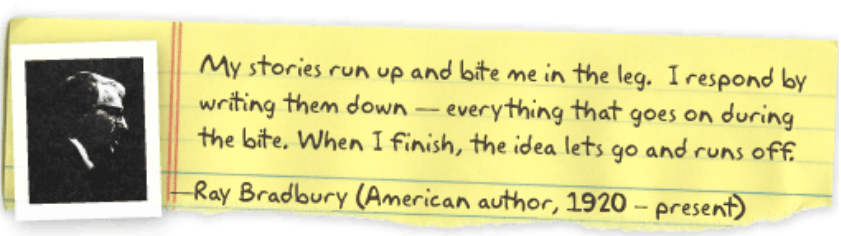
When you read this quotation, what's the first thing that grabs your attention?
Is it the surprising fact that a story idea introduces itself to Bradbury as if it's a character? That is intriguing — but what probably got your attention first is that it bites him in the leg!
3
Observe and explore techniques for creating a vivid setting by using the senses to provide details.
Explore ways to suggest tone and create an atmosphere in the larger story through setting.
Write details by observing the physical space around you for possible later use in a story or poem.

4
A story's setting includes the physical location where a story takes place, when the story takes place, and the general social environment as well. The setting is the necessary information that allows the reader to picture what is going on and understand the context of the events, conversations, and actions that unfold.

5
A story needs a setting to help the reader picture what's happening — but it also makes a difference how the setting is presented. A general description may get the basic idea across, but including sensory detail that the reader can imagine experiencing directly, and using the technique of show versus tell, will engage your reader in a more dynamic way.
Just as a reader needs details to understand a character, a reader will use whatever clues are given to try to picture where a story takes place. The more vivid imagery you include as a writer, the more complete the reader's picture will be. And how you describe the setting can affect the tone of the entire story. I copied and pasted this from the Unit 2 Overview
6
Adding sensory details to a description is an important way to help it come alive for a reader. But you need to be careful — too much information at once can be overwhelming. If this happens, instead of a rich world of sensory detail, your reader might experience verbal sensory overload or "pileup"!

7
This postcard syndrome is especially dangerous when we write about places we don't know very well. It's easy to fantasize about "exotic lands," but it's much harder to convey both the beauty and complexity of a place. Using specific sensory details like "the water is an amazing cerulean blue" can help a reader picture a setting. Flaws and unusual details can help a setting feel more real and intriguing, too.

8
Multiple Choice
Which description feels cliche?
A mouse so tiny that is scampered by without notice.
Eyes like clear blue sky.
His hands flashed like fish in the river.
Leaves burdened by the thick rain.
9
The course offers activities within the modules to help you develop as a writer. In the 2.1.1 Study there are two Read and Respond activities that can be very helpful. pages 8, 12 and 13. Give them a try!
There are more Read & Responds throughout the course. All optional

10

11
In a story, the general mood or feeling of the piece is its atmosphere. When we talk about the earth's atmosphere, we mean the air surrounding the planet, which scientists call a gaseous envelope.
Now imagine your story is an actual envelope. When your reader first opens it, what kind of air escapes? Is it a heavy, sad air that seems to weigh down all words with its gray sky? Or is it a soft, refreshing breeze you barely notice at first, until a nostalgic scent of honeysuckle starts to build in intensity?

Even before we fully understand what's happening in a story, we breathe its air — and the details of the setting are more often than not what provide these "breaths," or atmospheric clues, to a story.
12
Include details that make it feel as though something exciting might happen here in the near future.
Include details that suggest something intriguing or mysterious happened here in the past.
Introduce a character associated with this place who creates a sense of emotional excitement or intrigue.
Make the atmosphere of your setting so intense that it feels as though something must happen here soon (like the dense, heavy feeling of the air before a lightning storm).

13
The atmosphere of a story becomes a kind of emotional landscape overlaying the physical landscape you present in your setting. If you drew it, the emotional landscape might have its own map — different details that have special meaning for the character or characters who inhabit that place, its own dotted paths, maybe even alternate names for places.

14
Match
Atmosphere
Emotional landscape
Tone
Setting
the general mood of a story
How the reader experiences the story
The attitude of a piece of writing
The time and place where a story takes place
the general mood of a story
How the reader experiences the story
The attitude of a piece of writing
The time and place where a story takes place
15
You'll be creatively creating another Spy's Notebook of Observations.....

16
Explore methods of suggesting conflict and tension in a story using show versus tell.
Observe and explore the use of action and foreshadowing in prose writing through guided close reading.
Discover ways in which language can be used to show action in a story on the word, sentence, and paragraph levels.
Explore the difference between active and passive language.
Write a short scene that starts in the middle of a conflict between characters while using active language.

17
The key to creating action is conflict. Conflict happens when your character wants something — it could be something tangible like money or a new car, or something intangible like love or redemption — but something else stands in the way of getting it.
Your character has to struggle to get what he or she wants — and the effect of this struggle is tension. As long as the conflict continues to be unresolved, tension continues to build.

18

There are also a lot of Play on Page activities.
These are also optional but very valuable if you want to develop your skills as a writer.
19
Peer Review
Let someone else read your work. Ask them what they think. Did they "get" what you were trying to express? Are they curious about what will happen next?
A word about feedback: Don't be discouraged if some of your readers did not feel the conflict or tension that you intended. Instead, ask for ideas about how you could make the conflict clearer or more interesting, or what might increase the tension even more.

20
Foreshadowing is a Balance....
When a story uses just the right amount of foreshadowing, it helps the reader make sense of unexpected events and adds to the reader's anticipation of the final resolution.

21
We are going to read "The Cask of Amontillado" by Edgar Allan Poe. My personal favorite Poe story.... and I've read a bunch of them!!!!
As you read, pay special attention to how this initial conflict develops, raising questions in the reader's mind and building tension. Also notice how foreshadowing is used to hint at, but not completely reveal, the story's final action.
Might I suggest using the Reading Guide?

22

Descriptive language that focuses on the action can turn even a dull plot into an exciting piece of writing!
23

24
In general, revising the passive voice to the active voice will make your writing clearer and stronger.
But the passive voice can be the right choice when it complements the story you're telling.
For example, let's say your character is timid and worried about offending people.

25
Write a short scene introducing a conflict and foreshadowing what happens later. Your scene should be at least one typed, double-spaced page.
Keep in mind that conflict happens when someone wants something but has to struggle to get it.
Create tension by not resolving the conflict too quickly. Let the reader wonder how the conflict will be resolved.
Use foreshadowing to hint at — but not reveal! — what happens later in the story.
Use active language to keep your reader engaged.
For extra help on completing your assignment, click your practice guide.

26

Chat to ME
Revise this sentence so it is in Active Voice.
The ending of the movie was applauded by the audience.

Fiction Part 2
Setting Plot
2-1 Due Dates 2/26
2-2 Due Dates 2/28
2-3 Due Dates 3/01
2-4 Due Dates 3/06
2.5.2 CST & 2.5.3 TST Due Date 3/07
Show answer
Auto Play
Slide 1 / 26
SLIDE
Similar Resources on Wayground

22 questions
ACT Practice Reading
Presentation
•
11th Grade
21 questions
Oro A1 Entrance Test
Presentation
•
KG
21 questions
A Christmas Carol. Stave One - Scrooge
Presentation
•
10th - 11th Grade
21 questions
Narrative Tenses
Presentation
•
10th - 11th Grade
21 questions
Writing process
Presentation
•
11th - 12th Grade
20 questions
Rhetorical Analysis
Presentation
•
11th Grade
20 questions
Pronoun-Antecedent Agreement
Presentation
•
11th - 12th Grade
18 questions
IELTS WRITING TASK 2 - OPINION ESSAY
Presentation
•
11th - 12th Grade
Popular Resources on Wayground
10 questions
Safety Day 2026 – Student Review

Quiz
•
9th Grade
21 questions
Continents and Oceans
Quiz
•
6th Grade
20 questions
Parts of Speech
Quiz
•
5th Grade
16 questions
Subject & Predicate
Quiz
•
5th Grade
25 questions
Multiplication Facts
Quiz
•
5th Grade
12 questions
Map Skills
Quiz
•
3rd Grade
22 questions
Continents and Oceans
Quiz
•
5th Grade
15 questions
Rounding Decimals
Quiz
•
5th Grade
Discover more resources for English
16 questions
Complete Sentences vs Fragments and Run-Ons
Presentation
•
5th - 12th Grade
19 questions
Unit 1 Assessment Review
Quiz
•
11th Grade
28 questions
AP Vocab Group 7
Quiz
•
9th - 12th Grade
20 questions
Appositives & Commas
Quiz
•
9th - 12th Grade
40 questions
11th Grade ELA Fall 2026 Interim Review Quiz
Quiz
•
11th Grade
28 questions
The Lottery
Quiz
•
11th Grade
20 questions
The Crucible Act 1 and 2 Quiz
Quiz
•
9th - 12th Grade
40 questions
Of Mice & Men Major Test Ch. 1-6
Quiz
•
9th - 12th Grade