

Untitled Lesson

Presentation
•
English
•
Professional Development
•
Practice Problem
•
Hard

Nicolette Roque
FREE Resource
11 Slides • 6 Questions
1
Crisis Development Model and Verbal Escalation Continuum
By Nicolette Roque
2
The CPI Crisis Development Model

3
Open Ended
What is the CPI Crisis Development Model?
4
The CPI Crisis Development Model
Anxiety
A change in typical behavior
Ex: nervous movements, pacing, fidgeting, sighing, or shutting down.
5
The CPI Crisis Development Model
Empathetic, non-judgemental approach
Be patient, listen, and convey empathy.
Supportive
A change in typical behavior
Ex: nervous movements, pacing, fidgeting, sighing, or shutting down.
Anxiety
6
Multiple Choice
Which of the following is NOT a supportive communication strategy?
Acknowledging their feelings
Asking close-ended questions
Using caring and supportive tones
Offering to help
7
The CPI Crisis Development Model
Providing clear direction or instruction.
Use short, simple phrases that the person can follow; provide simple and reasonable choices.
Directive
Protecting oneself from a real or perceived challenge or threat.
Ex: shouting, refusal, asking challenging questions, or acting in a threatening manner.
Defensive
8
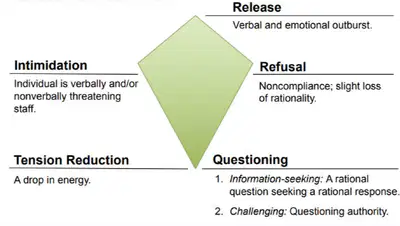
The Verbal Escalation Continuum
9
Open Ended
What is the Verbal Escalation Continuum?
10
Multiple Choice
Which of the following is an example of paraverbal or verbal defensive behavior?
Pushing something off a table or throwing an object on the floor
Turning their head and not following your instruction
Saying "no"
Refusing to speak
11
The CPI Crisis Development Model
Non-restrictive + restrictive strategies to maximize safety and minimize harm.
Always consider verbal and environmental non-restrictive approaches first.
Safety Interventions
Behavior that presents an imminent or immediate risk of harm to self or others.
Ex: striking, throwing objects, pulling pushing others, or harming oneself.
Risk Behavior
12
Safety Interventions
Physical, chemical, environmental, or mechanical intervention used to restrict a person's liberty of movement.
Restrictive
Verbal interventions
continuing to use supportive and directive interventions
Making the environment safe or moving to a place of safety.
Non-restrictive
13
Multiple Choice
Which of the following is non-restrictive?
Verbal and environmental interventions
Disengagement
Holding
14
The Decision-Making Matrix

15
Open Ended
What is the Decision-Making Matrix?
16
The CPI Crisis Development Model
Re-establish the relationship.
Address the needs of the person, support the person, and re-establish the relationship.
Therapeutic Rapport
Decrease in physical and emotional energy.
Ex: relaxing of posture, returning complexion, reduced muscle tension, withdrawal, sadness, or embarrassment.
Tension Reduction
17
Thank you!
Crisis Development Model and Verbal Escalation Continuum
By Nicolette Roque
Show answer
Auto Play
Slide 1 / 17
SLIDE
Similar Resources on Wayground

12 questions
Collaboration
Presentation
•
Professional Development
13 questions
HTML Tables
Presentation
•
Professional Development
11 questions
October 27th
Presentation
•
University
13 questions
Needs Analysis
Presentation
•
Professional Development
9 questions
B2 Don't fall for it
Presentation
•
Professional Development
10 questions
SM Spin L1
Presentation
•
KG - University
16 questions
Big Review
Presentation
•
Professional Development
16 questions
WGA Strikes
Presentation
•
Professional Development
Popular Resources on Wayground
24 questions
PBIS-HGMS Day 10

Quiz
•
6th - 8th Grade
10 questions
HCS SCI 03 Summer School Review 3
Quiz
•
3rd Grade
11 questions
Home Scope
Quiz
•
7th - 8th Grade
15 questions
HCS SCI 05 Summer School Assessment 3 Review
Quiz
•
5th Grade
35 questions
Lufkin Road Middle School Student Handbook & Policies Assessment
Quiz
•
7th Grade
18 questions
Geo 11.3 Area of Circles and Sectors
Quiz
•
9th - 11th Grade