Simulation review
Presentation
•
Science
•
5th Grade
•
Medium
+35
Standards-aligned
Jill King
Used 9+ times
FREE Resource
35 Slides • 186 Questions
1
Simulation Review
By Jill King
2
3
4
Multiple Choice
5
Multiple Choice
6
Multiple Choice
7
Multiple Choice
8
Multiple Choice
9
Multiple Choice
10
Multiple Choice
11
Multiple Choice
12
Multiple Choice
13
Multiple Choice
14
Multiple Choice
How does changing the color of the can affect how hot it will get in the sun?
15
Multiple Choice
"Three baseball players investigate to see who can throw a baseball the farthest. They mark off an area on the playground for their investigation."
16
Multiple Choice
17
Multiple Choice
18
Multiple Choice
19
Multiple Choice
20
21
22
Multiple Choice
Look at the picture of the food web. Which term describes the fox in this food web?
producer
consumer
decomposer
23
Multiple Choice
All the populations of different species that live in the same place are called a/an _____________.
ecosystem
community
population
niche
24
Multiple Choice
Ecosystem factors such as sunlight, water, nutrients, soil, and air are called _____________ factors.
living
renewable
non-living
nutrients
25
Multiple Choice
Look at the picture of the food web. Which term describes the tree in this food web?
producer
consumer
decomposer
26
Multiple Choice
1. When two or more blue jays live and interact in the same area, the blue jays are a(n)
ecosystem
population
community
single organism
27
Multiple Choice
Decomposers break down wastes into _________, which become part of the soil.
nutrients
algae
habitats
protons
28
Multiple Choice
A niche is a(n)
community of animals
part of the food web
organism's special role in the environment.
kind of habitat
29
Multiple Choice
A guide used to identify organisms based on characteristics is
an atlas
a ruler
a cylinder
a dichotomous key
30
Multiple Choice
Several food chains that overlap form a
a spider web
a food web
a community
niche
31
Multiple Choice
During its life cycle, an organism's role in the community (niche) may change.
true
false
32
Multiple Choice
The interactions and organization within an ecosystem is based on the use of energy from the ____.
moon
sun
Earth
plants
33
Multiple Choice
Organisms that live in the same ecosystem and share the same need for resources must _____ for them
compete
share willingly
interact
change
34
Multiple Choice
A ______ is always at the bottom of a food chain.
consumer
producer
decompser
snail
35
Multiple Choice
The arrow in a food chain always points to the organism_____
doing the eating
getting eaten
36
Multiple Choice
To the blue crab, the open bay of the Chesapeake Bay region is its_____
niche
habitat
community
population
37
38
39
40
Multiple Choice
Look at the picture of the cloud types. Which cloud type is associated with rain or snow that may fall within several hours?
Cirrus
Stratus
Cumulus
Cumulonimbus
41
Multiple Choice
Look at the picture of the cloud types. Which cloud type is associated with fair weather?
Cirrus
Stratus
Cumulus
Cumulonimbus
42
Multiple Choice
A weather report predicted that a low-pressure area was expected during the weekend. What type of weather should he expect?
Clouds and precipitation
Clouds but no precipitation
Clear skies and cold temperatures
Clear sky and warm temperatures
43
Multiple Choice
Which storm type occurs over warm, tropical water and has winds equal to or greater than 119 km per hour?
Hurricane
Thunderstorm
Tornado
44
Multiple Choice
Which storm type forms from thunderstorms as the wind changes direction and rotates?
Hurricane
Thunderstorm
Tornado
45
Multiple Choice
Look at the picture of the cloud types. Which cloud type is associated with light rain or drizzle?
Cirrus
Stratus
Cumulus
Cumulonimbus
46
Multiple Choice
Which storm type forms under warm, humid conditions and has a brief period of heavy rain?
Hurricane
Thunderstorm
Tornado
47
Multiple Choice
A student was organizing data collected from a weather station. Which measurement below would they make using the instrument pictured?
37°C
1.5 inches
7 mph
30 inHg
48
Multiple Choice
A student was organizing data collected from a weather station. Which measurement below would they make using the instrument pictured?
37°C
1.5 inches
7 mph
30 inHg
49
Multiple Choice
A student was organizing data collected from a weather station. Which measurement below would they make using the instrument pictured?
37°C
1.5 inches
7 mph
30 inHg
50
Multiple Choice
Look at the picture of the cloud types. Which cloud type is associated with thunderstorms?
Cirrus
Stratus
Cumulus
Cumulonimbus
51
Multiple Choice
Which answer correctly matches the weather equipment to what it measures?
Anemometer= air pressure
Barometer= wind speed
Temperature= rain gauge
Precipitation= thermometer
Anemometer= air pressure
Barometer= wind speed
Temperature= thermometer
Precipitation= rain gauge
Anemometer= wind speed
Barometer= air pressure
Temperature= thermometer
Precipitation= rain gauge
52
53
54
Multiple Choice
How many planets are there in our solar system?
10
5
8
9
55
Multiple Choice
What four planets are terrestrial planets?
Mercury, Jupiter, Mars, Venus
Mercury, Venus, Earth, Mars
Mars, Neptune, Saturn, Earth
Jupiter, Saturn, Uranus, Neptune
56
Multiple Select
What two types of planets are there in our solar system?
Stars
Gas Giants
Asteroids
Terrestrial
57
Multiple Choice
What four planets are gas giants?
Saturn, Jupiter, Mars, Venus
Mercury, Venus, Earth, Mars
Mars, Neptune, Saturn, Earth
Jupiter, Saturn, Uranus, Neptune
58
Multiple Choice
Gas giants are primarily made of _______________.
gas
ice
rocky substances
cores
59
Multiple Choice
Terrestrial planets are primarily made of __________________.
gas
ice
rocky substances
cores
60
Multiple Choice
Which of the following is true about gas giants?
They are heavy and large
They are lightweight, small, and have solid surfaces
They are made of rocky substances
They are lightweight, have rings, and have many moons
61
Multiple Choice
Which planet is similar in size and mass to Earth?
Venus
Mars
Jupiter
Mercury
62
Multiple Choice
Which planet is closest to the sun?
Mars
Mercury
Earth
Venus
63
Multiple Choice
Which is the largest planet in our solar system?
Uranus
Earth
Jupiter
Saturn
64
Multiple Choice
Which planet is farthest from the sun?
Jupiter
Earth
Uranus
Neptune
65
Multiple Choice
Which planet is so large it could fit all the other planets inside of it?
Saturn
Jupiter
Venus
Neptune
66
Multiple Choice
The Earth rotates on its ____________.
horizon
axis
poles
latitude
67
Multiple Choice
Planets travel in an oval path around the sun. What is this action called?
Revolution
Axis
Revolve
Orbit
68
69
70
Multiple Choice
The Earth ______________ around the sun.
rotates
tilts
revolves
doesn't move
71
Multiple Choice
Earth rotates on its axis as it orbits the sun. What do we call these two actions?
Turn
Revolution
Orbit
Rotate
72
Multiple Choice
How long does it take for the earth to make one revolution around the sun?
2 seasons
365 days
2 weeks
3 years
73
Multiple Choice
It takes the moon _______ days to revolve around the Earth.
16 days
29 days
20 days
32 days
74
Multiple Choice
What moon phase is shown?
first quarter
new moon
full moon
third quarter
75
Multiple Choice
The reason we have seasons is due to the ....
moon phases
the tilt of the Earth's axis and its revolution around the sun
the sun revolving around the Earth
the moon spinning on its axis
76
Multiple Choice
The Earth is divided into two halves called ___________
The equator
The West and East Hemishperes
none of these
The Northern and Southern Hemisphere
77
Multiple Choice
What is the moon phase shown?
new moon
third quarter
first quarter
full moon
78
Multiple Choice
It takes the Earth about _____________ to revolve around the sun.
356 years
6 months
30 days
365 days
79
Multiple Choice
Earth rotates on an imaginary line called an(a) _______________.
longitude line
equator
axis
all of the above
80
Multiple Choice
What cause day and night on Earth?
Earth's revolution
moon phases
Earth's tilt
Earth's rotation
81
Multiple Choice
When the Earth is between the Sun and the moon we have a ____________.
first quarter
new moon
third quarter
full moon
82
Multiple Choice
How long does it take the Earth to rotate on its axis?
1 year
24 hours
30 days
48 hours
83
Multiple Choice
When it is summer in the Northern Hemisphere, it is _________ in the Southern Hemisphere.
winter
spring
fall
summer
84
Multiple Choice
What moon phase is shown?
full moon
new moon
first quarter
third quarter
85
Multiple Choice
The moon reflects light from the _____________
moon
Earth
sun
stars
86
Multiple Choice
What phase is it when the moon is between the Earth and the sun?
full moon
first quarter
third quarter
new moon
87
Multiple Choice
High and low tides are caused by ______________.
the sun
the Earth
space
the moon
88
89
90
91
92
Multiple Choice
93
Multiple Choice
94
Multiple Choice
95
Multiple Choice
96
Multiple Choice
97
Multiple Choice
rivers
lakes
b
98
Multiple Choice
99
Multiple Choice
100
Multiple Choice
101
Multiple Choice
Which of the following is NOT one of the major watersheds in Virginia?
102
Multiple Choice
103
Multiple Choice
104
Multiple Choice
105
Multiple Choice
106
107
108
109
Multiple Choice
110
Multiple Choice
111
Multiple Choice
112
Multiple Choice
113
Multiple Choice
114
Multiple Choice
115
Multiple Choice
116
Multiple Choice
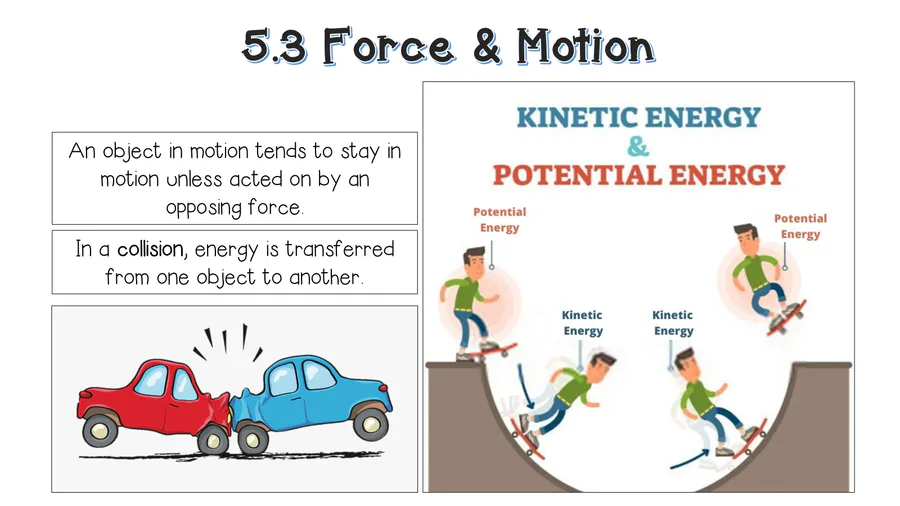
Students conducted an investigation in which they rolled marbles
across different surfaces to measure the effect of the force of
friction on each surface. Friction slows down and stops objects.
Which of the surfaces tested showed the greatest amount of friction?
Surface A
Surface B
Surface C
Surface D
117
Multiple Choice
True or False.... A rolling ball is in motion. If nothing touches it, it will continue to move in a straight line until it stops.
true
false
118
Multiple Choice
Which object would require the most force to move?
a tennis ball
a baby
a car
a cell phone
119
Multiple Choice
On which surface would a car pushed with the same force move the farthest?
a smooth surface
a bumpy surface
120
Multiple Choice
True or False...SPEED is the path a moving object takes?
True
False
121
Multiple Choice
The picture represents a forces exerted on opposite sides of an object that are not equal in strength.
seesaw
magnetic force
unbalanced force
balanced force
122
123
124
125
Multiple Choice
The flow of energy as a current is called ________________.
electricity
heat
light
sound
126
Multiple Choice
Materials that allow electricity to easily flow through them are _______________________.
circuits
conductors
inhibitors
insulators
127
Multiple Choice
Which of these is NOT a conductor?
copper wire
metal coin
rubber band
sea water
128
Multiple Choice
Materials that do not allow electricity to flow easily through them are _____________________.
circuits
conductors
inhibitors
insulators
129
Multiple Choice
True or False: An electrical current WILL flow through an open circuit.
true
false
130
Multiple Choice
A __________________ circuit allows electricity to flow within the circuit.
closed
open
short
131
Multiple Choice
The transfer of negatively charged particles between materials is called _______________________.
mechanical energy
radiant energy
static electricity
thermal energy
132
Multiple Choice
Which of these is NOT an example of static electricity?
getting a shock when touching a door knob
pedaling a bicycle
clothes sticking together when coming out of a dryer
lightning
133
Multiple Choice
A ___________________ circuit consists of a light bulb, a battery and a wire.
complex
elastic
simple
134
Multiple Choice
When using a fan, electrical energy is transformed into _____________________ energy.
mechanical
radiant
thermal
135
Multiple Choice
When using a toaster, electrical energy is transformed into _______________________ energy.
mechanical
radiant
thermal
136
Multiple Choice
When using a lamp, electrical energy is transformed into _________________ energy.
mechanical
radiant
thermal
137
Multiple Choice
When an electric current flows through a wire wrapped around an iron nail, what is formed?
lightning
open circuit
electromagnet
138
Multiple Choice
To increase the strength of an electromagnet, you would ____________________ the number of coils around the nail.
decrease
increase
139
Multiple Choice
You will have a stronger electromagnet if you wrap which material around the iron nail?
copper wire
rubber band
yarn
140
Multiple Choice
A current flowing through a wire creates a(n) ______________________.
blank space
electron transfer
magnetic field
141
142
143
144
Multiple Choice
Sound is a form of ______ energy made by ______ matter.
Thermal, vibrating
Radiant, oscillating
Mechanical, vibrating
Mechanical, echoing
145
Multiple Choice
A back and forth motion of an object
Vibration
Oscillation
Compression
Rarefaction
146
Multiple Choice
The movement of sound energy through air, liquid, or solid
Compressions
Sound waves
Rarefactions
Transverse waves
147
Multiple Choice
The result of molecules being squeezed or pressed together
Rarefactions
Oscillations
Vibrations
Compressions
148
Multiple Choice
Distance between two crests or two troughs of a wave
Crest
Wavelength
Rarefaction
Trough
149
Multiple Choice
Places where the molecules of air are not squeezed and are spread apart
Rarefaction
Compression
150
Multiple Choice
How high or low a sound is. This is determined by frequency
Frequency
Pitch
Vibrations
151
Multiple Choice
The number of complete wavelengths that pass a point in a given time: the higher the frequency, the higher the pitch
Amplitude
Pitch
Frequency
Volume
152
Multiple Choice
Produced by larger, longer, or thicker vibrating objects
High pitch
Low frequency
Low pitch
High frequency
153
Multiple Choice
Produced by smaller, shorter, or thinner (or stretched) vibrating objects
Low pitch
High frequency
Low frequency
High pitch
154
Multiple Choice
Sound travels fastest through _____ forms of matter
Liquid
Gas
Plasma
Solid
155
Reorder
For you to hear sound, what is the correct order of the three events that must take place? Indicate the order by sorting the cards into their correct order of what must happen first, second, third.
An object vibrates to make a sound.
Air particles vibrate as sound moves through the air.
Your eardrum vibrates when the sound wave reaches it
156
Multiple Choice
A teacher placed a cell phone in a special glass container called a “bell jar”, as shown on the picture below. Then, she removed all air particles out of the jar, using a pump. Complete the sentence below to explain what would happen if someone calls this phone.
"The phone will ____________________ because _________________________."
ring at a higher pitch;
the air particles have more energy
ring at a lower pitch;
there are no air particles to silence it
will not make a sound;
there are more air particles
ring at a regular pitch;
there are no air particles to transfer energy
157
Multiple Choice
Look at the graph. What can you conclude about how air temperature affects the speed of sound?
When air temperature increases, the speed of sound remains the same
When air temperature increases, the speed of sound increases.
When air temperature increases, the speed of sound decreases
Air temperature has no effect on the speed of sound.
158
Multiple Choice
Look at the graph. What would be a reasonable explanation of why sound travels faster through glass than gold?
Gold particles are closer together than glass particles
Glass particles are further apart than gold particles.
Glass is gas but gold is solid.
Glass transfers energy better than gold.
159
160
161
162
163
Multiple Choice
Label the transverse wave with the correct parts.
Wavelength
Crest
Trough
164
Multiple Choice
Label the transverse wave with the correct parts.
Wavelength
Crest
Trough
165
Multiple Choice
Label the transverse wave with the correct parts.
Wavelength
Crest
Trough
166
Multiple Choice
Light bouncing off an object is called --
absorbing
refracting
reflecting
bending
167
Multiple Choice
Students place a pencil in a glass of water as shown. The pencil in the water looks broken because --
water dissolves the pencil
water is colder than air
light refracts when it enters the water
light is absorbed when it hits the glass
168
Multiple Select
Which statements would be true of an object that appears white in the presence of light? Select all that apply.
The object does not absorb any wavelengths of the visible light spectrum.
The object reflects the smallest wavelength, violet, but not the largest wavelength, red.
The object absorbs all of the spectrum except for the wavelength of white.
The object reflects all wavelengths of the visible light spectrum.
The object is transparent allowing all wavelengths to pass through without absorbing or reflecting.
169
Multiple Choice
Which is the correct order of the colors of the visible light spectrum?
Orange, yellow, green, blue, violet, and red
Red, orange, green, blue, violet, and yellow
Red, orange, yellow, green, blue, and violet
Green, blue, violet, red, orange, and yellow
170
Multiple Choice
When all colors of the visible spectrum are absorbed, what color of light is produced?
Yellow
White
Black
Red
171
Multiple Choice
A black asphalt highway becomes hotter in the summer than a white concrete highway because --
it reflects all the colors of visible light except black, which it absorbs, making the highway hotter.
it absorbs all the colors of visible light and transforms that radiant energy into heat energy.
it absorbs all the colors of visible light except black, which it reflects, and transforms that radiant energy into heat energy.
it reflects all the colors of visible light and transforms that radiant energy into heat energy.
172
Multiple Choice
A beam of white light falls on a bunch of bananas. Which image shows the colors of light reflected from it?
173
Multiple Choice
Which of the following is the best observation of the refraction of light?
Looking at a shadow of an object
Viewing an object partially in the water
Looking at oneself in a mirror
Viewing an object through an open window
174
Multiple Choice
Objects are seen as different colors because --
objects reflect certain wavelengths and absorb others
objects reflect wavelengths and do not absorb others
objects do not reflect certain wavelengths
objects cannot be seen in different colors
175
Multiple Choice
Which of these objects is translucent?
A student notebook
A brick wall of a school
The lenses of sunglasses
A mirror on the bus
176
Multiple Choice
Which of these objects is opaque?
Liquid water
Eyeglass lenses
Brick wall
Stained glass window
177
Multiple Select
Which of the following items are transparent?
Plastic wrap
Windshield
Stain glass window
Construction Paper
Magnifying glass
178
Multiple Choice
Which tool can be used to separate white light into colors of the visible spectrum?
A prism
A mirror
A wave
A lens
179
180
181
Multiple Choice
______ is the amount of matter in an object.
Matter
Mass
Energy
182
Multiple Choice
Matter of any type can be broken down into particles called ______ that are too small to see.
Energy
Matter
Atoms
Solid
183
Multiple Choice
True or False:
Sometimes when two or more different substances are combined, they DO NOT lose their identifying characteristics.
True
False
184
Multiple Choice
True or False:
Matter gains AND loses mass during phase changes
True
False
185
Multiple Choice
As temperature increases, many kinds of matter change from a solid to a _______ to a gas.
solid
Liquid
Gas
186
Multiple Choice
As hot water is cooled, what process is used to change it from a gas to a liquid?
Solution
Condensation
Evaporation
Melting
187
Multiple Choice
Water changes from a solid to a liquid when you add
Cold
Heat
Ice
Liquid
188
Multiple Choice
Matter is made up of tiny parts called....
Atoms
Mass
Properties
Solids, liquids, and gases
189
Multiple Choice
Matter is _______________________________.
The amount of matter in an object.
The amount of space an object occupies.
Anything that has mass and volume.
190
Multiple Choice
191
Multiple Choice
When the temperature of matter increases the particles ...
192
Multiple Choice
The picture shows some different kinds of seed pods. Which graph correctly shows the number of seeds in each pod?
193
Multiple Choice
The process shown here would be classified as:
precipitation
condensation
transpiration
evaporation
194
Multiple Choice
Gallium is a metal that melts at about 30 degrees Celsius. If a person, whose body temperature is 37 degrees Celsius held a cube of Gallium for five minutes, what will most likely happen to the Gallium?
It will change to a gas.
It will change to a solution.
It will change to a liquid.
It will change to a mixture.
195
Multiple Choice
Which of these shows how frozen water changes as the temperature of the air increases?
Gas>Liquid>Solid
Solid>Gas>Liquid
Liquid>Gas>Solid
Solid>Liquid>Gas
196
Multiple Choice
Which one of these will change solid iron to a liquid?
Raising the air pressure.
Increasing the temperature.
Crushing the solid iron.
Adding water to the iron.
197
Multiple Choice
The circles in the bottles represent small particles of matter. Which pattern of particles represent a gas in a bottle?
1
2
3
4
198
Multiple Choice
What will happen if the lid is removed from a container that holds helium gas?
The gas will expand and escape from the container.
The gas will change slowly back into a liquid.
When light hits the gas, it will change colors.
Gravity will keep the gas in the container.
199
Multiple Choice
Which of these will happen if the temperature of a metal pan is increased?
The molecules/atoms of the pan will begin to move faster.
The pan will begin to lose heat.
The metal will change into another metal.
The pan will contract.
200
201
Multiple Choice
A student makes a fruit drink by mixing a powdered mix into cold water. Why is the fruit drink a solution?
The powder dissolves in the water.
The water changes color.
The student stirs the water.
The water is the proper temperature.
202
203
204
Multiple Choice
205
206
Multiple Choice
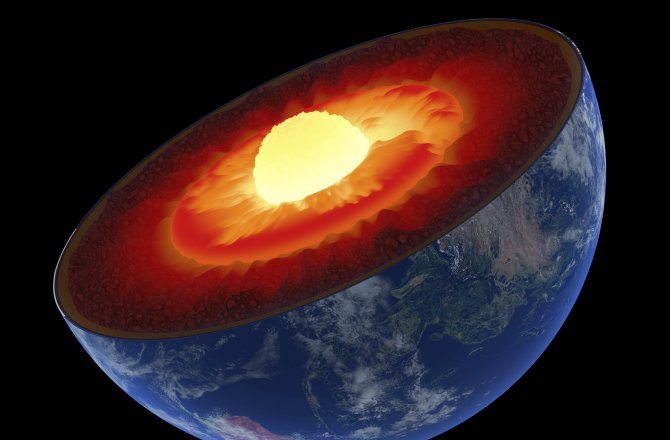
Which layer is the thinnest?
crust
mantle
outer core
inner core
207
Multiple Choice
The correct order of the Earth's layers starting from the OUTSIDE going IN is
crust, inner core, mantle, outer core
mantle, outer core, inner core, crust
crust, mantle, outer core, inner core
inner core, outer core, mantle, crust
208
Multiple Choice
Earth's crust is made of one solid piece of rock.
True
False
209
Multiple Choice
When two continental plates collide, they form
oceans
trenches
tall mountains
canyons
210
Multiple Choice
What is happening in the picture?
layers of the Earth are changing positions
the inner and outer core are solid
the internal heat of the Earth is causing the tectonic plates to move
the mantle is growing
211
Multiple Choice
212
Multiple Choice
213
Multiple Choice
214
Multiple Choice
215
Multiple Choice
216
Multiple Choice
______________________ occurs when eroded materials stop moving and begin to build up.
Weathering
Erosion
Deposition
217
Multiple Choice
The Geologic Time Scale identifies how fossils have changed over time. Which arrow points to the most ancient organisms?
A
B
C
D
218
Multiple Choice
219
Multiple Choice
220
Multiple Choice
221
Multiple Choice
What is the thickest layer of the Earth?
Crust
Mantle
Outer Core
Inner Core
Simulation Review
By Jill King
Show answer
Auto Play
Slide 1 / 221
SLIDE

Similar Resources on Wayground
212 questions
L22-29
Presentation
•
3rd Grade
197 questions
Persiapan PAS Informatika Kelas 7
Presentation
•
7th Grade
218 questions
Biology EOC Review
Presentation
•
10th Grade
199 questions
5a46013aff
Presentation
•
KG - University
205 questions
nansy
Presentation
•
7th Grade
202 questions
Wonders ESL K-1 Lesson 1
Presentation
•
1st - 5th Grade
Popular Resources on Wayground
20 questions
"What is the question asking??" Grades 3-5
Quiz
•
1st - 5th Grade
20 questions
“What is the question asking??” Grades 6-8
Quiz
•
6th - 8th Grade
10 questions
Fire Safety Quiz
Quiz
•
12th Grade
20 questions
Equivalent Fractions
Quiz
•
3rd Grade
34 questions
STAAR Review 6th - 8th grade Reading Part 1
Quiz
•
6th - 8th Grade
20 questions
“What is the question asking??” English I-II
Quiz
•
9th - 12th Grade
20 questions
Main Idea and Details
Quiz
•
5th Grade
47 questions
8th Grade Reading STAAR Ultimate Review!
Quiz
•
8th Grade
Discover more resources for Science
34 questions
5th Grade Science STAAR Review 2
Quiz
•
5th Grade
22 questions
5th grade Science STAAR REVIEW
Quiz
•
5th Grade
20 questions
Food Chains and Food Webs Review
Quiz
•
5th Grade
20 questions
Sedimentary Rocks & Fossil Fuels
Quiz
•
5th Grade
15 questions
Human Body Systems
Quiz
•
5th Grade
28 questions
5th Science STAAR Review
Quiz
•
5th Grade
21 questions
Solar System Review
Quiz
•
5th Grade
15 questions
Fossil Fuel & Sedimentary Rock Formations
Quiz
•
5th Grade