

Chemical Equations

Presentation
•
Science
•
6th - 8th Grade
•
Practice Problem
•
Medium
Standards-aligned

Boaz Rottet
Used 4+ times
FREE Resource
16 Slides • 4 Questions
1
Learners can:
rewrite a chemical reaction as a sentence
identify the reactants and products of a chemical reaction
Vocabulary: coefficient, product, reactant, yield

2
Draw
Try your best to make a drawing that represents the Law of Conservation of Mass
Your drawing shouldn't necessarily contain atoms, but it should be an analogy that has similarities to the Law of Conservation of Mass
3

What is the point of any math equation?
The answer is not: "To cause misery for 7th grade students"
How does this relate to the Law of Conservation of Mass?

4
Chemists use chemical equations to model the way atoms are rearranged during a chemical reaction. In today's lesson, you will learn:
the parts of a chemical equation; and
how to count atoms in a chemical equation.

5
Anatomy of a Chemical Equation
Recall that a chemical equation is a model that shows what happens during a chemical reaction. All chemical equations have common characteristics.
An arrow in the middle of the equation means yield, or produce. The arrow separates the reaction into the substances that enter the reaction and the substances that exit the reaction. An arrow in a chemical equation is similar to an equal sign in a math equation.
The substances to the left of the arrow are the reactants. A reactant is an element or compound that enters a chemical reaction. There can be one or many reactants in a chemical equation.
The substances to the right of the arrow are the products. A product is a substance that is produced by a chemical reaction. There can be one or more products in a chemical reaction.
A plus sign,+, shows that more than one product or reactant is present. A plus sign in a chemical equation works the same way as a plus sign in a math equation.

6
Most chemical equations contain numbers. There are two types of numbers commonly found in chemical equations.
Subscripts are small numbers to the right of and slightly below the element symbol.
A coefficient is a full-sized number to the left of a symbol or compound. A coefficient tells you how many of the element or compound are present.
Coefficients and Subscripts
O2

3O2

7
Multiple Choice
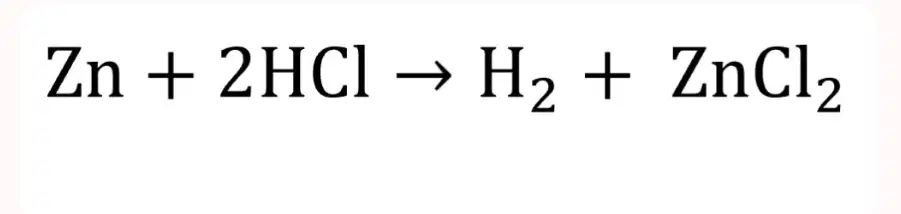
Which of the formulas contains a coefficient?
Zn
2HCl
ZnCl2
H2
8
A coefficient is a number found to the left of an element symbol or compound. A coefficient tells you how many of the element or compound are present, like a coefficient in a math equation tells you how many of a variable are present. Chemists use coefficients to make sure chemical equations follow the law of conservation of mass.

9
A chemical equation is like a chemistry sentence. When you read the formulas and symbols from left to right, a chemical equation tells you what happens during a chemical reaction.
Remember the following when you read an equation like a sentence.
If an element or compound does not have a coefficient, assume that the coefficient is 1.
A plus sign means and or combines with.
The arrow means yields or produces.

You can read the equation as the sentence: One molecule of N2 combines with three molecules of H2 to produce two molecules of NH3.

10
Multiple Choice
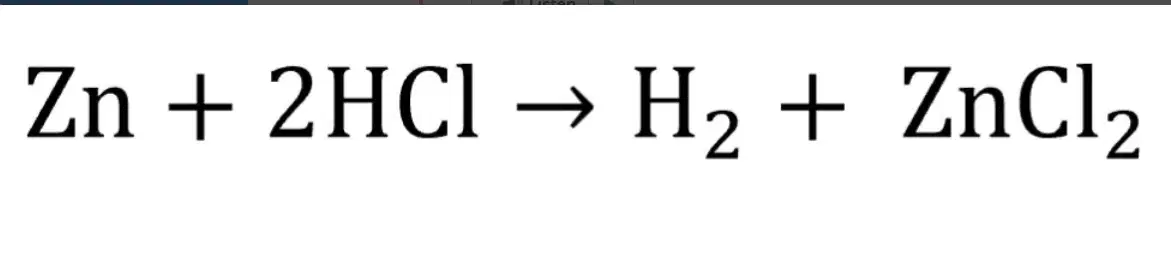
Which sentence correctly describes the equation?
One unit of Zn2HCl yields one unit of H2ZnCl2.
One atom of zinc combines with two units of HCl to yield one molecule of H2 and one unit of ZnCl2.
One unit of zinc yields two units of HCl, two units of hydrogen, and two units of ZnCl.
One unit of zinc and hydrogen yields two units of HCl and ZnCl2.

12
Counting Atoms in Equations
In an upcoming lesson, you will learn how to balance equations. To balance a chemical equation, you will count the number of each atom in both the products and the reactants. Now you will count the number of atoms of each element in each of the substances in the chemical equation:

13


14


15


16

17
Categorize
8
16
4
Match each element to the number of atoms of that element that are found in the formula 4C2H4O
18
When you find a coefficient before an element or compound, multiply the coefficient by the subscript to find the total number of atoms of each element.

A balanced chemical equation has equal numbers of atoms of each element in both the reactants and the products.
19

Is this balanced?
We will continue with this tomorrow!
20

Learners can:
rewrite a chemical reaction as a sentence
identify the reactants and products of a chemical reaction
Vocabulary: coefficient, product, reactant, yield
Show answer
Auto Play
Slide 1 / 20
SLIDE
Similar Resources on Wayground

14 questions
Periodic Table
Presentation
•
6th - 8th Grade
15 questions
Science Laboratory Safety
Presentation
•
6th - 8th Grade
15 questions
Kinetic Theory of Matter
Presentation
•
6th - 8th Grade
15 questions
Change of Seasons
Presentation
•
6th - 8th Grade
15 questions
Food Webs and Chains
Presentation
•
6th - 8th Grade
15 questions
Weight & Mass Review
Presentation
•
6th - 8th Grade
14 questions
Newton's First Law
Presentation
•
6th - 8th Grade
16 questions
Counting Atoms
Presentation
•
6th - 8th Grade
Popular Resources on Wayground
10 questions
How much do you know about our Portrait of an Eagle?

Quiz
•
10th Grade
10 questions
Fast Food Slogans
Quiz
•
6th - 8th Grade
21 questions
Continents and Oceans
Quiz
•
6th Grade
20 questions
Parts of Speech
Quiz
•
5th Grade
16 questions
Subject & Predicate
Quiz
•
5th Grade
25 questions
Multiplication Facts
Quiz
•
5th Grade
12 questions
Map Skills
Quiz
•
3rd Grade
22 questions
Continents and Oceans
Quiz
•
5th Grade
Discover more resources for Science
17 questions
7.6D Aqueous Solutions
Quiz
•
7th Grade
20 questions
Scientific Method and Variables
Quiz
•
8th Grade
20 questions
Scientific method and variables
Quiz
•
8th Grade
27 questions
Counting Atoms - Subscripts
Quiz
•
8th Grade
10 questions
6.6D - Relative Density Review
Quiz
•
6th Grade
20 questions
Claim, Evidence and Reasoning (CER)
Quiz
•
6th - 8th Grade
18 questions
Counting Atoms
Quiz
•
7th - 8th Grade
20 questions
Density
Quiz
•
6th Grade