
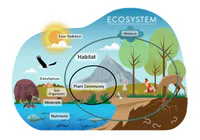
Ecosystem Part 1 (Relationships and Flow of Energy)
Presentation
•
Biology
•
10th Grade
•
Practice Problem
•
Easy
Jane Claussen
Used 8+ times
FREE Resource
9 Slides • 27 Questions
1
Stability of the Ecosystem
By Jane Claussen
2
Open Ended
Who or what helps you survive?
3
Open Ended
Describe interactions that are occurring in this ecosystem?
4
Open Ended
What would happen if those interactions did not take place?
5
Open Ended
Lets start with these interactions or RELATIONSHIPS of the ecosystem, what are some relationships you remember?
6
7
Drag and Drop
8
Drag and Drop
9
Drag and Drop
10
Drag and Drop
11
Drag and Drop
12
STAAR TEST Questions
13
Multiple Choice
The oak mistletoe is a green, leafy plant that grows on trees and has white berries. Mistletoe seeds are spread to other trees through the waste of birds that feed on the berries. The mistletoe seedlings grow into the tree, harming them to obtain water and nutrients.
Which answer choice correctly identifies a relationship between two of these organisms?
The relationship between the tree and the mistletoe is commensalism.
The relationship between the birds and the trees is predator-prey.
The relationship between the birds and the trees is mutualism.
The relationship between the tree and the mistletoe is parasitism.
14
Multiple Choice
Bees gather nectar and pollen from flowering plants, providing food for the bees. As the bees move to different flowers, some of the pollen attached to the bees' bodies is spread and released. If the pollen falls on the flower of a plant of the same species, it may fertilize the plant and produce seeds.
Which type of relationship does this describe?
Mutualism
Parasitism
Commensalism
Competition
15
Multiple Choice
Orchids are flowering plants that grow on other plants. They typically grow in tall trees high in the canopy, where they can reach sunlight for photosynthesis. They get water and nutrients from rainwater runoff that carries organic material down the host plant's branches. No water or nutrients are taken from the host plant.
Which type of relationship does this describe?
Mutualism
Parasitism
Commensalism
Competition
16
Open Ended
Ecological relationships occur between two species that live close to each other. Two examples of ecological relationships are described.
Example 1: Bees gather nectar and pollen from flowering plants, providing food for the bees. As the bees move to different flowers, some of the pollen attached to the bees' bodies is spread and released. If the pollen falls on the flower of a plant of the same species, it may fertilize the plant and produce seeds.
Example 2: Orchids are flowering plants that grow on other plants. They typically grow in tall trees high in the canopy, where they can reach sunlight for photosynthesis. They get water and nutrients from rainwater runoff that carries organic material down the host plant's branches. No water or nutrients are taken from the host plant.
What is the main difference between the ecological relationships described in the two examples? Include the scientific term used to define each of the relationships.
17
Multiple Choice
Spores of the fungus Ustilago maydis land and grow on sweet corn. The fungus then infects the plant tissue, extracting nutrients from the plant's cells.
The relationship between sweet corn and Ustilago maydis can best be described as --
competition
commensalism
predation
parasitism
18
Disruptions ecosystem Relationships and flow of matter
19
Open Ended
Attached is a food web showing relationships or interactions between species in an ecosystem. What would happen if mice were removed from this food web?
20
Open Ended
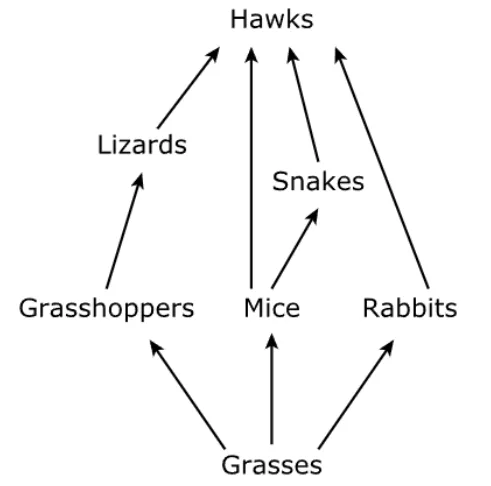
What is the main relationship that is occurring in food webs or food chains?
21
22
Predator/Prey Relationship
23
Multiple Choice
______ is an organism that hunts, kills, and eats other organisms
predator
prey
24
Multiple Choice
______ is an organism this is being hunted, killed, and eaten by other organisms.
predator
prey
25
Multiple Choice
The table shows the relationships of some organisms that live in a Texas Hill Country habitat.
Based on the data in the table, which food chain depicts a correct flow of energy through the Texas Hill Country habitat?
26
Energy in Food
27
Open Ended
Do you think carbs or proteins provide the most energy?
28
Multiple Choice
Carbs are -
grasses, trees, and shrubs
meats and bugs
29
Open Ended
If something is called a producer, what do they do?
30
10 percent of the energy is transferred to the next level
31
10 percent of the energy is transferred to the next level
32
Multiple Choice
How much energy is passed to the next trophic level?
0
10 percent
100 percent
50 percent
33
Multiple Choice
________ are organisms such as grasses, trees, and shrubs
producers
consumers
34
Reorder
Reorder the following
Producers
Primary Consumers
Secondary Consumers
Tertiary Consumers
35
Reorder
Reorder the following using the image above.
Grasses
Mice
Snakes
Hawks
36
Multiple Choice
A food chain is shown.
Grasses → Grubs → Armadillos → Coyotes
Which model best represents the amount of energy available for use at each trophic level represented in the food chain?
Stability of the Ecosystem
By Jane Claussen
Show answer
Auto Play
Slide 1 / 36
SLIDE

Similar Resources on Wayground
27 questions
Theory of Evolution: Natural Selection
Presentation
•
10th Grade
27 questions
Biogeochemical Cycles
Presentation
•
9th - 10th Grade
31 questions
Evidence of Evolution
Presentation
•
10th Grade
29 questions
Unusual sports from around the world
Presentation
•
10th Grade
30 questions
Biochemistry Review
Presentation
•
9th Grade
29 questions
28.2) PGD Lecture
Presentation
•
10th Grade
28 questions
Cells Theory, Microscopes, and Types of Cells
Presentation
•
10th Grade
27 questions
Human reproductive systems
Presentation
•
10th Grade
Popular Resources on Wayground
20 questions
"What is the question asking??" Grades 3-5
Quiz
•
1st - 5th Grade
20 questions
“What is the question asking??” Grades 6-8
Quiz
•
6th - 8th Grade
10 questions
Fire Safety Quiz
Quiz
•
12th Grade
20 questions
Equivalent Fractions
Quiz
•
3rd Grade
34 questions
STAAR Review 6th - 8th grade Reading Part 1
Quiz
•
6th - 8th Grade
20 questions
“What is the question asking??” English I-II
Quiz
•
9th - 12th Grade
20 questions
Main Idea and Details
Quiz
•
5th Grade
47 questions
8th Grade Reading STAAR Ultimate Review!
Quiz
•
8th Grade
Discover more resources for Biology
16 questions
AP Biology: Unit 1 Review (CED)
Quiz
•
9th - 12th Grade
20 questions
AP Biology: Unit 3 Review (CED)
Quiz
•
9th - 12th Grade
20 questions
Food Chains and Food Webs
Quiz
•
7th - 12th Grade
20 questions
Biology EOC Review 1
Quiz
•
10th Grade
10 questions
Exploring Evidence of Evolution
Interactive video
•
6th - 10th Grade
20 questions
Pre-Classification Vocabulary Review
Quiz
•
9th - 12th Grade
16 questions
AP Biology: Unit 2 Review (CED)
Quiz
•
9th - 12th Grade
22 questions
AP Biology: Unit 7 Review (CED)
Quiz
•
9th - 12th Grade