

The Birth of a New South- Section 1

Presentation
•
Social Studies
•
8th Grade
•
Medium

Sherry Helms
Used 12+ times
FREE Resource
16 Slides • 18 Questions
1
Farming and Industry
The Birth of a
New South
By Sherry Helms
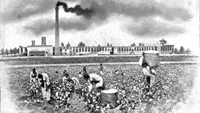
2
Standard 8-5.5
I Can Statements 1-12
3
First Things First...
What is meant by the "New South"?
A shift towards the industrialization (the development of industries in a country/region on a wide scale) and urbanization (the development of cities/towns) that began after the Civil War.
4
I can identify two factors in the post Civil War period that led to the rapid expansion of industry throughout the United States.
Answer:
1- Wartime government spending
2- Federal government's support for the
building of the transcontinental railroad

5
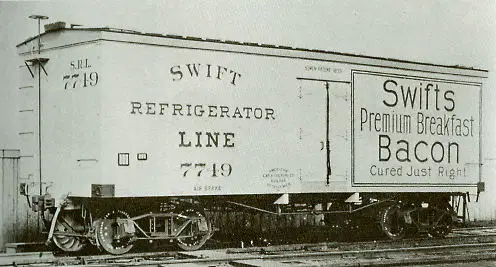
Built to make the bounty (abundance) of the ranches and farms of the West and the Midwest availble to people throughout the country.
Meat Packing/Grain Processing
Discoveries of iron ore and coal in the west and the need for steel for the railroad as well as the role of entrepreneurs and new technology.
Steel and Oil Industries
I can identify at least two industries that developed in the United States and explain what led to the development of these industries.
6
7
3. I can identify who provided the labor for
the expanding industries.
Answer:
Immigrants anxious to make their fortunes in America.
NOTE: Few immigrants settled in South Carolina during the Industrial Age because there were few factories in South Carolina.
8
I can explain why South Carolina was slower to industrialize than the rest of the nation.
Answer:
The planter elite looked down on the development of industry as a less noble calling than their antebellum agricultural society.
Conservatives were more interested in reviving the Old South rather than in fostering the birth of a New South.
NOTE: SC lagged behind the rest of the nation in industrial development but saw growth in the textile industry.
9
5. I can explain how the railroad boom that spurred national
industrialization led to the establishment of the "New
South."
Answer:
Major cities grew as a result of their location on track routes that connected them to suppliers and markets throughout the country.
Columbia was a regional railroad hub served by over 100 trains/day.
Transcontinental trains promoted the establishment of time zones and standard time.
10
6. I can identify three factors that led to the growth of the
textile industry in South Carolina.
Answer:
Ready supply of raw materials
Changing attitude toward the development of industry
Local investors provided most of the capital [finances; money] for the building of textile mills
11
7. I can identify where textile mills were located in South
Carolina.
Answer:
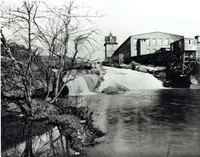
Located close to the cotton fields and along rivers that would supply river power.
First mills were started in the Upstate and within 15 years there were mills in the Midlands and the Low Country.
12
8. I can identify who provided the labor in South Carolina's
textile mills AND explain why they were attracted to the
textile mills.
Answer:
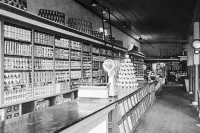
Poor farmers who could not make a living from the land were attracted to the mill villages that provided homes, schools, churches, and stores in addtition to jobs.

13
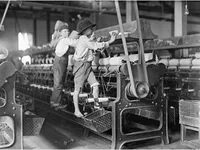
Their youth made them susceptible to workplace accidents.
Children who worked in the mill did NOT attend school.
Part B
Their small fingers made children better able to retie broken threads.
Part A
9. I can explain why mill owners would hire children to
work in the mill and explain the impact mill work had on
the children.
14
10. I can describe the work conditions of a mill worker in
South Carolina (work hours; salary; dangers/health
concerns)
Answer:
Work Hours...Men, women, and children worked long hours for low pay; worked 6:00 am - 6:00 pm
Salary...Earned less than 1/2 of what mill workers in other parts of the U.S. earned; women and children were paid even less than men.
Dangers/Health Concerns...Suffered from diseases of the lung (tuberculosis) from breathing in cotton fibers and from the crowded work conditions; workplace accidents could end a career.
15
- Union organizers were immediately fired
and the organized labor movement was
consistently crushed by the mill owners.
- The U.S. government and the political
leadership of SC backed the interests of the
mill owners rather than the workers.
Part B:
Workers organized labor unions to solve their workplace problems (low wages; unsafe work conditions)
Part A:
11. I can explain why labor unions were created AND were
unsuccessful in the South.
16
12. I can identify three other industries that developed in
South Carolina in the post-Civil War period.
Answer:
Cotton Seed Oil
Lumber
Phosphates

17
Multiple Choice
What is the best definition of the "New South"?
A shift towards industrialization and urbanization that began after the Civil War.
A shift towards industrialization and urbanization that began after World War II.
A vision for a racially-integrated, peaceful, and prosperous southern society.
A highly segregated society based on class and race.
18
Multiple Choice

This is an image of an invention in the early years of industrialization. How did this invention impact the western states?
Farms died as products from the eastern sates were shipped all over the country.
Farms grew in wealth as it became easier to ship their products.
Meat packing industries failed as fresh products could be stored longer.
Train companies went bankrupt by investing in this expensive technology.
19
Multiple Choice
Why did very few immigrants settle in South Carolina during the Industrial Age?
Immigrants wanted to buy land and farm, but surplus land in South Carolina was purchased by former slaves.
South Carolina passed quota laws liming immigration to the state.
Jim Crow laws in South Carolina specifically targeted immigrants.
Immigrants were looking for work in factories, and there were very few factories in South Carolina.
20
Multiple Choice
In the late 1800s, why was South Carolina slower to industrialize than northern states?
Many of the state's wealthiest individuals believed that agriculture was more noble than industry.
The state lacked natural resources, such as coal and steel, needed to build new industries.
Labor unions in the state made it difficult to establish factories because workers had to be paid such high wages.
The state lacked railroads and transportation systems that could be used to move goods.
21
Multiple Choice
After the Civil War, how did the expansion of railroads help South Carolina?
It led to the end of agriculture and the start of manufacturing.
It increased the growth and prosperity of cities near the rail lines.
It brought back the cultivation of rice in the Low Country.
It led to high paying, prestigious jobs in the textile factories.
22
Multiple Choice
What factor caused Columbia, South Carolina, to be considered an imporant industrial center in the late 19th century?
Columbia received grants from the state government to expand.
Columbia's population grew because of it push to establish and international steel industry.
Columbia was a regional hub that served hundreds of trains each day.
Columbia did not adopt Jim Crow laws, resulting in many African Americans moving there.
23
Multiple Choice
In the late 1800s, how did the expansion of railroads impact South Carolina?
It caused Low Country farmers to switch from farming cotton to rice.
It caused an immediate shift from an agicultural-based to an industrial-based economy.
It promoted the growth of textile mills by making it easier to ship finished products.
It brought high paying, prestigious jobs to African Americans in the state.
24
Multiple Choice
How did South Carolina's industrial development after the Civil War compare to the rest of the nation?
South Carolina was far more advanced in its mining, textile, and meat-packing industries.
South Carolina lagged behind the rest of the nation in industrial development but saw growth in the textile industry.
South Carolina resisted the growth of industry and stayed economically different from the other southern states.
South Carolina was on pace with the rest of the nation in terms of economic and manufacturing development.
25
Multiple Choice
Why did South Carolina develop the second largest textile industry in the nation by 1910?
There was strong support for a post-war shift to manufacturing by the planter-elite.
There were large numbers of former slaves to provide a source of labor.
There was easy access to cotton fields and navigable rivers.
There was significant financial investment from Europe.
26
Multiple Choice
Who typically worked in South Carolina's 19th century textile mills?
younger girls from nearby farms
African American freedmen
poor whites who could no longer earn enough farming
European immigrants from northern cities
27
Multiple Choice
How did the life of mill workers in South Carolina compare to those in northern states?
They made less money, but worked in more favorable conditions.
They worked similar hours, but made less than half of what northern workers earned.
There was no child labor in South Carolina which meant fewer workplace accidents.
Mill workers were generally treated with more dignity and allowed to collectively bargain.
28
Multiple Choice
Why were many northern businesses attracted to the idea of building factories in South Carolina after Reconstruction?
Business owners felt it was acceptable to invest in the South as African American rights increased.
Business owners felt that it was morally wrong to use the child labor that was common in the North.
The low wages and lack of union protection greatly lowered the operating costs.
The many coal and iron sources in the state made it a great location for industrialization.
29
Multiple Choice

Why did mill owners prefer to hire workers like the one in this photograph?
Females tended to be more focused on their work than males.
Younger children had smaller hands that could quickly tie broken threads.
Younger children were more prone to workplace accidents.
Immigrants did not have to be paid as much as native-born workers.
30
Multiple Choice

This photograph was taken in South Carolina during the Industrial Age. Which statement is an accurate reflection of life for children like the one in this photograph?
They were apprentices who advanced to high-paying management positions when they got older.
They had difficult lives since they earned very low wages, worked long hours, and did not attend school.
They worked in textile mills after school, weekends, and on holidays to save for college.
They were paid higher wages and had safer working conditions than if they worked on farms.
31
Multiple Choice
What is the main reason that mill workers in South Carolina were unable to improve their conditions and salaries?
Diseases like tuberculosis and brown lung killed off workers before they could organize.
Most of the laborers were children and unable to organize themselves.
Union organizers were fired and the labor movement was fiercely resisted by mill-owners.
Workers were well treated and did not need to bother trying to improve their situation.
32
Multiple Choice
What prevented mill workers in South Carolina from forming unions to improve their working conditions?
Political leaders in South Carolina supported mill owners in their fight to prevent the formation of unions.
Mill workers lacked support from national unions who refused to help textile workers.
There was ittle public support for the formation of unions because mill workers made high salaries.
There were not enough mill workers in South Carolina to justify the formation of a union.
33
Multiple Choice
Who did government tend to support in labor disputes in the late 19th century?
workers
freedmen
factory owners
union organizers
34
Multiple Choice
What industry was supported by natural deposits of phosphate in the Beaufort area of South Carolina?
the railroads
commercial fertilizer
textile mills
iron and steal production
Farming and Industry
The Birth of a
New South
By Sherry Helms
Show answer
Auto Play
Slide 1 / 34
SLIDE
Similar Resources on Wayground

29 questions
The Civil Rights Movement
Presentation
•
7th Grade
27 questions
Ionic and covalent bonding
Presentation
•
8th Grade
25 questions
The Reformation
Presentation
•
9th Grade
28 questions
Exploration & Settlement in GA
Presentation
•
8th Grade
25 questions
The US Constitution and Bill of Rights
Presentation
•
8th Grade
29 questions
Jefferson Becomes President 8.1 (Slides 13 & 14)
Presentation
•
8th Grade
25 questions
Israelites Vocabulary Part 1
Presentation
•
8th Grade
27 questions
Great Depression
Presentation
•
7th Grade
Popular Resources on Wayground
10 questions
Fire Safety Quiz

Quiz
•
12th Grade
20 questions
Equivalent Fractions
Quiz
•
3rd Grade
20 questions
Main Idea and Details
Quiz
•
5th Grade
20 questions
Context Clues
Quiz
•
6th Grade
20 questions
Inferences
Quiz
•
4th Grade
36 questions
6th Grade Math STAAR Review
Quiz
•
6th Grade
19 questions
Classifying Quadrilaterals
Quiz
•
3rd Grade
12 questions
What makes Nebraska's government unique?
Quiz
•
4th - 5th Grade
Discover more resources for Social Studies
44 questions
8th Grade Social Studies - Staar Review 2021
Quiz
•
8th Grade
29 questions
8th Grade Social Studies STAAR Review Part 2
Quiz
•
8th Grade
30 questions
STAAR Review Social Studies
Quiz
•
8th Grade
36 questions
Social Studies STAAR Review - 8th Grade
Quiz
•
4th - 8th Grade
44 questions
2023 8th Grade US History STAAR Practice
Quiz
•
8th Grade
21 questions
H7 GMAS PREP
Quiz
•
8th Grade
24 questions
SS8H8 GMAS PREP
Quiz
•
8th Grade
21 questions
8th Grade STAAR Review US History
Quiz
•
8th Grade