
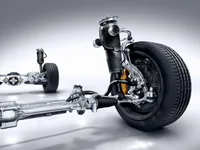
L2 Chassis - Suspension Lesson

Presentation
•
Engineering
•
KG
•
Practice Problem
•
Medium

Richard Whyley
Used 3+ times
FREE Resource
33 Slides • 27 Questions
1

2

3

4

5
Multiple Choice
What is the benefit of independent suspension
6
Multiple Choice
Cars without independent suspension often feature which type of axle?
Portal axle
Beam axle
Live axle
Dead axle
7

8

9
Multiple Choice
What is the advantage of lower un sprung weight?
enhances ride quality and roadholding
enhances load carrying capacity
enhances ride quality
enhances the fuel consumption of a vehicle
10

11

12
Multiple Choice
Which of the following is not a common suspension spring
Coil Spring
Leaf Spring
Clock Spring
Air Spring
13
Multiple Choice
What does the suspension spring not do?
The suspension spring sets the vehicles ride height
The suspension spring allows the vehicle to remain level
The suspension spring supports the weight of a vehicles load
The suspension spring stops the suspension bouncing on a rough surface
14

15
Multiple Choice
Another common name for a damper is:
Road Spring
Shock Absorber
Compliance Bush
Track Rod
16

17

18
Multiple Choice
What is an advantage of adjustable dampers?
They can be adjusted to account for wear
They can be adjusted for different surfaces and uses
They can be adjusted rather than replaced
They can be adjusted to save fuel and emissions
19

20

21
Multiple Choice
What does an accumulator do in a hydraulic suspension system?
22

23

24

25
Multiple Choice
How does a torsion bar provide suspension movement
26
Multiple Choice
What are the advantages of torsion bar type suspension
Torsion bars are strong and robust
Torsion bars give a comfier ride
Torsion bars are easier to repair
Torsion bars take up less room than coil springs
27

28

29

30
Multiple Choice
What does a drop link do on an anti roll bar system
31

32

33

34
Multiple Choice
How should you test a rubber suspension bush for excessive play?
35
Multiple Choice
What material is most suspension bushes made from?
Rubber
Nylon
Polyurethane
Polyvinyl
36

37

38

39

40
Multiple Choice
Ball joints and king and link pins both allow the suspension to travel up and down, and also rotate?
True
False
41

42

43

44
Multiple Choice
What is the purpose of either a pan-hard rod, or watts linkage?
Prevent side to side movement of the axle
Prevent up and down movement of the suspension
Prevent forward and backward axle movement
Prevent the vehicle from suffering passive rear steering
45

46

47
Multiple Choice
What should the bounce test prove?
The dampers are working correctly
The springs are unbroken
The suspension bushes haven't dried out
The wishbones are correctly aligned
48

49

50
Multiple Choice
How oscillations would you expect to see when performing a bounce test on a vehicles suspension?
three
Five
four
six
51
Multiple Choice
what is the most common spring type used on the front axle of light vehicles?
torsion bar springs
coil springs
leaf springs
52
Multiple Choice
In relation to suspension what is meant by the term roll?
leaning movement of the body when turning
lifting of the front during acceleration
53
Multiple Choice
unsprung weight can be reduced by fitting:
steel road wheels
alloy road wheels
larger diameter wheels
54
Multiple Choice
Which type of suspension does not allow each wheel to move independently from the others?
non independent rear suspension
torsion bar suspension
isolastic suspension
adaptive suspension
55
Multiple Choice
What is active suspension?
hydraulic damping controlled by sensors, actuators and an ecu
manually adjustable friction dampers
56
Multiple Choice
a damper works by:
forcing oil through valves to restrict flow
forcing air through valves to slow its movement
57
Multiple Choice
Which of the following faults could be caused by worn shock absorbers?
Increase in braking distance
Poor vehicle acceleration
Reduced road spring oscillation
Decrease in braking distance
58
Multiple Choice
In vehicle suspension what does the term ‘dive’ refer to?
The dipping and rising of the vehicle on uneven road surfaces
The lifting of the front of the vehicle during acceleration
The leaning movement of the body when turning
The dipping of the front of the vehicle during braking
59
Multiple Choice
What is the difference between rake and trail in vehicle steering systems?
Rake is the angle of the steering axis, while trail is the distance between the steering axis intersection and tyre contact patch.
Rake is the distance between the wheels, while trail is the angle of the steering axis.
Rake is the height of the vehicle, while trail is the width of the vehicle.
Rake is the weight of the vehicle, while trail is the length of the vehicle.
60
Multiple Choice
Show answer
Auto Play
Slide 1 / 60
SLIDE
Similar Resources on Wayground

54 questions
Russia
Presentation
•
6th Grade
56 questions
Lesson 6 - Creating Email and Calendars
Presentation
•
6th Grade
55 questions
Upwellings and Currents
Presentation
•
8th Grade
55 questions
Edward Tulane Chapters 9-11 & Vocab
Presentation
•
3rd - 5th Grade
55 questions
Poetry Unit Introduction
Presentation
•
7th Grade
55 questions
El preterito
Presentation
•
9th - 12th Grade
54 questions
Part 4 EOC Review
Presentation
•
10th Grade
54 questions
Financial Aid for College
Presentation
•
10th Grade - University
Popular Resources on Wayground
10 questions
Safety Day 2026 – Student Review

Quiz
•
9th Grade
21 questions
Continents and Oceans
Quiz
•
6th Grade
20 questions
Parts of Speech
Quiz
•
5th Grade
16 questions
Subject & Predicate
Quiz
•
5th Grade
25 questions
Multiplication Facts
Quiz
•
5th Grade
12 questions
Map Skills
Quiz
•
3rd Grade
22 questions
Continents and Oceans
Quiz
•
5th Grade
15 questions
Rounding Decimals
Quiz
•
5th Grade
Discover more resources for Engineering
26 questions
SLIME!!!!!
Quiz
•
KG - 12th Grade
20 questions
Place Value
Quiz
•
KG - 3rd Grade
4 questions
K-2 Force and Motion Lesson
Presentation
•
KG - 2nd Grade
12 questions
Tone and Mood
Presentation
•
KG
10 questions
Day and Night Patterns
Quiz
•
KG
20 questions
Disney Characters
Quiz
•
KG
12 questions
Nouns and Verbs
Quiz
•
KG - 2nd Grade
15 questions
Short Vowels
Quiz
•
KG - 2nd Grade